

The days before Diwali have a glow all their own — the lights going up, the Gold Souk glittering a little more enticingly, a sense of something auspicious stirring. In Dubai, where the Indian diaspora runs deep, you can feel it building. At its heart is Dhanteras, two days before Diwali and one of the biggest gold-buying moments of the year, when tradition calls for carrying something precious — gold above all — over the threshold to welcome good fortune in. There’s just one wrinkle this year. Gold has rarely been this expensive — 24-carat is circling Dh500 a gram — and since May, New Delhi has added a 15 per cent import duty to take the strain off the rupee. So, what do you buy on gold’s big day, when the yellow metal itself has become the hardest thing to justify?
I put it to the people who’d know — the jewellers watching it unfold — and they told me versions of the same thing: the gold coin is losing its shine. “People want a piece they can wear every day rather than that one big set or those gold coins,” says Vik Jethwani, co-founder of Dubai’s VikJet. Something saved up for, coveted, and still worn long after the diyas are packed away.
And increasingly, the prize worth coveting is the stone, not the setting. “Buying something precious is evolving into buying something truly special,” says Dr Siddhartha Sacheti, creative director and CEO of Jaipur Gems, who has spent years championing coloured gemstones over bullion by the gram. In his words, “the gold becomes the architecture that supports the gemstone rather than the principal reason for the jewellery’s existence”. Less gold, in other words, and a great deal more glory.
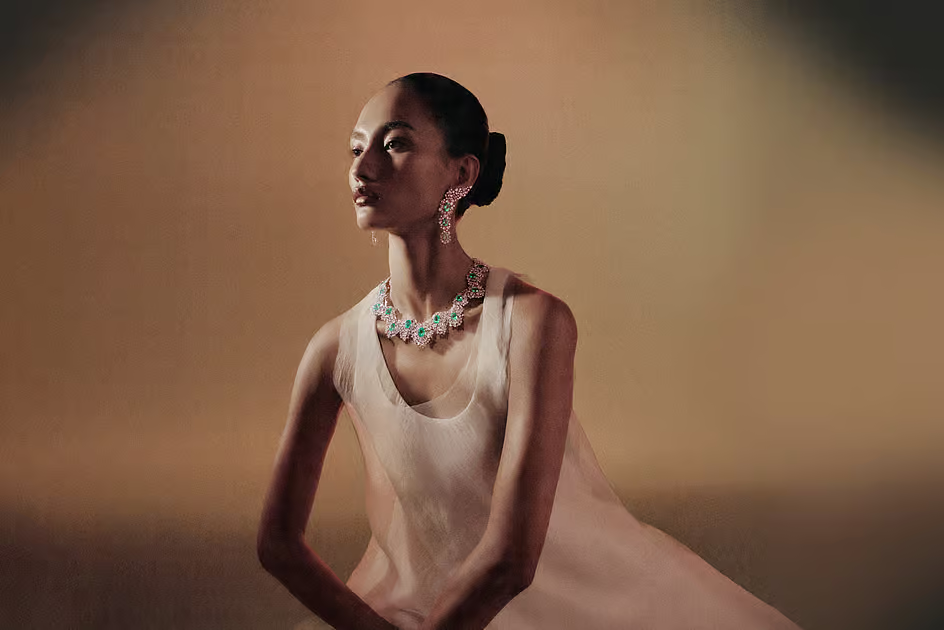
It helps that the stone having its moment is, above all, the emerald — “the stone of prosperity and happiness,” as Radhika Nayar, founder and creative director of Devi Jewels, puts it. But don’t mistake any of this for tradition fading. Gold has always been streedhan — a woman’s own wealth, liquid, portable, hers — and that logic endures; it simply wears green now. The newer shift is who’s buying. Where this was once family and gifting, the Dubai woman increasingly buys for herself. Jewellery, Sacheti notes, “can represent family continuity, but it can equally represent a woman’s independence”.
There’s a certain thrift to it, too. At these prices, Dubai’s ateliers are busy melting down clients’ grandmothers’ heavy sets and remaking them into something the next generation will actually wear — a piece, Sacheti says, that feels “both part of its history and entirely its own”. And it’s revealing what people ask to keep. “They almost always want to preserve the stones,” says Ananya Malhotra, founder of the London house ANANYA, whose newly launched Atelier rebuilds inherited jewels around their original gems — “a family sapphire, emerald or diamond.” The gold is negotiable; the stone is sacred.
Almost in tandem, the market is splitting as it goes. At the mass-premium end the big players are consolidating — Titan, the owner of Tanishq, now holds a majority stake in Dubai’s Damas — which only sharpens the edge of the independents, from Devi Jewels and VikJet to Jaipur Gems, who trade on the one thing scale can’t mass-produce: individuality. What her clients are buying, Malhotra says, is design, not carats — “how a piece moves, feels and sits on the body.” Her ‘Emerald Wave’, rippling through ANANYA’s signature ombré, is that idea made visible: the stones carry the piece, the metal no more than a scaffold for the colour.
So yes, buy something precious this Dhanteras. Only know that the luckiest thing in the room may no longer be gold at all. The wish hasn’t changed —prosperity, protection, a little sparkle of the divine. Just the vessel: from a gold coin you’d never wear, to a green stone you’ll never take off.
Source: Khaleej Times