

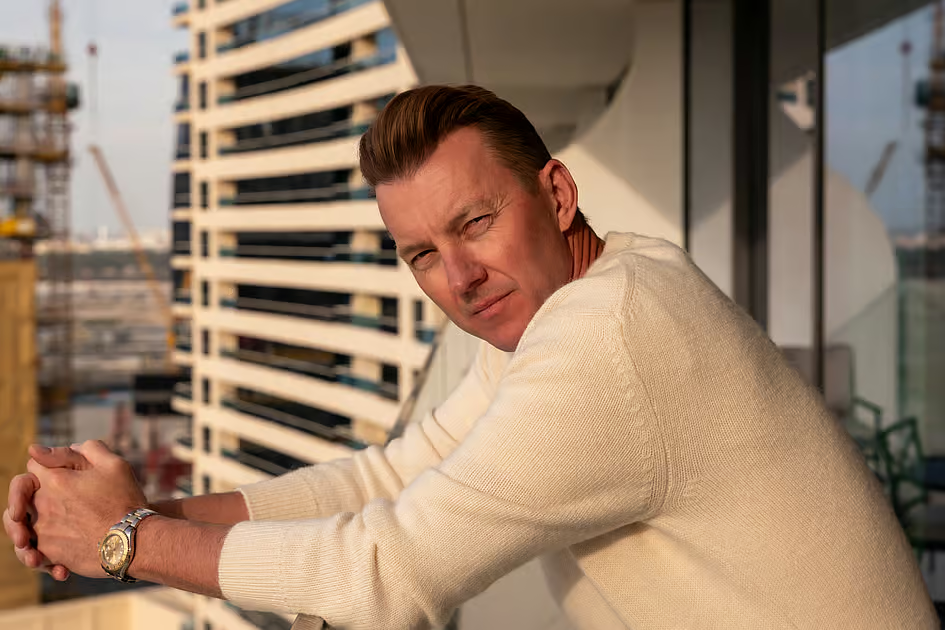
For someone who defied doctors’ warnings after suffering a serious back injury in his teens to chase his fast-bowling dreams, it’s hardly surprising that Brett Lee has few regrets in life.
Injuries continued to haunt him even after he became an elite international cricketer, forcing him to miss several major tournaments, including the 2007 World Cup.
Yet, he cemented his place in the pantheon of the fastest bowlers of all time while remaining a vital cog in the great Australian teams of the 2000s.
Just a week shy of his 50th birthday, Lee, who is now a Dubai resident, no longer has to get up early in the morning to go through the rigours of training.
But what hasn’t changed over the years is his ability to cheer up those around him with a big, bright smile.
It was with that trademark smile that he admitted to falling in love with Dubai and revealed that his only regret in life now is not moving to these shores earlier.
Lee also smiles from ear to ear when you ask him about the thrill of bowling alongside Glenn McGrath, Jason Gillespie and the immortal Shane Warne.
But he is a man who has embraced his second innings in life, happy to talk about playing backyard cricket with his children in Dubai.
In an exclusive interview with Khaleej Times, Lee also opened up about his association with Play971, the UAE’s first licensed sports wagering and gaming platform, his special connection with Indian fans and that unforgettable moment with Andrew Flintoff, which has now become a powerful symbol of sporting spirit.
Q. You are the brand ambassador for Play971, the UAE’s first licensed sports wagering and gaming platform. How nice is it to be the face of this project?
A. If you look at Play971, I’m honored to be involved. It’s the first and only regulated sports wagering and gaming platform in the UAE. To me that is historic. I’m honored to be the ambassador and it should be about fun. The way that I’ve lived my life has always been about enjoyment, fun, community-based, and the thing that I noticed firstly about Play971 was its integrity. I’ve built my life around integrity. I’ve always made sure that the enjoyment factor is the most important, so to be involved with such a historic opportunity is very special because we share the same morals, we share the same integrity, respect, having fun, engagement, community. That’s why I’m so proud of being an ambassador.
Q. How did the opportunity come up?
A. This has taken months of planning, and making sure that first and foremost that our brands aligned. I keep mentioning what Play971 stands for: integrity, fun element, engagement, community with the sporting fans. That’s what I’ve tried to build throughout my whole life, so I guess, it’s a match made in heaven. Through many conversations and a lot of phone calls and in-person meetings, we had the opportunity to officially announce it, and that’s something that I’m very excited about. It’s not only what has happened in the last few months, but what’s going to happen in the future.
Q. Life after retirement can be difficult for elite athletes because the structure and adrenaline of professional sport suddenly disappear. But you have made the transition wonderfully…
A. Yeah, well, I officially retired from cricket in 2015 after the Big Bash and then last year officially played in the Masters Leagues. Thank God that’s over because it’s just so hard on the body. And I’m turning 50 soon (November 8), and to think that I’ve been bowling for 40 years, you’ve got to understand that it’s so much pressure on the body when you’re in your 20s, let alone when you’re in your late 40s. So, I made that call to move away from cricket and still play a bit of backyard cricket with my kids, which is exciting.
Q. And that’s why you joining the KT Luxe Healthy Ageing Summit 2026 on November 25 is so important…
A. I know there’s a big push in the UAE and certainly around the world for healthy living and enjoyment in life, but also longevity. And that’s a space I’m very passionate about, and obviously, the event that we’ll be doing, I’m excited about it. And personally, I’ve tried to make sure that I was always the fittest in the team. I was adamant that I had to be looking after myself, not only on the field but off the field as well. I want to be that healthy adult moving into stage two of my life, or the second innings, if you want to use a cricket analogy. So, to me, it’s about living as long as possible and as healthily as possible, to be around for my beautiful children.
Q. We are sure you are enjoying playing cricket in the backyard with your children in Dubai. You are a Dubai resident now. What was it like for you and your family to move to Dubai from Australia?
A. It’s been 15 months since I moved here. If you asked me 17 months ago whether I would be living in the UAE, I would have said it wasn’t even on my radar. To me, the UAE was always a stepping stone. It was always a great place to visit, a place for tournaments here. I’ve been very lucky to be here on a number of occasions, but it was always to get me somewhere else. This was the stopover place. And I’ve used that word very timely because that’s what it used to be back in the early 2000s, and then an opportunity came up to come over here commercially, and, you know, we had a very normal, happy, healthy lifestyle back in Australia. So, to leave all that behind, that was a big step to move the entire family over. But what I can say about the UAE, and it all comes back to what we’re talking about today, is that it’s the environment that I want to be in. There’s so much energy over here in the UAE, so much energy here in Dubai, and it’s safe. I still believe it’s the safest place in the world, and we’ve proven that. My children are so happy at school, you know, with 200 different cultures at their school and learning Arabic. I never thought my children would be learning Arabic. My wife’s happy, the girls are safe here, the opportunity to play sport, the opportunity to get ahead in life, and all these opportunities, like we’re talking about today, would not have come up if I hadn’t made that move. So, the only regret I have in my life is that I didn’t come over here earlier.
Q. Talking about backyard cricket, we know that you played a lot of it in Australia with your two brothers, Shane, who also played international cricket, and Grant. What do you remember about those early games from your childhood days?
A. You know, among the three of us (brothers), Grant was the most talented and I was the least talented in my family. But I was the hungriest. So, what I tell people in sport and business is that hunger is the most important quality. You know, you need natural talent. You have to have natural talent. But hunger incorporates discipline, commitment and sacrifice. If you want it enough, you’ll achieve it. And yeah, I was the least talented, but I was the hungriest.
Q. It’s interesting to hear you speak about hunger. We know that you suffered a serious back injury as a teenager. A back injury is a big blow to deal with for a fast bowler. Without that hunger, you probably would never have made it to international cricket…
A. Yes, I think I was 17. And growing up, all of my doctors were of Indian heritage. I’ve had this fascination with India since I was young. I don’t know why. You know, things happen for a reason, but I don’t know. In my whole life, there’s always been an Indian connection around me. And I remember going to the doctor, and he said, ‘You’ve got a broken back.’ And he goes, ‘As a specialist, as a doctor, I’m going to advise you that you won’t be able to bowl fast again. You should try batting or a different sport because you have got a complete fracture in your lower back, which is not good, and I don’t think your back’s going to be able to withstand the pressure of bowling fast.’ And me being young and hungry, I’d set my mind from the age of nine that I was going to play for Australia. So, I don’t care what anyone said; I was playing for Australia no matter what, at any cost. And I said, ‘Look, I appreciate your guidance, and I appreciate you’re a doctor, but I am going to play for Australia. I’m going to bowl 160kmph, and when I do, I’ll get you two tickets to my first Test match.’
Q. Wow, that’s incredible. And your debut Test was against India in Melbourne. Did you give him the match tickets?
A. I did, and yes, it was against India, so he was happy. So I said, ‘I’ll sort the tickets, you sort the flights. We’re all happy.’
Q. Now that we know the doctor story and your unflinching spirit, it feels surreal that you took five wickets in the first innings of your debut Test at the iconic MCG…
A. I had waited for this moment for so long, and it was like, don’t stuff it up now. Go out there and have fun. So, my whole life has been built around enjoyment and fun, and, yeah, to me, that was about going out there and trying to express myself as an athlete on the world’s biggest stage.
Q. Your doctors were mostly of Indian heritage. Your debut Test was the Boxing Day Test at the MCG against India. And then you went on to build such a beautiful connection with Indian fans that even now, when you go to India, you are mobbed. The India-Australia rivalry became so fierce in the 2000s, when you were one of the big stars of the Australian team. There were some huge controversial moments as well. But there was no dent in your popularity. So, what is it about you that makes people like and admire you so much in India?
A. It’s funny because people who don’t know me see me as a cricketer, which is what I did for most of my life. But that doesn’t define who I am as a person. You know, I’m a human being, and I’m a man. I love cricket, of course. So, when I was out competing, I was literally trying to win every single match for Australia, to get that last wicket, that last run, to hold the trophy up. But you also realise that off the field, it’s about friendships. And there are a number of sportspeople who can’t distinguish between the two. But off the field, I’d catch up with the teams from around the world, in particular India. I’ve got friends from all over the world, but I can go anywhere in India now, and I can call people up whom I’ve played against, with whom I’ve had challenges on the field. That’s healthy. That’s what you do. You leave it out on the field, leave it out on the pitch. And you’re also a human being off the field. I’m very close to my parents; I speak to Mum and Dad every single day. We have a really good connection in my family, and I see a lot of that in Indian culture.
Q. Moving to Dubai has also helped you strengthen your relationship with India even further…
A. Of course, in two hours and fifteen minutes, I can land in Mumbai. I’ve done that on occasions when I fly in the morning and fly back that afternoon. Now, if I were doing that from Australia, you’d take a day to get there, a day to get back, or two days to get over the jet lag. You do your event, and it becomes a week-long event to go and do a meet and greet. The thing I love about the UAE is the diaspora of people who are here. There’s a huge South Asian community, you know, with a lot of Indian heritage, a lot of Pakistani heritage, Bangladeshi, Sri Lankan and Nepalese people, and they all love sport. So, you know, I’m very fortunate that when I go out, I get to meet a lot of people, and whether it’s at the shopping centres or at the sporting fields, when I go down to watch my children play, people come up and say g’day, and that’s lovely. You know, I don’t have an issue with that. I always say that the day people don’t want a photograph or an autograph is the day I’m too old. So, if they’re asking, I’m happy.
Q. Now, you are also a brand ambassador for the UAE’s IPL-style T20 league, ILT20. One of your colleagues in ILT20 is Shoaib Akhtar. You and Shoaib are two of the fastest bowlers in the history of cricket. Was there always a competition where, if Shoaib bowled at 158km/h, you wanted to bowl even faster?
A. Of course. Yes, we had that healthy competition. I was with him recently in Dubai. You know, we shared great stories about us in the early 2000s, when we were trying to break the speed barrier. And I think the fans enjoyed watching that. The batsmen didn’t enjoy it. But once again, we were entertainers, and we enjoyed being able to do that because we’ve been blessed with a gift that allows us to run and bowl fast. That’s something you have to harness. And now that we’re all past that, that happened 15 years ago or so, we still talk about it when we catch up. And we often ask who was the quickest, and we just say to each other, ‘Ask him, ask him.’
Q. Now, we need to ask you what it was like bowling to Brian Lara and Sachin Tendulkar. Watching these two batting legends compete against that great Australian team was like watching that legendary 2008 Wimbledon final between Rafael Nadal and Roger Federer…
A. I feel blessed that I played in that era. You know, Lara and Tendulkar, I still think, are the best batsmen to ever play the game, in my opinion. And to have those battles against those two guys, who are dear friends of mine, I might add, and people go, ‘How can you guys be mates? You know, you’re out there bowling bouncers to him, he’s hitting you for six. How can you guys be friends?’ We keep in contact. Yeah, it’s just a blessing to bowl against those guys. But they were different players. And Sachin, technically, wherever you bowl the ball, he hits the ball, whereas Lara was more flamboyant, with that West Indian, that Caribbean flair that he had. Both were different. But I still think, I’ve said it publicly before, that Jacques Kallis is the best cricketer to play the game.
Q. Kallis is inarguably one of the greatest all-rounders ever. But one of your most unforgettable moments on a cricket field came with another great all-rounder, Andrew Flintoff, who put his arm around you to console you right after England had beaten you in a dramatic Ashes Test in 2005. It’s unbelievable how Flintoff didn’t join his teammates to celebrate that incredible England win and instead walked up to you to comfort you…
A. Well, firstly, that iconic moment, which is etched in history, and I’m so proud that it actually happened. You know, you win games and you lose games, and that’s all part of sport. That’s the reason why you play. But the fact that that is now used as a Spirit of Cricket Award is iconic. It’s great to be part of that. What was said in the moment, I can’t really recall. Honestly, it was such a blur. As I said, it happened so quickly, and there was so much emotion floating around. But credit to him, because he could have been celebrating with his teammates, but he came over to console me first before he went to his teammates, which is very special. And that, to me, is why you elevate a guy like Freddie Flintoff.
Q. Cricket has rarely seen a bowling attack that elevated the game like the Australian line-up did in the 2000s, when you bowled alongside Gillespie, McGrath and Warne. What was it like to be part of that dream attack?
A. Can you imagine five little puppies all trying to get a feed? You put one bowl of puppy food down, and you’ve got five really hungry, excited little puppies all trying to get the food. That was us trying to get a wicket. Like, I don’t know how I got any wickets when I had Shane Warne in the team, Jason Gillespie, Glenn McGrath, Andy Bichel and Michael Kasprowicz. And I had to go and get wickets because everyone’s so good. So, I thank my lucky stars every single day that I got the chance to play with these guys.
Q. When you meet your former teammates now, do you talk about cricket and how you guys ruled the sport for such a long time?
A. When we’re together, we talk a lot, but you don’t necessarily miss the cricket. You miss the camaraderie, you miss the change-room chat, you miss the nights when we would celebrate, have some fun and be in that moment. So, I don’t miss the pain of playing sport, but you miss the friendships. And it’s after the match, and even mixing with the opposition. You know, they’re those special moments that you would never get back again. We talk about our children, we talk about what they’re doing. We don’t talk about what we did.
Q. Fans still talk about the Piers Morgan-Brett Lee face-off. In 2013, you challenged the famous British journalist to face you in the nets after he criticised Australian batters for their poor batting in the Ashes. You had already retired from international cricket, but you were still quick. And quite incredibly, he accepted the challenge and faced you in the nets. He was hit on the ribs, but he continued and completed one over of hostile Brett Lee bowling. Are you still in touch with him?
A. Piers Morgan is a dear friend of mine. I get people all the time saying that it comes up on their social media feeds about Piers Morgan’s comments. Look, he showed courage to get in the nets and do that. I would never do that. I’m glad he didn’t get badly hurt. But yeah, we keep in contact a lot, and he always has a laugh.
Q. Were you bowling at full throttle?
A. Yeah, easily 150kmph.
Q. He probably didn’t see any of those…
A. Clearly not. One of them hit his ribs. Hello, Piers!
Source: Khaleej Times