

For decades, Shaukat Rana Muhammad Rafi has been collecting photographs of Dubai, preserving images of streets, buildings and neighbourhoods that have changed beyond recognition.
From a city of modest buildings and narrow roads to one of skyscrapers and highways, he has watched the transformation through the lens of his camera.
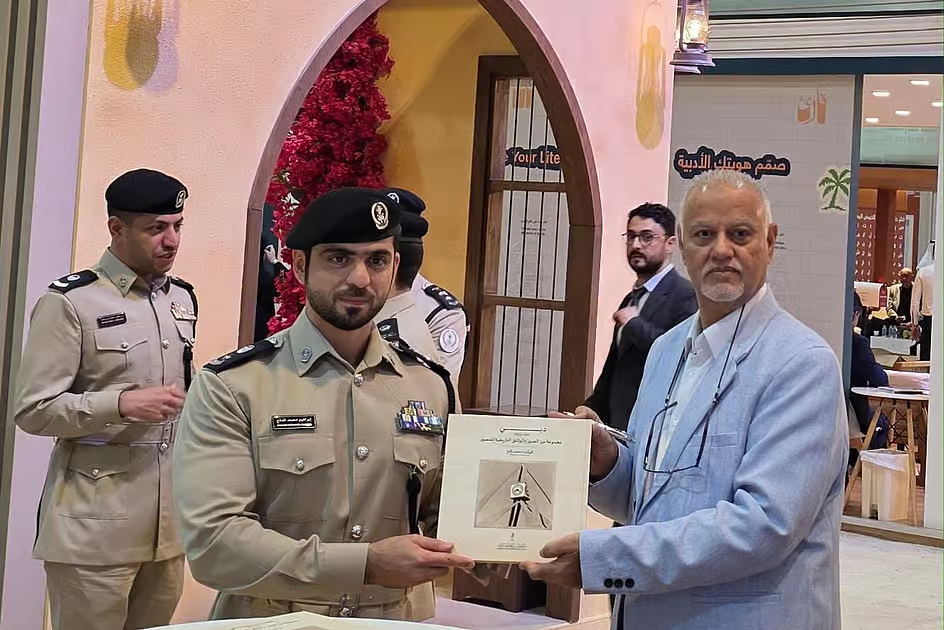
Now, after building a collection of nearly 200,000 photographs, the long-time Dubai resident has brought some of those memories together in his first book — Dubai 1960–1993 — which was launched at the Sharjah International Book Fair (SIBF) on Tuesday, November 10.
Stay up to date with the latest news. Follow KT on WhatsApp Channels.
The book, published in collaboration with the Hamdan Bin Mohammed Heritage Centre, features approximately 150 to 200 historical photographs and documents offering a glimpse into Dubai’s past.
“This book is about the documents of old Dubai and the history of Dubai. It also shows how Dubai looked in the 1960s and 1970s,” Rana told Khaleej Times.
From film rolls to digital cameras
Rana, who has spent decades documenting life in the UAE, remembers a time when photography required careful planning and every photograph came at a cost.
“In those days, in the 1960s, 1970s and 1980s, I used cameras with film rolls,” he recalled.
The arrival of digital photography changed the way he recorded the city.
“When digital cameras came, and later mobile phones, photography became free for me,” he said, referring to the cost of taking pictures without buying film.
“Now, in one day, I can easily take 150 pictures.”
Despite having such a large collection, Rana has selected only a small number of photographs for his first publication. He said more material could eventually be published in separate volumes.
“I actually have several books, almost 11 to 15 books, in the pipeline,” he said. “At this moment, this is my first book to come out.”
When Dubai began changing rapidly
Having witnessed Dubai’s development over several decades, Rana believes the 1980s and 1990s marked an important period in the city’s transformation.
He recalled how the development that followed the establishment of Dubai’s World Trade Centre helped change the city’s appearance.
“When you look at Dubai’s transformation, it really began to take shape when the city was becoming a business centre,” he said.
“After the World Trade Centre, development started moving rapidly in the 1980s. Then came the 1990s, and later, the developments continued at such a speed.”
For Rana, the changes were sometimes difficult to keep up with, even as someone who had spent years exploring and photographing the city.
“The development was happening so fast that sometimes you could forget your own roads. You would wonder where you were going and where you had come from,” he recalled.
He pointed to the later emergence of Business Bay, Dubai Marina, Jumeirah Lakes Towers and Jumeirah Beach Residence, along with the expansion of the road network, as examples of how the city continued to grow.
“The development in the 1980s and 1990s was the most important,” he said.
Support from heritage centre
Rana said the publication was made possible through collaboration with the Hamdan Bin Mohammed Heritage Centre, which works to document and preserve the UAE’s cultural heritage and history.
“They sponsored me and published the book,” he said.
Explaining the collaboration, Rana said the centre’s work aligned with his own interest in preserving historical material.
“It is actually a research centre. They present history and also preserve it,” he said. The book was launched at the centre’s stand in Hall 5 at Expo Centre Sharjah during the Sharjah International Book Fair.
Rana described the occasion as an important moment in his decades-long journey of documenting the UAE. “It is a matter of great honour for me that they organised this programme for me in Sharjah,” he said.
He added that the launch attracted visitors and representatives of government departments. “High-level delegations from the government came to see the book and collect copies,” he said, adding that guests from Abu Dhabi and Sharjah were among those who attended.
More copies planned
For those hoping to own a copy, Rana said the first print run was limited, but plans were underway to produce additional copies.
“At present, it has been printed in a limited quantity. We will be ordering more copies,” he said.
He explained that people interested in the collection could currently visit the heritage centre’s library to view the book.
“In the future, as more copies become available, people can send their requests and we can arrange to provide them,” he said.
For Rana, the publication is only the beginning of a larger effort to make his collection accessible to future generations, offering them a chance to see the Dubai that existed before many of today’s landmarks were built.
Source: Khaleej Times