

Among the Indian films that released recently, Namit Malhotra’s Ramayana: Part 1 can be equated with the mighty Goliath—standing tall with its largeness, extravaganza, massive VFX and star paraphernalia. But as the legendary David, is the small film Chita (Pyre), holding ground with authenticity, simplicity, audacity and tenaciousness.
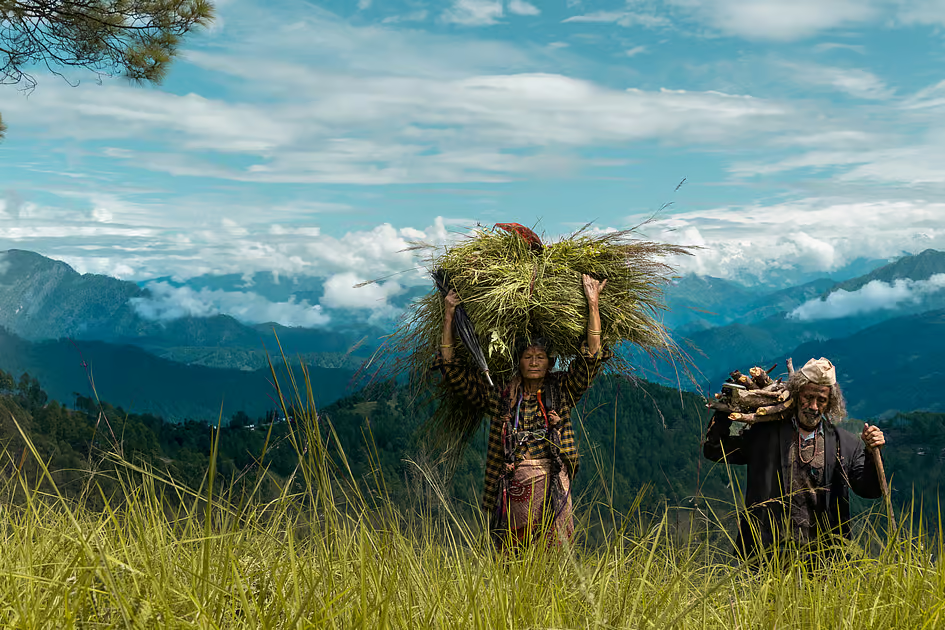
Written, directed and produced by journalist-turned-filmmaker Vinod Kapri, the film is bereft of VFX, is shot raw in the rains in Pithoragarh in Kumaon, in the north Indian mountainous state of Uttarakhand. The main leads are first-time actors—70- and 80-year-old senior citizens and the real mountains are a backdrop to a story of love, courage and isolation.
“Though I belong to Uttarakhand, my father was in the Indian army and I was born in Secunderabad (in the south Indian state of Telangana),” says Kapri. “As a journalist I did a lot of stories on the Himalayas and in that way relearned my family’s history.”
The lush locales of Kumaon and its monsoons form the backdrop of this simple tale narrated with sincerity and conviction. “I wanted the real monsoon and didn’t want to use a green screen.”
The inspiration for Pyre
Kapri had met this elderly couple in Uttarakhand’s hill station of Munsiyari and felt intrigued by their isolated life. They lived with 30-40 goats and they would give a goat or two to people who helped them in crisis. The man feared that if he died, his wife would be alone. She feared that if she died first, the man would starve and die since he couldn’t cook.
When Kapri asked him how he would manage if all the goats were given away, he had said something poignant. “He said he would pass away before that.” That thought is the spine of Chita (Pyre), a film on love that stands tall over time and circumstance. Not the rose-tinted romance but a love that is quiet and often looks like drudgery.
Kapri first thought of casting the real-life couple in the role but 10 days of trying to make them act convinced him he had to look for others. From 2018 till 2020 he auditioned pahadi (mountain-region) actors but wasn’t convinced. He then took his script to the veteran actor-couple Naseeruddin Shah and Ratna Pathak Shah who loved it. But Covid years happened and Shah fell ill and couldn’t do the film. “He advised me to work with actors from the Himalayan region.”
Destiny aided in the casting. In July 2022, it was time for his father’s 80th birthday and Vinod decided to call all his father’s siblings to Noida for a surprise party. Among them was his dad’s brother, his uncle Padam Singh Kapri, a retired soldier from the Indian Army. He expressed interest in the role though Kapri wasn’t really sure of it.
“I decided to give him a chance and asked him to enact a scene from the film. He did it convincingly… I decided to test him again with help from a friend who is an National School of Drama actor,” laughs Kapri. “We did 18-20 scenes with him and he blew my mind and I decided to lock him as the hero of my film.”
Now they had to look for the female lead. “I started looking for 70-80-year-old women and on the 15th day, I found the lady I was looking for. She was cutting grass from the mountainside. When I approached her, she and the villagers thought I was from the forest office and was going to arrest them. That is when a girl explained that I was looking for a heroine for my film.”
Everything falls in place
“Suddenly I saw this elderly 70-year-old woman fling the grass bundle she was carrying on the ground and proclaim, ‘I am your heroine. What do you want me to do?’ I was dumbstruck by her confidence. Also, she told me she doesn’t speak Hindi and only speaks Kumaoni (the language spoken in the region). I gave her a scene from the film and she made the cut. We finally locked Heera Devi.”
Filming wasn’t easy, especially on a shoestring budget. “I was keen to shoot it in the monsoon and the space had leopards in abundance. But something magical happened. One by one the crew members came in—most of them worked for one fourth the amount they charge,” he says. And there was more.
“95 per cent of the crew came from Kolkata. I had shared the script with the reputed Marathi film director Manoj Kadam and he called me to tell me that he wanted to be part of my film. Then came the Life of Pi music composer Mychael Danna, who was on a sabbatical, yet Zoom-called me and asked me what I wanted. He did the music for free because he loved the first cut.”
So did the lyricist Gulzar, who wrote one song of the film for free. “He told me that he felt like Satyajit Ray was shooting in the mountains and he had to be part of the film. What is a better compliment than this, it is like an award for me,” he said. “When I asked him about payment, he told me, ‘Have you become such a big film maker that you are now offering to pay me?'”
Then the German editor Patricia Rommel came on board. “She worked on the film for a year and didn’t charge a fee when my team reached out. She said it was her privilege to work on this project.”
The film travelled global festival circuits but couldn’t find a release in India. “I was so frustrated and broke that when I received an award at Mosaic International South Asian Film Festival in Canada, where Pyre won Best Film and Best Music from Deepa Mehta (the award-winning filmmaker), I announced that this was my last film because like its title, it had almost led me to my own pyre.”
But something magical happened again. “My executive producer Arindra Rai Chaudhuri went to Dubai for another film’s premiere (Oh My Dog) and met London-based businessman Suresh Joshi. He discussed this film with him and Suresh was keen to watch it and agreed to a limited theatrical release in India. “I warned him that he too would lose money like I did but he, thankfully, stuck to his guns. Thanks to Arindra and Suresh, things changed and it was released in India on October 30, 2026. As we speak, we are entering the third week despite Ramayana.”
From not being able to pay his apartment’s maintenance money for six months, to the verge of quitting, Kapri still calls himself a struggling filmmaker. “My film company Bhagirathi Film Production Company still has a bank balance of Rs 7,423 (Dh290 approximately). So many friends advised me to go back to TV journalism. But Pyre had to happen.”
The film is now playing in 300-plus screens in the third week since its release and is now planning a release in UAE, US and UK. “It is going to BAFTA and the Academy. All the love and adulation we received has gotten us all confident.”
Source: Khaleej Times