

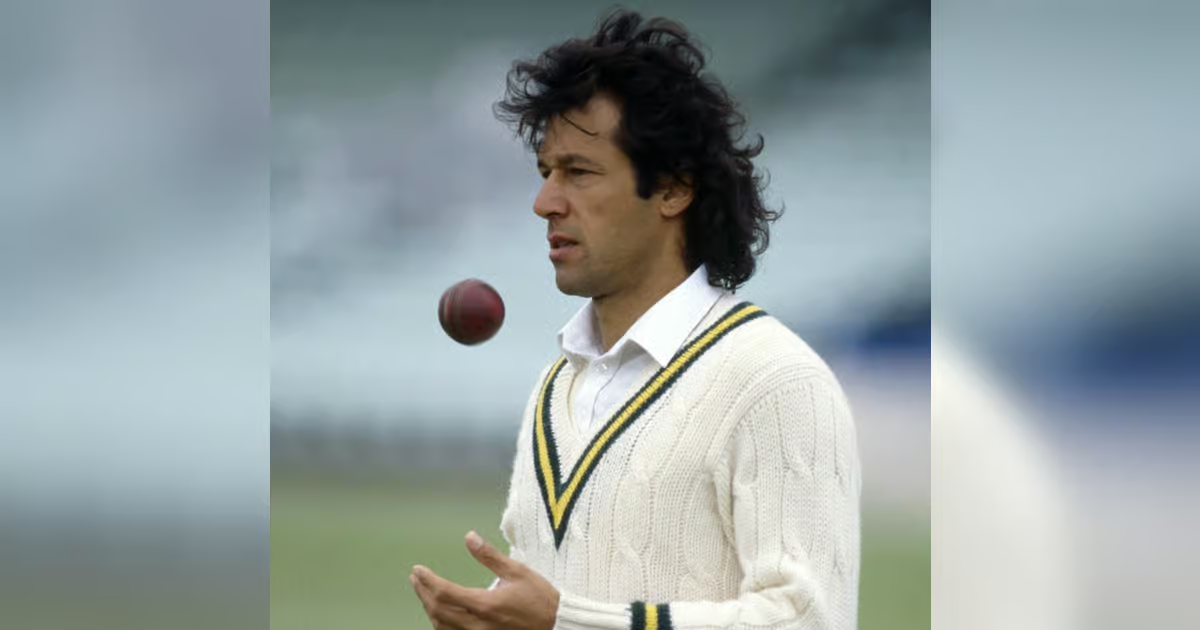
It’s been 44 years since Pakistan legend Imran Khan tormented India with reverse swing in the 1982 Test series, but for Dilip Vengsarkar, it still feels like yesterday.
Vengsarkar, 70, remembers vividly when the old ball started to swing during a Test match and how Imran became unplayable, leading to strong media speculation about ball-tampering.
The art of bowling reverse swing — either through pure skill or the dark arts — is back in debate now following Pakistan-born former Australian Test batsman Usman Khawaja’s explosive ‘Sandpapergate’ claim in his new book, ‘Sabr’.
Khawaja’s revelation that all members of the Australian team knew of the plan to apply sandpaper to the ball in the 2018 South Africa Test series has sparked a civil war Down Under.
While Khawaja’s claim was backed by David Warner and Cameron Bancroft, who faced lengthy bans for their roles in it alongside the then captain Steve Smith, fast bowlers Pat Cummins, the current Australian Test captain, and Josh Hazlewood have continued to deny any knowledge of the team’s conspiracy to push the legal boundaries for reverse swing.
The Australian bowlers also claim to have no recollection of any team discussions in the dressing room about using sandpaper on the field.
But Vengsarkar clearly remembers how the Indian batsmen felt helpless when Imran started to get devastating reverse swing in the six-Test series in 1982.
Imran took a staggering 40 wickets in six Tests, earning Pakistan a comprehensive 3-0 win on home soil over their bitter rivals.
While Pakistani fast bowlers, especially Sarfaraz Nawaz, had shown a great ability to swing the old ball in the late 1970s, nobody bowled reverse swing — which requires bowlers and fielders to keep one side of the old ball smooth and the other rough — as devastatingly as Imran did in 1982.
India happened to be at the receiving end of the first truly great display of unconventional swing.
“This was the first time we experienced this (reverse swing). We just saw that one side of the ball was darker and the other side was rough,” Vengsarkar told the Khaleej Times.
“Those days, even during a drinks break, the ball was never given to the umpire, like they do now. And the ball used to swing immediately after a break. There was massive swing. And Imran had incredible pace. When he started to swing the ball at that pace, he became unplayable.”
Abnormal swing
In the second Test match at Karachi, after conceding a big first-innings lead, India lost the first wicket at 28 when Vengsarkar joined skipper Sunil Gavaskar in the second innings.
The two batsmen formed a solid partnership to stage a comeback, taking the score to 102 for one.
But once the old ball started reversing, Imran was back in the thick of things to spark a stunning batting collapse as India slumped from 102 for one to 114 for seven.
Vengsarkar (79) fought heroically with the bat, but the classy middle-order batter was hapless against Imran, who took eight wickets for 60 runs as Pakistan won by an innings and 82 runs.
“Whenever he (Imran) got the reverse swing going, he could get three or four wickets straight away, and that would be the end of it. The swing was abnormal,” Vengsarkar recalled.
While the former India captain stayed clear of the lingering ball-tampering rumours surrounding the 1982 series, Imran did admit to using a bottle top to roughen one side of the ball during a county match between Sussex and Hampshire in 1981.
International cricket has since then seen plenty of incidents when players were caught tampering with the ball, with many of them facing ICC (International Cricket Council) sanctions.
The desperation to gain an advantage on the field when the ball stops swinging has led some of the biggest names in cricket, including Michael Atherton, Rahul Dravid and Waqar Younis, to play with fire, eventually getting fines and suspensions.
Unfortunate incident
Bancroft, Warner and Smith paid a heavy price for Sandpapergate in 2018.
Now Khawaja’s claim that the three players took the bullet to save the rest of the team in Australian cricket’s biggest scandal will continue to raise uncomfortable questions.
In a lengthy newspaper column, Bancroft backed Khawaja, reiterating that everyone in the team was involved in the plan, including the bowlers.
While Warner and Smith made successful returns after the end of their one-year bans, Bancroft, one of the youngest members of the team in 2018 who received a nine-month ban, never managed to revive his international career.
“If three players were sacrificed, and if, as they say, the whole team knew about it, then why didn’t the team stand by those three players? I mean, there are a lot of questions that can be asked about this,” Vengsarkar said.
“Why didn’t the entire team stand by those three players? Were they sacrificed because they were made to do this? And when they were caught, the others said, “We didn’t know anything about it.” I mean, that is, of course, Cricket Australia’s prerogative, what they want to do about it. But it’s an unfortunate incident.”
The different versions of the truth could haunt Cummins like a nightmare when he faces the media in the upcoming Test series against New Zealand.
Until the full truth — not just about cheating, but also accountability — emerges, the Australian bowlers will continue to face an element of suspicion in the cricketing world.
Source: Khaleej Times