

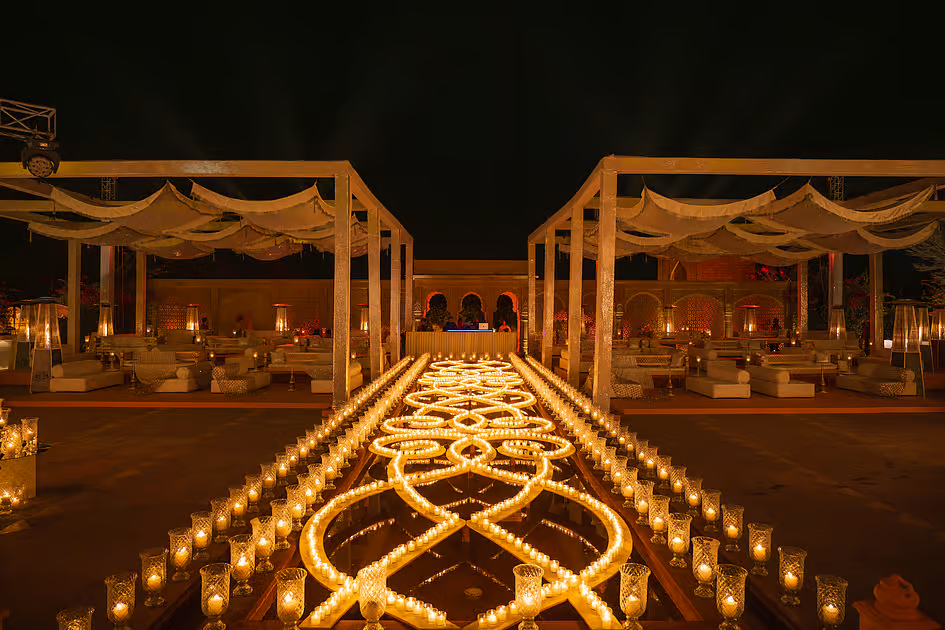
For some, Diwali begins with lighting the first diya. For others, it starts months earlier, with moodboards, guest lists, elaborate decor concepts and countless decisions about how to transform a familiar space into something extraordinary.
In Dubai, where the festive season brings with it a calendar of lavish gatherings, hosting a Diwali party has become something of an art form. Private villas are transformed with intricate floral installations, gardens come alive with carefully curated lighting and dining tables are dressed to reflect themes that have been planned down to the smallest detail. From bespoke invitations and personalised beverages to elaborate entrances and thoughtfully chosen return favours, the modern Diwali celebration has become a masterclass in creating memorable experiences that bring people together.
But behind the seemingly effortless glamour of these evenings lies months of preparation, creative planning and a rather meticulous attention to detail. And while the scale of celebrations may have grown, those who host and design them say the definition of luxury is also evolving.
For Indian couple Aarushi, a creative strategist, and Aditya, a consultant, hosting Diwali has become an annual tradition that began long before they started organising elaborate celebrations in Dubai. “It all began when we were students in the UK. Our campus had only a handful of Indian students, so we took it upon ourselves to host Diwali for everyone who was missing their family during the festival,” they recall.
The tradition followed them to Dubai, where their annual gathering now brings together friends from different chapters of their lives, many of whom reunite only on this occasion. There is also a particularly sentimental reason behind their enthusiasm for the festival. “Our love story actually began at a Diwali party, it’s where our paths first crossed many years ago. That is why we always go all out.”
Months in the making
For the couple, the process begins not with the guest list or menu, but with a concept. Every year brings an entirely new theme, around which the rest of the evening is carefully designed. “We always start with the concept and we start months in advance. Each year has a brand-new one and everything else flows from it — the decor, the menu, the drinks, the activity and even the return favours.”
Planning early is particularly important in Dubai, where the festive calendar fills up quickly. The couple sends out save-the-dates at least two months in advance, ensuring their guests can reserve the evening before other invitations begin arriving.
Once the concept has been finalised, the attention turns to creating an experience that feels cohesive from beginning to end. Even the invitation is designed to introduce guests to the theme before they arrive. “Luxury, for us, is a little bit of drama and a lot of detail,” they add. “We want guests to have a real wow moment the second they walk in, our space/venue completely transformed around that year’s concept, overflowing with florals and glowing with diyas and candles.”
The couple also considers how guests will travel to and from the venue, whether through valet arrangements, private cars or discounts for safe driver services. Each person is welcomed personally at the entrance, while the food, drinks and return favours are individually considered.
For Jai Sharma, founder of Envelop Designs Arabia, an experience design studio specialising in immersive environments, this shift towards more thoughtful celebrations reflects a broader change in what clients expect from luxury events. “A few years ago, luxe mostly meant more. More gold, more flowers, more lights, a bigger entrance. Today, when someone says luxe, they usually mean they want the evening to feel considered,” he says.
This philosophy also influences how Sharma approaches the initial consultation. Rather than beginning with colour palettes or floral preferences, he asks clients about their childhood memories, family rituals and what Diwali has traditionally meant in their homes. “The question has moved from how grand it should look to how it should make their guests feel. Diwali is a festival people carry deep memories of, so hosts don’t want a generic party. They want it to feel like their Diwali.”
Setting the scene
Of course, the visual appeal of a Diwali celebration remains an important part of the experience, particularly in a city where elaborate festive gatherings have become increasingly popular. According to Fatema Nimuchwala, owner of The Event Tree, clients are paying closer attention to how every part of their celebration looks, from the entrance to the smallest decorative corner. “Today, it’s about being aesthetically driven, with grandeur at its peak and every corner being Instagram-worthy. A dedicated wall is now designed just for selfies,” she says.
Interestingly, while the appetite for visually striking settings remains strong, Nimuchwala is also seeing a move towards more refined styling. “Today, less is more. However, minimalism still has to be extraordinary, elegant, refined, and stunning to the eye.”
The growing preference for artificial flowers is another change she has observed, with clients opting for elaborate arrangements that can achieve a particular aesthetic without compromising on creativity.
When it comes to where hosts are investing their budgets, outdoor spaces are proving especially popular. “The lighting of the entire villa and backyard remain the most favourite and most invested-in spaces, followed by the lounging area,” she explains, adding that the pleasant weather during the festive season makes poolside gatherings an attractive option.
Themes, too, are becoming increasingly imaginative. From Mahjong parties, card parties and musical evenings to patakha-inspired celebrations and garden brunches, hosts are exploring ways to give their gatherings a distinctive personality. Yet, even amidst the contemporary styling, certain traditional elements remain indispensable. “No matter how aesthetic or grand the decor is, marigold and rangoli remain beautifully woven into it,” says Nimuchwala.
Sharma has noticed a renewed appreciation for traditional Indian craftsmanship, with clients increasingly drawn to handcrafted terracotta, sculptural diyas, intricate Indian motifs and statement installations inspired by marigolds. “We never recreate tradition, we look for its essence. Everyone knows the obvious symbols, and they’re beautiful, but when every celebration uses the same ones, they stop meaning anything.”
The details guests don’t see
While flowers, lighting and installations may be the most visible elements of a celebration, experienced hosts know that some of the most important decisions are the ones guests may never consciously notice.
For Sharma, one such detail is scent. “Light shapes emotion, sound creates rhythm, but scent evokes memory,” he explains. “Guests will rarely say the entrance smelled wonderful, but they walk in and something in them settles, because it smells like a festival, like home, like something familiar.”
Nimuchwala similarly believes that the entrance deserves particular attention, as it establishes the atmosphere before guests have even stepped inside. “One of the key aspects is convincing clients to invest in entrance decor, as that is where the entire mood and vibe are set,” she adds.
But designing a celebration within a private home also comes with its own challenges. Unlike purpose-built event venues, villas and apartments have existing layouts, limited capacities and practical constraints that must be carefully considered.
For Sharma, the solution is to treat the home as a journey, allowing guests to discover different elements of the celebration as they move from one space to another. “The entrance becomes a threshold and each room is its own chapter with its own light and mood, so guests discover the evening as they move through it.”
Art of the matter
For Aarushi and Aditya, however, there’s one element of hosting on which they refuse to compromise: the food. Self-confessed food enthusiasts, the couple takes a hands-on approach to curating their menus, often creating fusion dishes and developing their own beverages. They even teach the recipes to the people in charge ahead of the celebration, ensuring the beverages are prepared exactly as intended.
Naming the dishes and drinks has become one of their favourite parts of the planning process. Music is another priority, alongside interactive stalls or activities designed around the annual theme. With guests arriving from different social circles, the couple wants to create opportunities for strangers to strike up conversations and leave as friends.
Certain traditions, meanwhile, remain unchanged regardless of the concept. Diyas are lit before guests arrive, fresh flowers fill the home, and mithai (sweets) is always served as a reminder of the festive sweets exchanged by their families.
There’s also the tradition of sending every guest home with a return favour, carefully selected to complement the evening’s theme. And after years of hosting, the couple has learned that the secret to enjoying their own celebrations lies in preparing early enough to avoid last-minute pressures. “If you splurge on one thing, make it the food, because it’s what people remember long after the night ends.”
Ultimately, while the visual language of luxury Diwali celebrations continues to evolve, the sentiment behind them remains remarkably familiar.
And for Aarushi and Aditya, the real measure of a successful evening is not whether every detail was executed perfectly, but whether their guests leave feeling welcomed, already looking forward to the following year. “Our Diwali parties are about people, not perfection,” they say. “To us, true luxury is not only what guests see, but the time, thought and care that go into every detail. Because long after the evening is over, what stays with people is how you made them feel.”
Source: Khaleej Times