

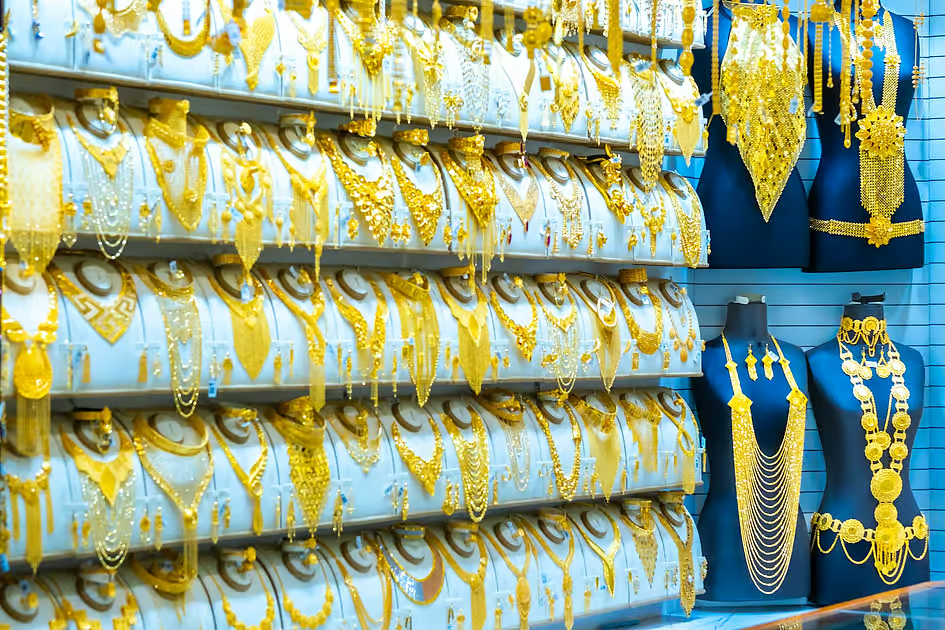
Gold jewellery demand in the UAE fell 29 per cent year on year to 4.5 tonnes in the third quarter, one of the steepest declines of any major market, according to the World Gold Council’s (WGC) Gold Demand Trends: Q3 2026 report.
The report said high gold prices, pressure on household purchasing power and geopolitical uncertainty, which has also weighed on tourist numbers, held back discretionary purchases across the Middle East. UAE jewellery demand was also 19 per cent lower than in the previous quarter.
Stay up to date with the latest news. Follow KT on WhatsApp Channels.
UAE bar and coin demand fell 15 per cent year on year and 46 per cent quarter on quarter to 2.9 tonnes, as investors held back in anticipation of further price weakness, the report said.
on Tuesday morning, gold prices were trending down, trading at $3,909 an ounce, down 1.2 per cent. In Dubai, 24K and 22K gold prices were trading at Dh473 and Dh438 per gram.
Elsewhere in the region, Saudi Arabia’s jewellery demand fell 12 per cent to 8.2 tonnes and Kuwait’s dropped 29 per cent to 1.7 tonnes. Middle East retail bar and coin investment fell 24 per cent to 22 tonnes.
Global demand holds firm
Despite the weakness in jewellery, total global demand, including over-the-counter trade, slipped just 1 per cent year on year to 1,369 tonnes. For the first nine months, demand of 3,881 tonnes virtually matched the record 3,884 tonnes set in 2025, while its value reached a record US$566 billion.
The gold price averaged $4,262 an ounce in the quarter, 23 per cent higher than a year earlier and the third-highest quarterly average on record.
Central bank buying jumped 42 per cent year on year to 321 tonnes, well above the five-year quarterly average of 227 tonnes. Year-to-date purchases reached 675 tonnes, 6 per cent higher than the same period last year. The People’s Bank of China was the largest reported buyer with 63 tonnes, followed by Poland’s central bank with 40 tonnes.
Gold-backed exchange-traded funds attracted 211 tonnes of inflows after outflows in the second quarter, lifting global holdings to a record 4,256 tonnes. Inflows reached a record US$31 billion, driven partly by concerns over fiscal sustainability and inflation.
Jewellery hits record low
Global jewellery demand fell 17 per cent to 313 tonnes, the weakest third quarter in the WGC’s data going back to 2000, and the 13th consecutive quarterly decline. Value edged up 2 per cent to US$43 billion as consumers paid more for less gold, favouring lighter and lower-carat pieces.
In India, the world’s biggest jewellery market, demand fell 20 per cent to 99.9 tonnes, the weakest third quarter since 2020. The WGC said domestic gold prices were around 45 per cent higher than a year earlier, and a later festive calendar shifted some purchases into the fourth quarter.
Indian bar and coin demand fell 40 per cent to 55 tonnes, accounting for 60 per cent of the global year-on-year decline in the category. In mid-October, Indian mutual funds suspended fresh subscriptions into gold fund-of-funds, a move likely aimed at curbing gold imports.
Pakistan’s jewellery demand fell 15 per cent to 3.1 tonnes, and its bar and coin demand fell 12 per cent to 3.8 tonnes.
Outlook
Mine production rose 3 per cent to a third-quarter record of 1,071 tonnes, but recycling fell 8 per cent to 314 tonnes, leaving total supply 1 per cent lower.
Looking ahead, the WGC expects investment to remain the main driver of demand growth in 2026, finishing around 200 tonnes above 2025. It expects central bank buying to at least match 2025 and jewellery demand to keep declining. Higher policy rates, bond yields and a stronger US dollar could weigh on demand in the fourth quarter, while inflation risks, geopolitical tensions and financial market stress may provide support.
Source: Khaleej Times