

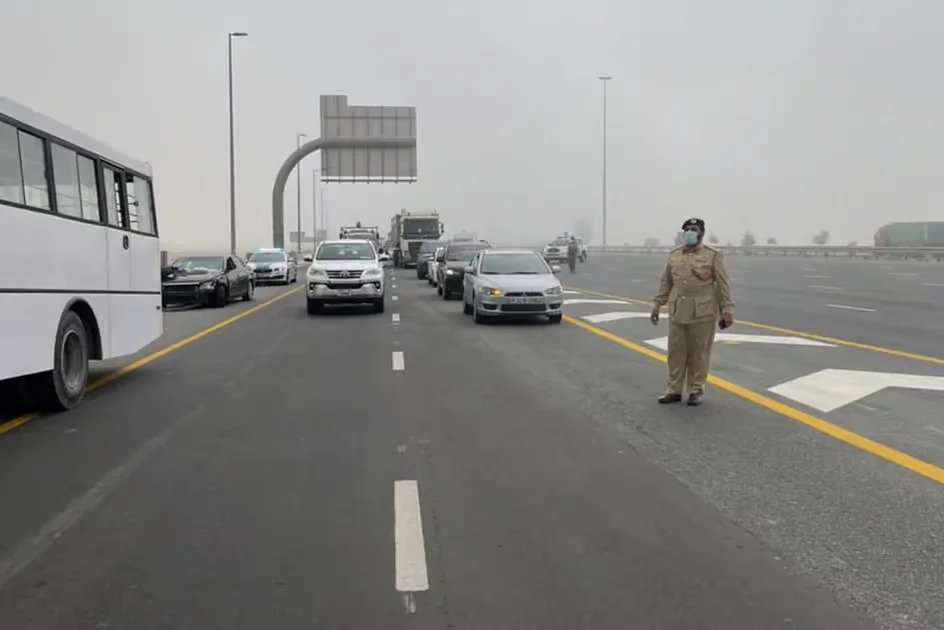
Bodies of victims killed in a fatal road accident on Dubai’s Emirates Road earlier this week have begun reaching their respective home countries, as coordinated repatriation efforts continue across multiple jurisdictions.
Authorities confirmed that four bodies were repatriated on Sunday, June 14, including two to Telangana, and one each to New Delhi and Sri Lanka. Two other bodies were already flown to Varanasi on Saturday, where last rites have since been performed. Another body is expected to be sent to Telangana later tonight.
The crash, which occurred on June 8 on Emirates Road, involved a workers’ minibus carrying 16 passengers that collided with a truck reportedly stopped on the roadside due to a technical fault. According to Dubai Police, seven people were killed and nine others injured in the incident.
Stay up to date with the latest news. Follow KT on WhatsApp Channels.
Meanwhile, a member of the Legislative Assembly from Telangana, Medipally Sathyam of the Choppadandi constituency in Karimnagar district, travelled to Dubai to support bereaved families and ensure swift completion of formalities, that was done in coordination with the Indian Consulate.
The member noted that coordination between local authorities and Indian diplomatic missions had been critical in facilitating the return of the victims’ remains.
Officials involved in the process reportedly said that the situation required coordination across multiple states and countries, given that the deceased hailed from different regions, including Telangana and other parts of India, as well as Sri Lanka.
Safety questions resurface after fatal crash
Preliminary observations have indicated that the driver involved in the collision had a clean driving record, though investigations into the circumstances of the crash continue.
The incident has once again brought the safety of minibuses in the UAE into focus, particularly the risks they pose in high-impact collisions. Road safety experts say such vehicles remain a recurring concern on the country’s highways.
Road safety expert and founder of MA Traffic Consulting, Mustafa Aldah, earlier said that minibuses have long been a point of concern in his study of road crashes in Dubai, recalling that issues involving such vehicles have persisted for years, particularly since the mid-2000s when he began examining accident patterns.
He pointed out that former Federal Traffic Council leadership had previously raised concerns about minibuses, including calls to eliminate unsafe seating configurations that once allowed overcrowding. He also noted that recommendations were made in 2019 to ban passenger minibuses from UAE roads after reports linked them to a significant proportion of road fatalities, while school transport use was already restricted earlier in Dubai.
Why minibuses present safety risks
Founder of RoadSafetyUAE, Thomas Edelmann, previously reiterated that minibuses continue to present safety risks due to structural limitations, including weaker build quality and inadequate passenger protection compared to standard buses.
He added that these vehicles often lack critical safety features such as emergency exits and modern collision warning systems, and that their seating configurations place passengers too close together, increasing vulnerability in severe crashes. He had further observed that the capacity limits of such minibuses are often considered too high for their design stability.
Experts also pointed to the broader economic and human impact of such accidents. Aldah estimated that each road fatality can cost the UAE economy between Dh6 million and Dh9 million in productivity loss, medical care, and associated impacts, while stressing that the greatest cost remains human, particularly among low-income labourers.
Source: Khaleej Times