

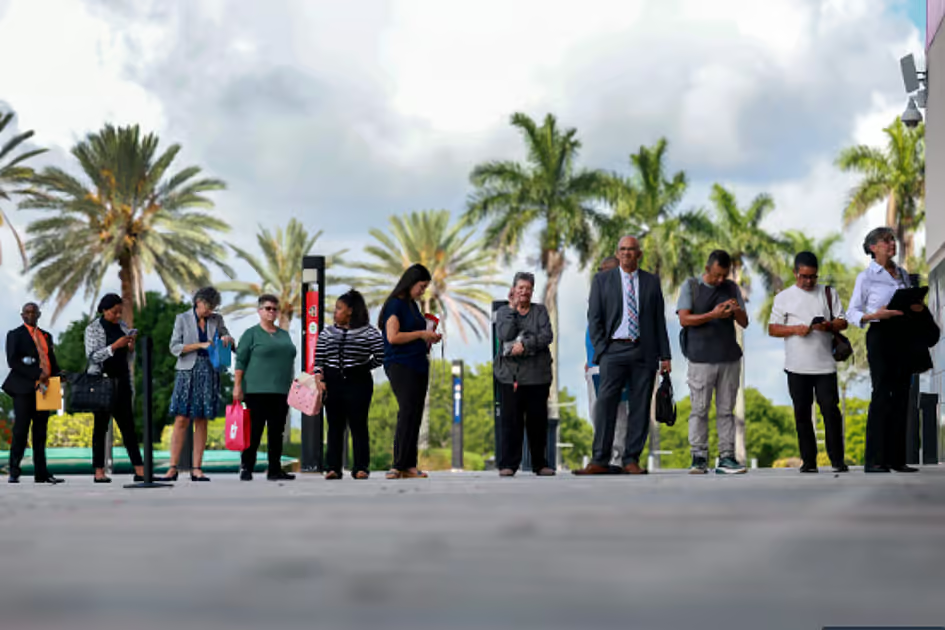
The number of Americans filing claims for unemployment benefits increased slightly last week, while layoffs dropped to a two-year low in July, consistent with a stable labor market.
Other data on Thursday showed worker productivity grew faster than expected in the second quarter, curbing gains in labor costs. The lack of labor market stress and contained wage pressures gave the Federal Reserve room to focus on the inflation fallout from the Middle East conflict, economists said. They said there were some signs that the adoption of artificial intelligence by businesses was raising productivity.
Still, economists said the U.S. central bank could raise interest rates next month unless inflation improved.
“A true productivity miracle that brings down some of the higher price costs borne by consumers and business and keeps overall inflation in check depends on whether the emerging advancements in AI technology truly enable workers to produce goods more cheaply and provide services at a lower cost over time,” said Christopher Rupkey, chief economist at FWDBONDS.
Initial claims for state unemployment benefits rose 1,000 to a seasonally adjusted 199,000 for the week ended August 1, the Labour Department said. Economists polled had forecast 202,000 claims for the latest week. Claims have dropped considerably since surging in early June, and are at the lower end of their 189,000-230,000 range for this year. Though some of the decline reflects difficulties adjusting the data for seasonal fluctuations in summer, layoffs have remained very low despite the oil price shock from the U.S.-Israeli war with Iran, now in its sixth month.
There are also no signs of widespread job losses linked to the AI buildout, with layoffs mostly confined to the technology industry. A separate report from global outplacement firm Challenger, Gray and Christmas on Thursday showed planned job cuts by U.S.-based employers dropped 27% to 33,429 in July, the lowest level since July 2024. Announced layoffs fell 46% from a year ago. They are down 41% this year compared to the same period in 2025.
The number of people receiving unemployment benefits after an initial week of aid, a proxy for hiring, increased 24,000 to a seasonally adjusted 1.801 million during the week ended July 25, the claims report showed. The claims data have no bearing on the Labor Department’s closely watched employment report for July, scheduled to be released on Friday. Nonfarm payrolls likely increased by 80,000 jobs last month after rising 57,000 in June, a Reuters survey of economists showed. The unemployment rate is forecast holding steady at 4.2%. There is, however, a risk the jobless rate could edge higher after a Conference Board survey last week showed the share of consumers viewing jobs as “plentiful” dropped in July to the lowest level since February 2021.
Job growth has slowed after accelerating in the spring. An Institute for Supply Management survey on Wednesday showed a measure of services sector employment contracted in July. Stocks on Wall Street were mostly lower. The dollar gained versus a basket of currencies. U.S. Treasury yields rose.
The Fed last week left its benchmark overnight interest rate in a 3.50%-3.75% range. Three members of the U.S. central bank’s policy-setting committee dissented. They “preferred” a quarter-percentage-point hike.
Wage inflation contained
In a separate report, the Labour Department’s Bureau of Labor Statistics said nonfarm productivity, which measures hourly output per worker, increased at a 1.4% annualized rate last quarter after advancing at an upwardly revised 0.8% pace in the January-March quarter. Economists had forecast productivity would grow at a 0.6% rate following a previously reported 0.3% pace of increase in the first quarter. Productivity grew at a 2.2% rate from a year ago. It has grown at a 2.1% rate from the fourth quarter of 2019 through the second quarter of 2026. The BLS said the labor share, the percentage of output that accrues to workers in the form of compensation, hit a record low 52.9% last quarter.
“Weak growth in the labor force likely is pushing companies to squeeze a bit more from their existing workforce,” said Oliver Allen, senior U.S. economist at Pantheon Macroeconomics.
Economists and policymakers are anticipating an AI buildout will boost productivity and curb inflation through a reduction in labor costs. Unit labor costs — the price of labor per single unit of output — increased at a 1.3% rate last quarter, after rising at a downwardly revised 1.3% pace in the first quarter.
Economists had expected unit labor costs to increase at a 2.1% rate last quarter after a previously reported 1.8% pace of growth in the January-March quarter. Labour costs grew at a 1.4% rate from a year ago. Hourly compensation increased at a 2.7% rate last quarter and grew at a 3.7% pace from a year ago. Some economists drew attention to unit nonlabor payments, and argued that benign labor costs on their own were insufficient to turn the tide on inflation. Unit nonlabor payments surged at a 14.0% pace last quarter, the fastest in four years, and increased at a 9.0% rate from a year ago. “So, relatively tame unit labor costs are not a sufficient condition for achieving 2% inflation in the current environment,” said Stephen Stanley, chief U.S. economist at Santander U.S. Capital Markets.
Source: Khaleej Times