

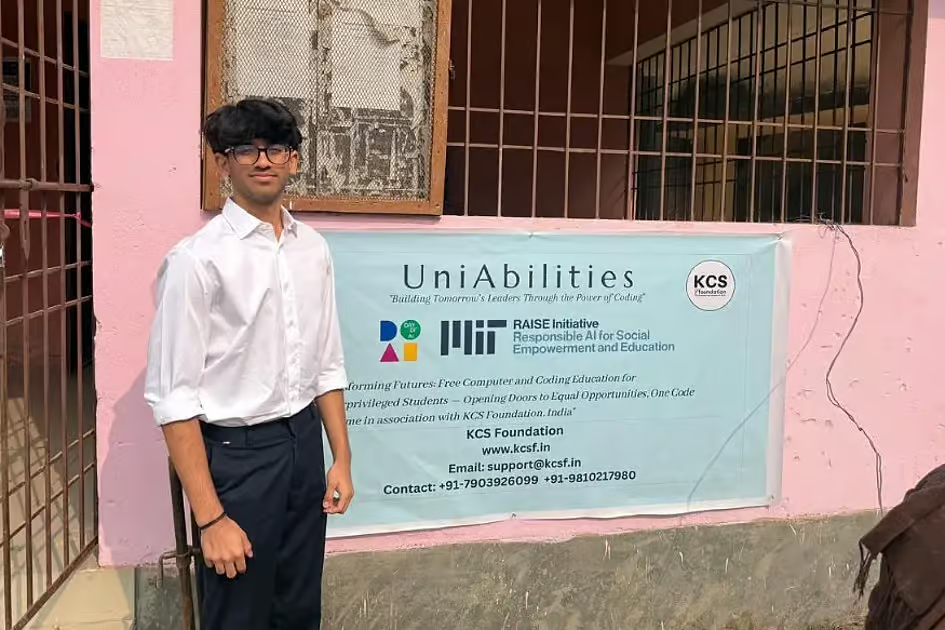
When Dhruv Sharma was around 12 or 13, a visit to his grandparents home in India confronted him with a reality very different from the life he knew in Dubai.
The children of a woman working at the house were there with their mother. Curious, Dhruv asked why they were not in school.
“They said, ‘We don’t go to school because we don’t have the finances. We cannot afford to go to school,’” the 17-year-old Dubai College student recalled.
Dhruv decided to spend an hour of his day teaching them. The children, whom he remembers being around nine or 10 years old, became some of his first students.
“I taught them STEM. I taught them physics, chemistry, biology,” he told Khaleej Times. “I kind of just wanted to see what type of impact I could make on them.”
What began with a handful of children would eventually grow into UniAbilities, Dhruv’s education initiative that has now reached approximately 8,750 students, largely in Bihar, India.
Stay up to date with the latest news. Follow KT on WhatsApp Channels.
From Dubai to Bihar
Dhruv, who was born and raised in Dubai, said his grandfather also played an important role in turning that early experience into something bigger.
After seeing his interest in teaching, his grandfather connected him with New Era Public School in Bihar, where Dhruv visited in 2019.
The trip gave him his first opportunity to understand how students in more rural communities were learning and what they needed.
Then the pandemic hit.
Unable to continue regular face-to-face visits in 2020 and 2021, Dhruv began conducting smaller online sessions. The limitations of the pandemic ultimately gave him another idea: if he could not physically be in a classroom, could he create something students could access without him?
That question led to UniAbilities, an online educational platform offering free resources in subjects including physics, computer science and artificial intelligence.
Students can access lessons through a phone or computer, complete quizzes and track their progress.
“I created that website for them, just out of wanting to help them in any way I can,” he said.
For some, it starts with a mouse
For children who have grown up surrounded by smartphones and laptops, learning coding or AI might feel like the natural next step.
For some of the children Dhruv’s initiative works with, however, the starting point can be much earlier.
“Many of the children in these underserved areas have never seen a computer before in their life,” he said. “They don’t know what a mouse is. They don’t know what a keyboard is.”
That means lessons can begin with the basics, including how to operate a computer, access a website and navigate digital resources.
Dhruv has also helped establish a computer lab with more than 20 computers in Samastipur, Bihar. He said around US15,000 was raised with support from the Krishna Chandra Shakti Foundation (KCS Foundation) and donors to help make the lab possible.
But putting computers in a room was only part of the challenge. Someone still needed to teach students how to use them.
Dhruv therefore adopted a “train the trainer” approach, training around 32 people who can now pass those skills on to students locally.
It has also allowed the teenager to continue running the initiative while attending school thousands of kilometres away in Dubai.
During the academic year, Dhruv conducts regular weekend sessions, increasing them during school holidays.
‘Even if it is one out of 100’
Reaching thousands of children has not meant that every student immediately embraces the opportunity.
Dhruv said one of the lessons he learned during his visits was that access alone does not necessarily create motivation.
In some early in-person sessions, he recalled teaching classrooms of around 20 students and finding that only two or three would actively approach him afterwards with questions.
Some would ask how much the programme cost.
“I told them, ‘No, it’s completely free.’ Then they would ask, ‘When can we start?’”
Those students became an important measure of success for him.
“Even if I see one out of 100 people, it makes me feel humbled,” he said. “I can help at least one person who’s willing to get the opportunity.”
Dhruv now wants to take students beyond basic computer literacy by expanding access to coding, Python, AI and astrophysics.
For him, exposing rural students to emerging technology is also about employability. He wants them to learn practical tools such as Microsoft Word, Excel and PowerPoint before building towards more advanced digital skills.
A 17-year-old thinking about space
As he prepares for his final year of school, Dhruv hopes to study physics or astrophysics in the US or UK, while using university resources and connections to expand UniAbilities.
For now, his goal is to grow the initiative from around 8,750 students to more than 14,000 this year.
The experience has also changed how he views his own opportunities growing up in Dubai.
“I was privileged enough to live somewhere where I’ve been given everything,” he said. “I knew that people weren’t as privileged as me, but I didn’t see how big that gap was.”
For Dhruv, giving even one student access to those opportunities could have an impact far beyond the programme.
“You never know if someone who you offer these skills to can become one of the most influential people,” he said. “They can maybe create software which helps even more people.”
Source: Khaleej Times