

Gold’s recent slide from record highs near $4,500 an ounce to around $4,317 is a corrective, profit-taking phase rather than the start of a bearish reversal, according to market analysts, who say the metal’s underlying bullish drivers remain firmly intact.
Rania Gule, senior market analyst at xs.com, said the pullback allows short-term positions opened during gold’s rapid advance to be flushed out, helping the market rebuild a more balanced base from which prices can resume their upward trajectory once buying flows return.
“I still believe the broader outlook for gold remains positive, although the path higher will not be a straight one,” Gule said, noting that recent US inflation data came broadly in line with expectations while the labour market has begun showing signs of weakness, reducing pressure for tighter monetary policy.
She said the latest data failed to give the Federal Reserve strong justification for another rate hike, with markets growing increasingly sensitive to any figures that could push yields and the dollar lower – a dynamic that favours gold given its lower opportunity cost as a non-yielding asset.
Gold price closed at $4,367 per ounce, up 0.31 per cent over the weekend.
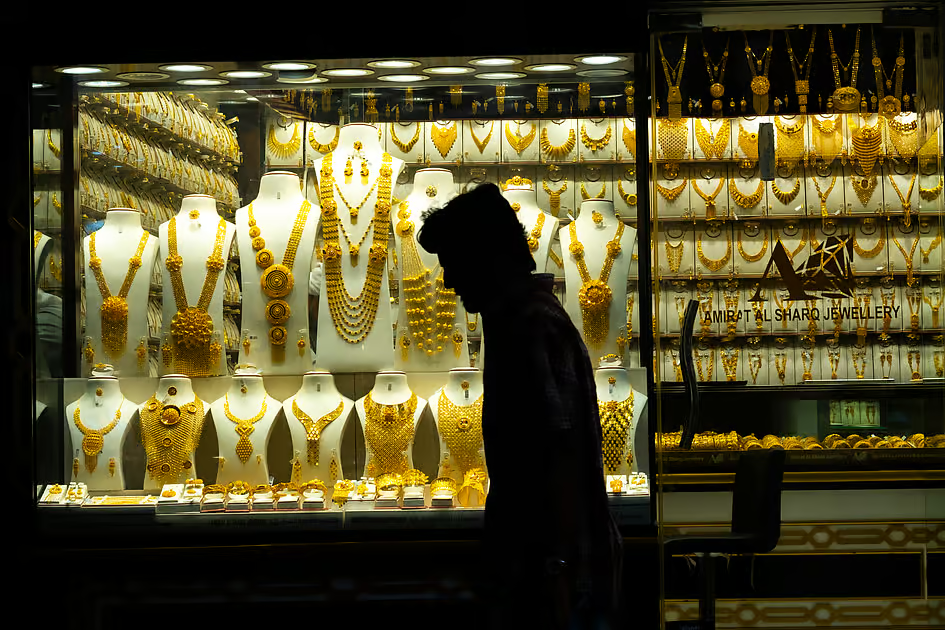
In the UAE, 24K and 22K gold prices were trading at Dh527.5 and Dh488.5 per gram, respectively, according to Dubai Jewellery Group data.
Looking ahead, Gule said US spending and consumption data will be among the most important catalysts for gold, both for their direct impact on the dollar and for what they reveal about the economy’s ability to withstand current interest-rate levels.
A slowdown without a resurgence in inflation would strengthen the case for holding rates steady before easing policy – a scenario she views as supportive for gold over the medium term. Stronger-than-expected data, by contrast, could trigger a temporary rise in the dollar and Treasury yields, pressuring gold before investors reassess the broader picture.
Central banks driving shift
Beyond the US rate story, Gule pointed to a deeper structural shift in how global reserves are managed. Citing the World Gold Council’s 2026 survey, she said 74 per cent of participating central banks expect the dollar’s share of global reserves to decline over the next five years, while 89 per cent of reserve managers expect central bank gold holdings to keep rising over the next 12 months.
“Gold is increasingly becoming a tool for reserve diversification and reducing dependence on a single asset, particularly amid rising geopolitical and financial risks surrounding the dollar and the US Treasury market,” she said.
She added that China’s decision to extend its gold-buying streak to a fifth consecutive month in July underscored that central bank demand – unlike speculative trading – is driven by long-term reserve strategy rather than short-term profit-taking, meaning deeper corrections could attract long-term buyers.
“I do not see the decline toward $4,317 as the end of the trend. Instead, I currently view it as part of a process of rebalancing, liquidity gathering, and profit-taking.”
Inflation, jobs data
Ahmad Assiri, Research Strategist at Pepperstone, said gold’s rally has been supported by inflation figures that came in line with expectations and soft non-farm payrolls, both of which have eased concerns over a Fed tightening bias heading into September.
He noted that options dealers had found the previous month’s roughly 5 per cent trading range ideal for selling gold options and collecting premiums, but as gold breaks out of that range, dealers covering their exposure could be adding further flow to the rally.
On geopolitics, Assiri said Middle East tensions appeared to have moved somewhat out of market focus despite the absence of any breakthrough in Oman-related talks, with attention shifting elsewhere. This, he said, offers marginal short-term support for gold by allowing flow dynamics to dominate price action, even as geopolitical risk remains present in the background.
Source: Khaleej Times