

Residents of congested, sprawling cities are spending more time in their vehicles. There is even global research to support this theory — in 2025, the car marketplace Autotrader surveyed car users from 17 countries to find out the amount of time they spent in their vehicles. According to its website, South Africa topped the list, with motorists spending ‘10 days, 4 hours and 48 minutes annually commuting to and from work’, followed by India.
While some hate long commutes, others look at it as a chance to dive into work or just enjoy a few minutes of solitude before plunging into the day’s chaos. And car owners, especially younger buyers who actively seek out experiences that promote their well-being, increase longevity and eliminate stress from their lives, look for cars that feel like hi-tech, personalised havens.
Luxury car brands have taken note and transformed their cabins into mobile wellness pods as wealthy buyers increasingly want to spend their time commuting in the lap of luxury, say experts. Waleed Al Balushi, general manager of luxury car dealership Oscar Luxury Auto LLC, explains, “Luxury brands have noticed this, so they are placing greater emphasis on making the cabin quiet, comfortable and stress-free.” And they do so by adding a range of features like massage seats, heated and ventilated seats, premium air filtration, ambient lighting, premium sound systems, fragrance systems, soft-close doors and very quiet cabins, he says.
“Mercedes has the Energising Comfort programmes, Range Rover has excellent air purification and massage seats, Bentley has wellness seating, and Rolls-Royce is all about creating a calm and peaceful cabin. These features make a big difference, especially for customers who drive a lot or have a chauffeur,” he adds.
Luxury meets wellness
Roberto Lopes Da Silva, general manager, NIO UAE, explains that the trend is “part of a much broader shift in how people define luxury”. “Traditionally, luxury was associated with craftsmanship, performance and exclusivity,” he says. “Those qualities remain important, but today’s users are also asking a different question: how does this product make me feel? Naturally, that expectation has extended to the automotive industry.”
Ricky Mullins, executive vice president, Exeed, too, points out that people want the time spent inside their cars to be comfortable and enjoyable. “This is especially true in the UAE,” he observes. “A typical day might involve the school run, commuting to the office, sitting in traffic, driving between Dubai and Abu Dhabi, heading to a workout class or going away for the weekend.” For many people, he points out, their cars are one of the few private spaces they have while navigating a busy day.
Also, wellness is no longer a part-time passion that people pursue sporadically at a spa, he continues, pointing out that especially for younger customers, it has become an integral part of their lives. “For them, wellness is about how well they slept, how much they moved that day, their stress levels, recovery, mindfulness, air quality or even the atmosphere of the space they are in. So, it makes complete sense that the car is becoming part of that conversation too,” he explains.
Spa on wheels
NIO’s vision, explains Da Silva, was to design spaces that resembled a contemporary living space “rather than traditional automotive design”. So certain models have features like ‘Hot Stone Massage’ and ‘Zero Gravity Reclining’. The former, as the name suggests, helps relax the body. The latter reclines the seat to an angle of up to 120 degrees which, according to descriptions of such seats online, eases pressure on the spine and joints. There is also customisable ambient lighting, an AI-powered companion called NOMI to help set the “climate, lighting, seating and entertainment through natural voice interaction”, an in-built Tide app that offers “guided breathing exercises, meditation sessions”, and ‘Lounge Mode’ for a more tranquil setting with soothing sounds and adjusted lights and seats.
“What’s interesting is that these features are often used during the quieter moments that exist between destinations,” continues Da Silva. “Whether someone is waiting to collect their children, taking a break between meetings, charging the vehicle or simply arriving home a little early before going inside, those few minutes become an opportunity to reset rather than simply wait.”
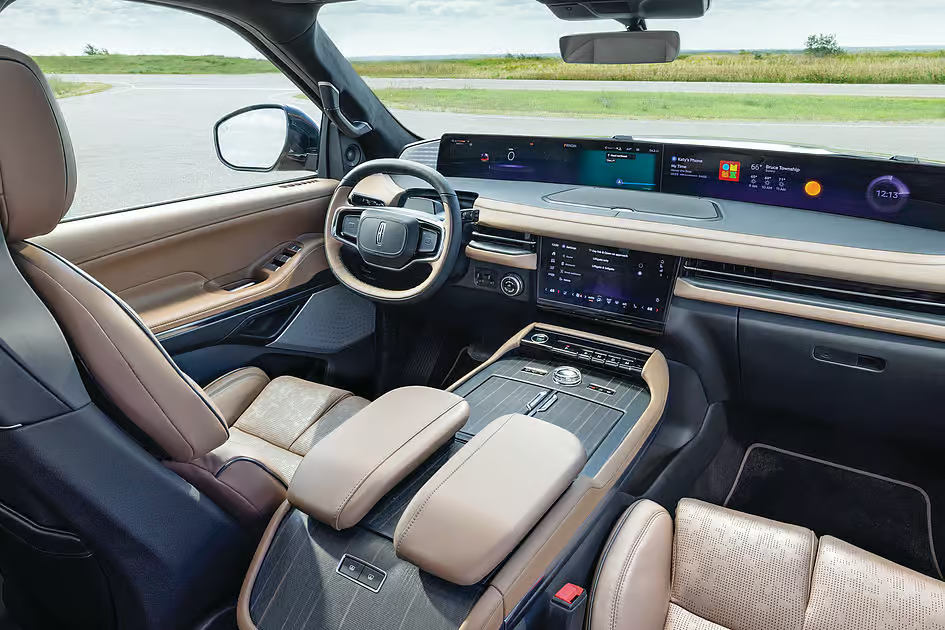
There are other examples too. Lincoln Navigator and Lincoln Nautilus models that come with the ‘Lincoln Rejuvenate’ feature offer a ‘multi-sensory digital spa-like experience’ to its occupants. Its newest theme, ‘Forest Meditation’, which was designed along with mental health and wellness company Calm, has calming forest visuals, “immersive audio and guided meditation sessions lasting five or 10 minutes”. And elevating the experience further are the brand’s digital scents, with whimsical names like Mystic Forest and Ozonic Azure, which are diffused through the centre armrest.
Depending on the Exeed model, says Mullins, there are features like “zero-pressure and spa-grade massage seats, seat heating and ventilation, air purification, fragrance systems, ambient lighting and quieter cabin environments”. “The ET REEV, for example, has a zero-pressure passenger seat with massage, heating and ventilation, while the ES offers spa-grade massage seating,” he elaborates. “The MX also features negative-ion air purification, PM0.3 filtration, one-touch odour removal and three fragrance modes.”
Predicting the future
Experts believe that these features will not stay limited to the luxury car segment and that they will become more technologically advanced in the coming years, as the trend is predominantly fuelled by younger customers who are accustomed to feeding their devices with data and expect tailor-made experiences in return.
Waleed Al Balushi points out that features like heated seats and adaptive cruise control first debuted in luxury cars and are now widely available in affordable cars. And Mullins predicts that cars will get smarter at gauging and catering to the needs of its occupants. He explains that cars will be able to adapt more seamlessly to “how tired you are, the temperature outside, the quality of the air, your preferred seating position or even information from your wearable devices” and tweak various settings like lighting, temperature, sound and seat settings accordingly. “For me, the most exciting direction is when technology becomes almost invisible,” he explains. “You should not have to go through ten menus and press several buttons to create the right environment.” And Da Silva adds that the GCC region is particularly well-placed to embrace this shift. “People spend a significant amount of time in their vehicles, often in challenging climates, so comfort and well-being have a real impact on the overall ownership experience,” he points out.
While it’s still early days, one thing is certain: if these features become available across more cars, your next spa-like experience may be just a car door away.
Source: Khaleej Times