

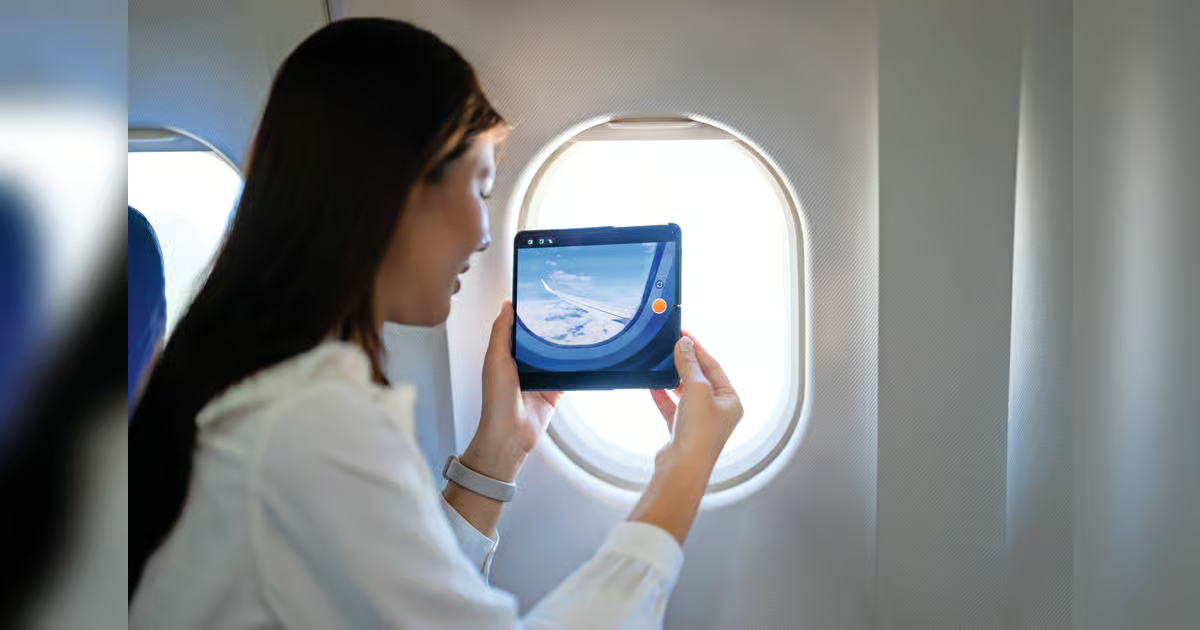
The foldable smartphone market is entering a new phase of growth as consumers increasingly seek devices that combine portability, productivity and artificial intelligence in a single package. Once viewed as a niche category, foldables are rapidly gaining mainstream appeal, thanks to slimmer designs, stronger hinges, larger batteries and enhanced durability that address many of the shortcomings of early-generation models.
However, hardware innovation is only part of the story. The real game changer is artificial intelligence, which is transforming foldables into intelligent productivity hubs. From real-time translation and AI-generated subtitles to advanced photo editing, content summarisation and multitasking assistance, AI is helping users unlock the full potential of larger, flexible displays. The expanded screen real estate allows AI tools to work more effectively, enabling users to edit documents, attend virtual meetings, create content and manage multiple applications simultaneously without sacrificing mobility.
Industry executives believe these advances are accelerating consumer adoption. With brands such as Samsung, Huawei, HONOR, Xiaomi and other manufacturers integrating features such as AI Eraser, live translation and automatic video subtitles into their foldable devices, smartphones are evolving from communication tools into personal digital assistants designed to enhance productivity and creativity.
“While AI is available across smartphones, foldables provide the screen real estate needed to unlock its full potential. From real-time translation and intelligent multitasking to AI-powered content creation and productivity tools, foldables are emerging as the ideal platform for the next generation of mobile AI experiences,” said an industry expert.
As foldables become more durable, more intelligent and increasingly practical for everyday use, industry observers believe they are poised to redefine the premium smartphone market, offering consumers the best of both worlds: the portability of a smartphone and the productivity of a tablet.
Holding the Future
Looking ahead, experts expect foldables to become one of the fastest-growing segments in consumer electronics. IDC projects global foldable smartphone shipments to reach nearly 20 million units in 2025, representing annual growth of around 6%. The research firm expects shipments to exceed 20.6 million units by year-end and believes foldables will continue to outpace the broader smartphone market throughout the remainder of the decade.
The anticipated arrival of Apple’s first foldable device could further validate the category and fuel wider consumer interest. Analysts believe Apple’s entry would raise awareness, expand the addressable market and accelerate mainstream adoption, helping foldables cross the chasm from a specialist segment to a core category within the premium smartphone market.
IDC forecasts foldable smartphone shipments could grow by about 30% in 2026, driven by continued innovation from Samsung and Huawei, the expansion of tri-fold devices and the expected arrival of Apple’s first foldable iPhone. The company projects foldables will achieve a compound annual growth rate (CAGR) of 17% through 2029, significantly outpacing growth in the traditional smartphone market.
It’s Time for Foldables
Debo Zhang, CEO of HONOR GCC, said consumer preferences are rapidly shifting as foldables evolve from a niche curiosity into mainstream productivity tools.
“We have attributed the trend of a foldable shift because they offer the real estate of a small tablet without sacrificing the portability of a standard smartphone,” Zhang told BTR.
“At HONOR, we see this transition driven by high-efficiency multitasking — such as running side-by-side apps, editing documents on the fly, and consuming video content on an expansive screen. Innovations like the HONOR Magic V6 deliver this experience in an ultra-slim 8.75mm profile powered by a massive 6,660mAh silicon-carbon battery, giving users full-day tablet productivity in a sleek phone body,” he said.
“Our HONOR devices also come with advanced AI features that are designed with the consumers in mind. Some examples include dedicated photo editing features such as AI eraser and even AI subtitles, which automatically displays subtitles for videos playing on the screen,” he added.
Fadi Abu Shamat, Vice-President and Head of the Mobile eXperience Division, Samsung Gulf Electronics, said the biggest change in the behaviour of a consumer is that foldables are no longer being chosen for the novelty of a phone that folds. Their expectations have moved well beyond that.
“Consumers are increasingly looking at the practical benefits the form factor brings to everyday use. This year’s lineup reflects those different priorities, with the Galaxy Z Fold8, Galaxy Z Fold8 Ultra and Galaxy Z Flip8 each tailored to different consumer needs and lifestyles,” Abu Shamat told BTR.
For Galaxy Z Fold8 and Galaxy Z Fold8 Ultra users, he said the larger display has become central to the experience. “Content-related activities such as watching, browsing and gaming now account for the majority of daily usage time, while the additional screen space also supports more practical use cases, from working across multiple apps and reviewing documents to video calls and content creation. The value is in having that larger canvas available when needed, without having to carry a second device.”
Abu Shamat said portability has become equally important. Consumers want the benefits of a larger display without the weight and bulk traditionally associated with it. Galaxy Z Fold8 is designed around that balance, with a 10:16 cover screen for quick, everyday interactions and a 4:3 main display when unfolded for watching, reading and browsing. “At just 201g, it is also the world’s lightest fold yet, making the transition between a bar type smartphone experience and a larger workspace far easier throughout the day.”
The Galaxy Z Flip8 responds to a different set of priorities. Rather than creating more screen space, it brings a full flagship experience into a more compact form. The FlexWindow has also become a more functional part of the device, giving users access to apps, quick interactions and Galaxy AI without needing to unfold the phone for every task.
Seven generations later, there isn’t one reason people choose a foldable anymore. Some consumers value a larger canvas for content and productivity; others prioritize compactness and convenience. Foldables are increasingly being chosen around these practical, everyday behaviors.
“And consumer demand reflects that. Preorders for the new Galaxy Z Series were up more than 30% globally compared with the previous generation, while South Korea recorded 1.44 million preorders across Fold8, Fold8 Ultra and Flip8 combined. Demand was strong enough for manufacturing orders to increase by an additional one million units in a single week to keep pace.”
Foldables Vs Traditional
Abu Shamat said a foldable still has to be a great smartphone first. Consumers aren’t going to accept weaker performance, cameras, battery life, or durability simply because the screen folds. “That’s where the category has changed dramatically. Seven generations of development have allowed it to keep reducing many of the compromises associated with the earliest foldables. The Galaxy Z Fold8 is the lightest Fold yet at 201g.”
The Galaxy Z Fold8 Ultra brings an 8-inch display, 200MP main camera, 5,000mAh battery, and Snapdragon 8 Elite Gen 5 for Galaxy, while the new Flex Titanium display structure is another step forward in durability.
“Once those fundamentals are there, the form factor becomes the advantage. A foldable can be your everyday smartphone when it’s closed and then give you wider workspace for multitasking, watching content, or creating when you open it. “So, the choice is about which form works better for the way you use your phone. Flagships will continue to have a very strong place in the market, but foldables now offer a genuinely different experience without asking consumers to give up the things they expect from a flagship.”
Zhang opine that some tech-savvy smartphone buyers opt for foldables devices as they balance screen size against durability, battery life and cost of traditional gadgets.
“When choosing between a conventional flagship and a foldable, buyers balance screen size against durability, battery life, and cost. Traditional slab phones have historically offered peace of mind through lower prices, higher dust/water resistance, and simple drop durability,” he said.
However, he said HONOR has directly systematically solved these trade-offs. “With the Magic V6, we have a strong Super Steel hinge, dual IP68/IP69 water, sand and dust resistance, and drop protection, effectively removing the physical durability compromise. Coupled with our open cross-platform compatibility with iOS and Mac setups, consumers gain all the screen real estate of a foldable without losing ecosystem convenience or structural peace of mind.”
IDC projects foldable smartphones to achieve a 17% CAGR through 2029, dramatically outperforming the broader smartphone industry, which is expected to grow by less than 1% annually over the same period. This contrast highlights the different stages of maturity between the two markets. Conventional smartphones have reached saturation in most developed economies, with longer replacement cycles and limited hardware differentiation constraining growth.
By comparison, foldables remain in the early stages of adoption, providing manufacturers with a significant opportunity to drive premium upgrades and stimulate consumer demand through innovative form factors and enhanced productivity features.
In volume terms, the difference is particularly striking. Global smartphone shipments exceed 1.2 billion units annually, yet year-over-year growth remains modest as consumers hold onto devices for longer periods and incremental improvements make upgrades less compelling. Foldable smartphones, by contrast, are projected to ship approximately 19.8-20.6 million units in 2025, representing only around 1.5-2% of the total smartphone market. However, their growth rate is several times higher than that of traditional smartphones, underlining their importance as a future growth engine for the industry.
Apple Foldables impact
Zhang said Apple entry into the foldable category has been a long time coming and it may accelerate mainstream consumer adoption depending on the product.
“At HONOR, we believe foldables are poised to become a core standard in the premium smartphone market rather than remaining a minor sub-segment. That said, both form factors will coexist to serve distinct needs: traditional slab smartphones will remain popular for users who prioritise single-screen simplicity, while foldables like the HONOR Magic Series will define the premium tier for power users, professionals, and mobile creators seeking maximum productivity, cinematic viewing, and AI-driven multitasking.
“We saw this trend with the launch of the HONOR Magic V6 earlier this year, which resulted in us taking up 50% of the foldable market share within the first few months of launch,” he said.
Abu Shamat said more competition in foldables is a positive sign for the category. “It brings greater attention to the form factor, creates more choice for consumers, and raises expectations across the industry. Samsung has spent eight years and seven generations developing foldables, so the category entering a more competitive phase is a natural part of that progress.”
He said foldables have come a long way in those eight years. The first Galaxy Z Fold had to prove that a folding smartphone could work as an everyday device. The generations that followed addressed durability, weight and portability. Today, our foldables are performing well on cameras, battery life, performance, AI and design, just like any premium smartphone.
“This also doesn’t mean foldables have to replace bar type smartphones. Foldables and slab-style devices serve different preferences, and that is likely to continue. Some consumers want the familiarity of a flagship, others value the larger screen or compact design. Expanding the foldable line-up reflects those differences rather than expecting every consumer to adopt the same form factor.
“Repurchase behaviour is also an important indicator. The Galaxy Z Fold7 and Galaxy Z Flip7 repurchase rates show that most users who choose a foldable stay with the category when it is time to upgrade. That is significant because it points to more than initial curiosity. The form factor is becoming part of how people use their phones every day,” he said.
As production costs decline and supply chains mature, foldable smartphones are expected to become increasingly accessible while retaining their premium positioning. The combination of stronger shipment growth, new form factors, AI integration, and growing vendor competition suggests that foldables will remain one of the most dynamic segments of the mobile industry. Over the next five years, they are likely to play a pivotal role in driving smartphone upgrades, improving industry profitability, and shaping the future of mobile computing.
HOW DURABILITY HAS IMPROVED
The smartphone manufacturers have invested heavily in hinge engineering because the hinge is the most critical component affecting reliability. Recent flagship foldables have demonstrated meaningful improvements in durability while also becoming thinner and lighter.
The latest foldables from Samsung, Huawei, Honor, Xiaomi, Oppo, and Motorola feature:
-
Stronger hinge mechanisms designed for hundreds of thousands of folds
-
Improved ultra-thin glass (UTG) layers that better resist scratches and repeated bending
-
Reduced screen creasing and better structural rigidity
-
Enhanced dust and water resistance in some flagship models
-
Thinner and lighter designs without sacrificing durability
HOW LONG DO FOLDABLES LAST?
Most leading manufacturers rate their hinges for roughly 200,000 to 500,000 folds, depending on the model. In practical terms:
· 100 folds per day = about 5 to 13 years of use
· 150 folds per day = about 3.5 to 9 years of use
For most consumers, hinge lifespan is no longer the primary concern. The bigger questions are screen durability, repair costs, and long-term wear.
While foldable displays have improved dramatically, they remain more delicate than the hardened glass used on conventional smartphones.
Source: Khaleej Times