

A blurry-looking photo of a celebrity at an airport. A near-perfect red-carpet moment. A “leaked” film still that has fans convinced their favourite star has joined a major franchise. In the age of AI, it’s getting harder and harder to tell what is real and what has been “generated” into existence.
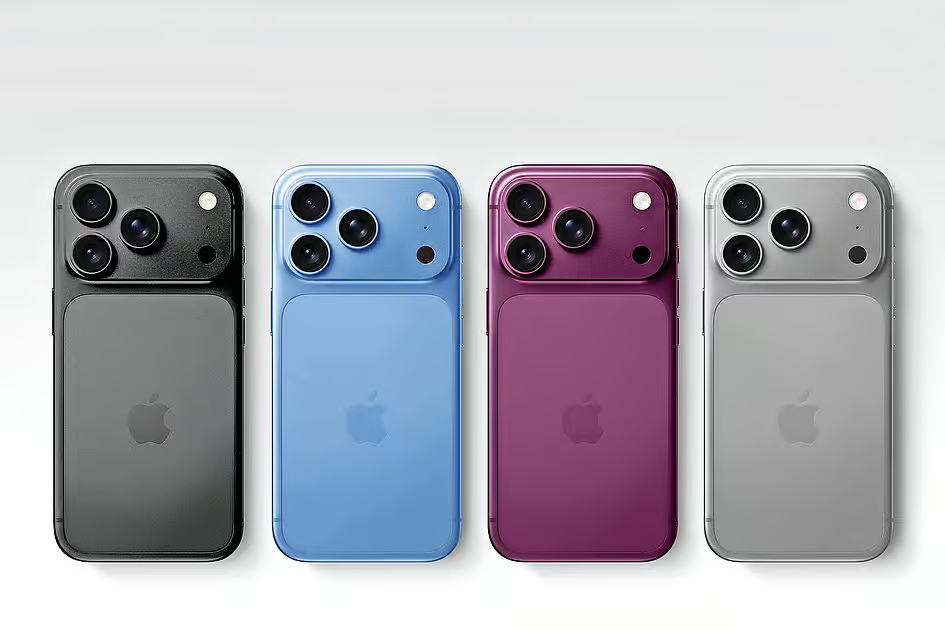
Apple thinks it may have a partial answer. With the iPhone 18 Pro and iPhone 18 Pro Max, the company has introduced Apple Reference Image, a new camera feature intended to help users prove that a photo was genuinely captured on their device and show whether it was altered later, including through AI.
But before anyone assumes their next iPhone will be able to scan every viral celebrity picture and announce whether it’s fake or not, there’s an important catch: this is not a universal deepfake detector.
What is Apple Reference Image?
Think of it as a high-tech digital negative. When someone takes a picture using the iPhone 18 Pro’s new opt-in Reference mode, the phone creates an authenticated version of what its camera sensor originally captured.
Apple says the sensor signs the pixels it sees, while its Private Cloud Compute system creates an unalterable reference image that is stored alongside the regular photograph.
The everyday version of the photo can still be edited, cropped, colour-corrected and shared as usual. But the reference image gives viewers a way to compare the final version with the original camera capture.
So, if someone used AI to replace a person’s face, add a celebrity to a scene, change an outfit or manipulate a background, the comparison could reveal that something has changed.
Apple says the feature has been designed to let users verify whether an image taken on an iPhone 18 Pro has been altered after it was captured.
Can it tell if a celebrity image is AI-generated?
Not exactly. Apple Reference Image does not work like a magic “AI or not AI?” button for every image that floats on social media. It cannot take a random paparazzi picture from Instagram, a screenshot from X or a WhatsApp-forwarded celebrity photo and definitively tell you whether it was generated by AI.
What it can do is provide a strong record for a photo that was taken with the feature switched on. If a photographer takes an authentic photo of a celebrity in Reference mode, there is a signed original image that can be used to show what the camera saw at that moment. So, if the circulated version later appears with a different detail, the altered image can be compared with the original reference.
However, if a viral photo has no Apple Reference Image attached, that does not automatically mean it is fake. It might be a genuine photograph taken on another device, an older image, a professionally shot picture, or simply a file whose metadata did not survive the journey across apps and social platforms.
Why celebrity deepfakes are the real test
Celebrity imagery is arguably where this technology could become most relevant. Of late, audiences have become increasingly used to highly polished, retouched visuals of celebrities, which has made fabricated images especially easy to believe.
A convincing fake can now circulate internationally within minutes, often long before a publicist, studio or celebrity has had the chance to issue a clarification or denial.
Hollywood has already begun responding through contracts. SAG-AFTRA’s agreements require informed consent and compensation when studios create or use performers’ digital replicas, reflecting growing concerns that AI could reproduce an actor’s face or voice without clear permission or payment.
This is where features such as Apple’s Reference Image could prove useful, helping photographers and celebrity teams establish a clearer chain of evidence for original images and distinguish authentic photographs from manipulated versions.
What about AI watermarks?
Apple is also planning support for SynthID, an invisible watermarking technology developed by Google DeepMind. Apple says the watermark will be included with most AI-edited images, depending on the type of change made, in a software update expected later this year.
In theory, this could give users another clue about whether a picture has been created or changed using AI tools.
But watermarks and metadata are not a complete fix either. Images are routinely cropped, compressed, screenshot, reposted and sent across apps, where metadata can be lost or stripped away. Someone determined to create a celebrity deepfake may even use tools that that remove or obscure markers designed to identify AI content.
That means there will still be plenty of grey areas, especially on fast-moving platforms where images are passed around with no original source, no photographer credit and no context.
So, will it stop celebrity deepfakes? Not on its own. But it could make it easier to prove when a genuine image is genuine, particularly as similar features emerge over the next few years and make the process of distinguishing authentic images from manipulated ones more reliable.
Source: Khaleej Times