

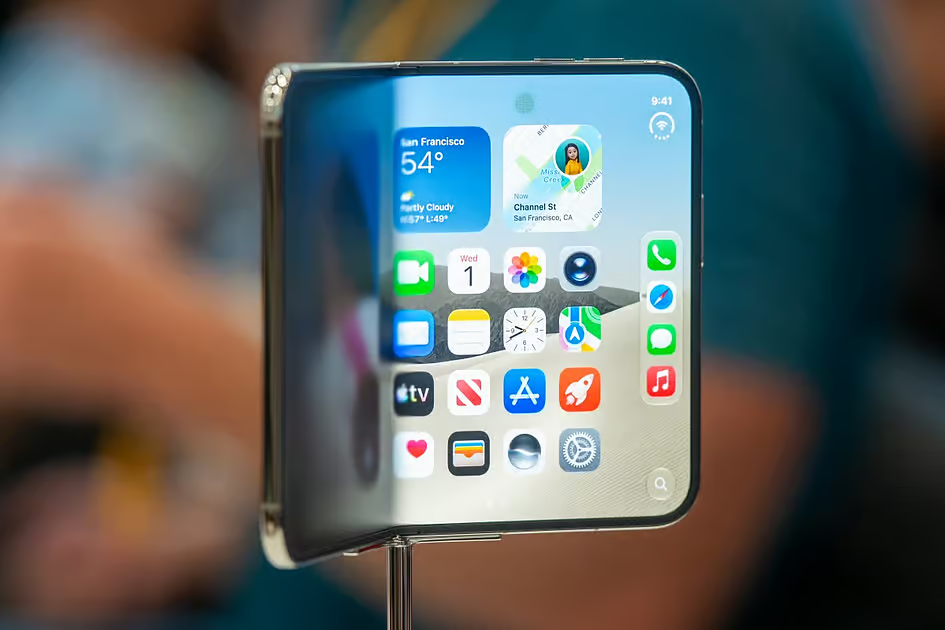
Apple’s first foldable iPhone, priced from Dh8,499 in the UAE, is set to test how far consumers are willing to stretch their budgets for the company’s most premium smartphone yet, while investors assess whether the new device can deliver meaningful growth.
The iPhone Duo, unveiled as part of Apple’s biggest iPhone redesign in a decade, will be available in the UAE from October 23, with pre-orders opening on October 16. The UAE will be among the first markets to receive the device.
Prices start at Dh8,499 and rise to Dh13,599 for the highest configuration, putting the foldable firmly at the top end of the smartphone market.
Stay up to date with the latest news. Follow KT on WhatsApp Channels.
Rayad Kamal Ayub, technologist and managing director of Rayad Group, said the premium should primarily be understood as the cost of Apple’s first foldable design and the engineering required to produce it.
“Much of the underlying AI privacy architecture belongs to iOS 27 and Apple Intelligence rather than being exclusive to the Duo,” he said.
That distinction could be important for consumers deciding whether the new form factor itself justifies the substantial premium over Apple’s conventional high-end iPhones.
Josh Gilbert, lead analyst for APAC and the Middle East at investment platform eToro, said the key challenge for Apple would be converting interest in the new form factor into sales at scale.
“The challenge for Ternus is persuading consumers to spend that money on a new device at scale,” he said, referring to Apple CEO John Ternus. “For the Duo to make a meaningful contribution, it needs to ship in volume. A place in the product line-up alone will not be enough.”
The launch also marks Ternus’ first major product showcase as Apple chief executive, following his succession of Tim Cook.
Apple shares fluctuated during the event before ending broadly flat. Gilbert said the market reaction was relatively positive given that Apple’s stock had already risen by about 40 per cent over the previous 12 months.
“Investors had already bought into the foldable story, so finishing practically flat is a fairly decent result given recent history,” he said. “Ternus has come through his first big test, and the initial market reaction suggests investors are receptive to what Apple’s longstanding hardware leader has delivered.”
High price, high expectations
The iPhone Duo starts at US$1,999 globally and rises to US$3,199 for the highest configuration.
Gilbert said financing and monthly leasing options could reduce the immediate cost for consumers, but the ultimate test would be whether Apple could move beyond its most loyal customers.
The launch comes as Apple seeks to maintain growth in its hardware business while facing higher component costs.
Gilbert pointed to pressure on gross margins in the company’s most recent quarter, alongside rising memory costs, as factors investors will be watching closely.
“The Duo’s engineering does not come cheap. Two displays and extensive miniaturisation add to the cost, while memory prices remain a headache,” he said.
Apple increased the price of the Pro and Pro Max models by US$100, while prices for the existing iPhone 16, 17e, 17 and Air models also rose by US$100, according to the analysis.
“The increases Apple has pushed through look modest against those pressures. That is the concern for margins from here,” Gilbert said.
AI, privacy and what buyers are actually paying for
While the foldable hardware was the centrepiece of the launch, Apple also faced questions over the pace of its artificial intelligence development.
The presentation largely built on Apple Intelligence and Siri developments previously shown in June, with Ternus positioning the iPhone as an intelligent personal hub.
Ayub said one of the more significant aspects of Apple’s AI approach was not simply the processing power of the new device, but how the company divides AI workloads between the device and its cloud infrastructure.
The increased neural-processing capacity allows more AI inference to take place locally, while more demanding requests can be transferred to Apple’s Private Cloud Compute system, he said.
“Local inference reduces the amount of personal data transmitted to external infrastructure, limits cloud retention and lowers exposure to centralised breaches, interception and unnecessary telemetry,” Ayub said.
He said Apple’s combination of local processing with an attested cloud fallback could provide a meaningful privacy advantage, although it should not be treated as an absolute guarantee.
“Apple has an architectural advantage, but not immunity or an uncontested monopoly on private AI,” he said, noting that competitors including Google and Samsung have also adopted combinations of local AI and cloud-based computing.
For consumers, however, the broader AI architecture is not necessarily a Duo-only feature.
Apple’s AI and privacy developments are part of its wider software and Apple Intelligence strategy, meaning buyers are also paying for the physical transformation of the iPhone into a foldable device.
New direction under Ternus
The foldable launch could provide an early indication of the priorities under Ternus, who spent much of his career leading Apple’s hardware development.
“If Cook’s decade was about services, Ternus’ looks set to be about devices and getting more Apple products into more rooms,” Gilbert said.
“But investors are still waiting for a clearer step forward on AI. Apple has put a builder in charge; now the test is whether that hardware expertise can deliver the growth the market expects while competitors accelerate their AI efforts.”
For Apple, the iPhone Duo therefore represents more than the addition of a new form factor to its smartphone line-up.
Its high UAE price will put the focus on whether the company can turn demand for an ultra-premium device into sufficient volumes, while balancing the higher cost of producing a foldable against the need to protect profitability.
Source: Khaleej Times