

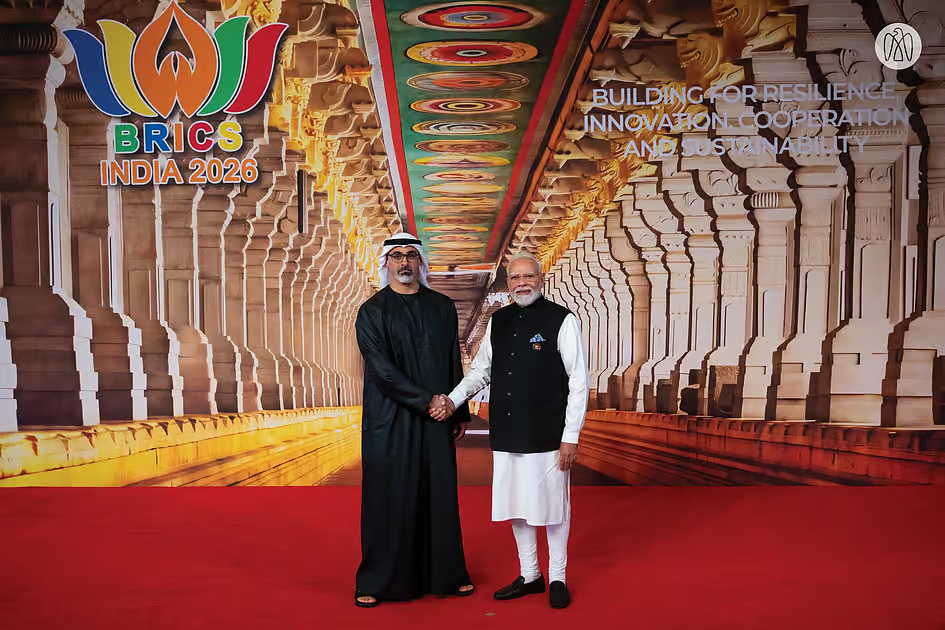
The 18th Brics Summit kicked off in New Delhi on Saturday, bringing together leaders and senior representatives from the world’s major emerging economies, including Sheikh Khaled bin Mohamed bin Zayed Al Nahyan, Crown Prince of Abu Dhabi, who is leading the UAE delegation on behalf of President Sheikh Mohamed bin Zayed Al Nahyan.
Indian Prime Minister Narendra Modi has said that Brics countries have emerged as a major force in the global economy, with member and partner countries together accounting for nearly 50 per cent of the world’s population, 40 per cent of global GDP and more than 25 per cent of international trade.
Speaking at the Brics Business Forum 2026, which kicked off in New Delhi on Saturday, Modi said the combined GDP of Brics countries has grown around 4.5 times since the grouping was established in 2006, compared with around 2.5 times growth in the global economy over the same period. He said the figures reflect the growing economic strength of Brics, which has expanded at nearly twice the pace of the global economy.
Stay up to date with the latest news. Follow KT on WhatsApp Channels.
From four countries to 21
Modi said the grouping, which began with four countries two decades ago, has expanded to include 21 countries, including partner nations. He described Brics as an increasingly important hub for innovation and solutions, ranging from grassroots initiatives to advanced technologies.
The theme of India’s Brics presidency is “Building for Resilience, Innovation, Cooperation and Sustainability.” Modi said India has spent the past 12 years diversifying supply chains and strengthening their reliability across sectors including energy and technology, while expanding infrastructure covering roads, railways, ports and airports.
India is also building capabilities in shipbuilding, semiconductors, quantum technologies, critical minerals and biotechnology. He invited global companies to take advantage of opportunities in the country with the message: “Make in India, innovate with India and scale to the world.”
More than 200,000 startups
Modi highlighted India’s expanding startup ecosystem, saying the country is home to more than 200,000 startups and over 120 unicorns across sectors including artificial intelligence, education, healthcare, green hydrogen, batteries, defence and space.
On financial technology, he said India’s Unified Payments Interface (UPI) accounts for 50 per cent of the world’s real-time digital payments.
India is ready to share its digital experience with other BRICS countries and help innovators develop solutions suited to their respective markets, he added.
Push to remove trade barriers
Modi said India wants to build economic bridges at a time when trade barriers are increasing globally. Since 2014, India has concluded free trade agreements with around 40 countries, he said, adding that its approach within Brics is focused on reducing barriers and creating more opportunities for businesses.
He also announced new cooperation networks covering agriculture, healthcare, skills and smart grids, alongside a Brics incubator network, SME gateway and startup innovation fund aimed at connecting emerging businesses with markets and financing.
Modi called on the Brics Business Council to identify and address the 10 biggest trade barriers among member countries.
He also proposed supporting 100 startups every year to expand into Brics markets and facilitating 1,000 new partnerships between companies across the grouping, with progress to be reviewed annually.
Secure maritime routes key to global trade
Modi stressed that global trade growth depends on secure maritime corridors, uninterrupted supply routes and the safety of seafarers, while reaffirming India’s support for freedom of navigation.
He also highlighted the role of the Brics Women’s Business Alliance, noting that around 200 women entrepreneurs participated in meetings hosted by India.
Modi concluded by calling on Brics countries to turn their ambitions into concrete action and use their collective economic strength to develop solutions that can help drive the global economy forward.
Source: Khaleej Times