

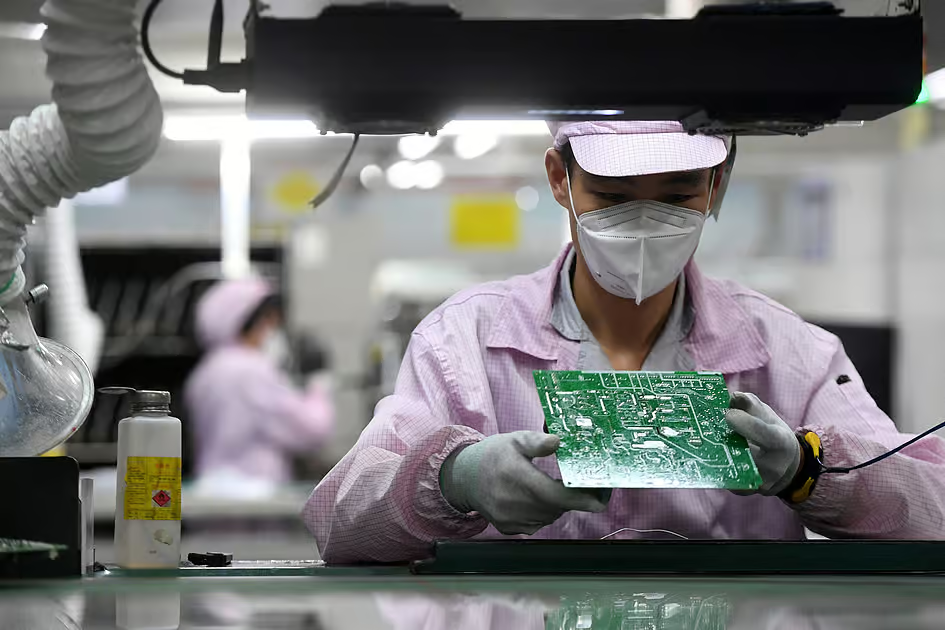
China’s industrial sector showed renewed strength in August as the AI-driven tech boom fuelled factory output, though sluggish consumption and a worsening investment slump reinforced concerns over deepening economic imbalances.
Tuesday’s data highlighted a familiar fault line in the world’s second-largest economy, where resilient manufacturing and exports are sustaining growth even as weak household spending and a property market downturn weigh on domestic demand. The divergence is likely to intensify pressure on Beijing to roll out more support measures as policymakers seek a more balanced recovery.
Industrial output grew 5.2% from a year earlier in August,
quickening from a 4.5% increase in July and beating expectations
for a 4.8% rise, figures released by the National Bureau of
Statistics showed. Strong expansion in equipment and high-tech
manufacturing underpinned the production upturn.
Retail sales, a gauge of consumer activity, rose 0.4%,
slowing from a 0.6% gain in July and below an expected 0.8%
rise.
Weak consumption and the real estate market crisis dragged
second-quarter gross domestic product growth to 4.3%, the
slowest pace in more than three years and below the lower end of
China’s 4.5%-5.0% annual target.
“Barring an unexpectedly strong September, GDP growth will
likely remain sluggish in the third quarter,” said Lynn Song,
ING’s Greater China chief economist.
Oxford Economics lowered its 2026 growth forecast by 0.1
percentage point to 4.7% and cut next year’s to 4.3%, from 4.6%,
“reflecting a more prolonged property downturn which is likely
to keep growth subdued despite stronger public investment,”
senior economist Sheana Yue said.
The data barely moved China’s markets, leaving the key stock
benchmarks down roughly 0.3% while the yuan
weakened slightly against the dollar.
The latest data underscored the scale of the challenge
facing policymakers as businesses remain reluctant to commit new
capital and the property market continues to sap consumption and
restrain growth.
Fixed-asset investment, which includes infrastructure and
property investment, declined 7.2% in the first eight months,
marking the steepest drop since April 2020.
Property investment dived 19.9% in the first eight months
from the same period last year, and new home prices extended
declines from the previous month, signalling a housing market
still trapped in a prolonged downturn.
Against that backdrop, strong exports driven by AI
infrastructure spending and demand for advanced technology
products are providing a critical buffer for growth.
Investment in high-tech industries expanded 5.2% in the
January-to-August period, in keeping with the global AI boom.
Output of lithium-ion batteries and industrial robots, for
example, soared 57.2% and 34.6% year-on-year, respectively.
Behind the divide is a government push to guide resources to
the advanced manufacturing sector to reduce the economy’s
reliance on property and bolster technological self-sufficiency,
but the surge in high-tech investment has yet to translate into
stronger household incomes or greater job security.
The nationwide urban surveyed unemployment rate came in at
5.3% for August, edging up from 5.2% the previous month.
Factory activity improved last month, but it remained in
contraction and services activity stayed sluggish. Weak domestic
demand also weighed on credit growth, as new bank loans returned
to positive territory but fell well short of analysts’ forecasts
after a record contraction in July.
Extreme weather likely remained a drag on activity. Four
typhoons made landfall in China during August, disrupting
operations in the east-coast manufacturing and logistics belt.
Growth also faces mounting external headwinds, including
the Middle East conflict, elevated oil prices and a global
tightening cycle that is keeping borrowing costs high.
“The external environment is complex and challenging, while
domestic structural adjustment pressures persist, meaning
sustained efforts are still needed to put the economy on a
firmer growth trajectory,” Fu Linghui, a spokesperson at the
statistics bureau, told a briefing.
Beijing has responded to the challenges with faster
government bond issuance and expanded loan interest subsidies
for small private firms and consumers, while the central bank
has pledged additional policy support without signalling
explicit cuts to policy rates or banks’ reserve-requirement
ratio.
“Policymakers’ reluctance to deploy a more forceful
consumption-focused stimulus is likely to prolong the adjustment
process,” analysts at Barclays said in a note to clients.
Source: Khaleej Times