

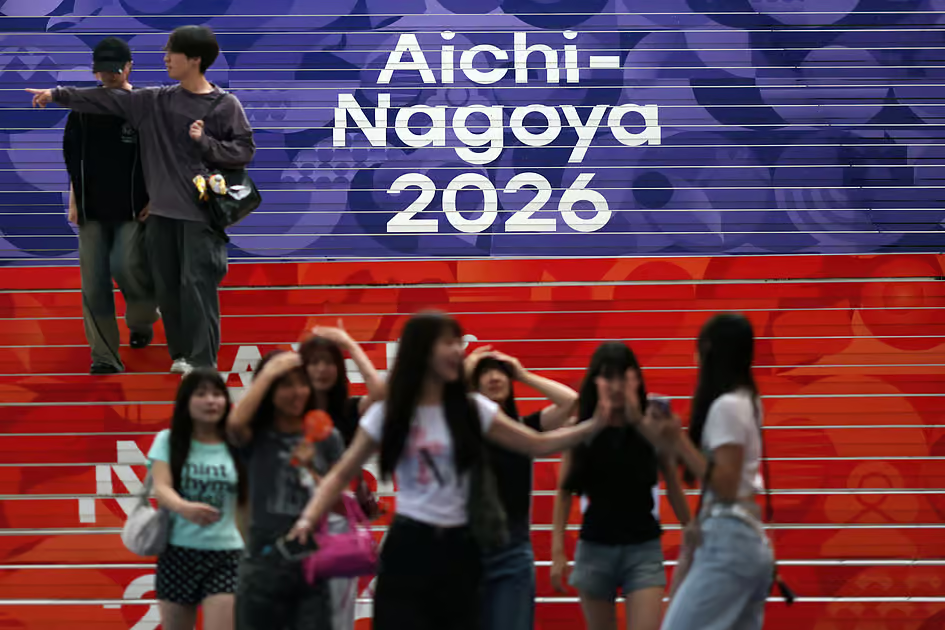
Five years after the Covid-19 pandemic robbed Tokyo of the Olympic party it hoped for, Japan will welcome fans to a major multi-sport event when the 20th Asian Games open in Nagoya on Saturday.
Japan’s third Asian Games, and first since Hiroshima 1994, gives the nation a chance to restore some of the communal sporting experience lost at the Covid-delayed Olympics, when health restrictions barred spectators from almost all events.
Yet the mood may not quite match the enthusiasm Japan had envisaged for the Olympics.
Public interest in the Aichi-Nagoya Games, based in Japan’s industrial heartland, has been muted. Organisers have had to work hard to shift tickets, and torrential rain in the buildup dampened spirits.
Hundreds of athletes and officials had to evacuate their accommodation briefly due to the weather last week while roofs leaked at several competition venues.
There has also been friction between local organisers’ plans for a “simple, streamlined and functional event” versus the grander vision of the Olympic Council of Asia, the quadrennial Games’ governing body.
Organisers had budgeted for about 15,000 athletes and
officials from 45 participating countries and regions, but found
registrations had risen to around 17,000 for the September 19 to
October 4 Games, in part due to the late addition of new sports.
While the Paris Olympics had 329 medal events in 32 sports,
Nagoya’s Games will feature 469 medal events in 43 sports, up
from 40 sports at Hangzhou three years ago.
While cramming more in, Nagoya has also dropped a number of
non-traditional competitions from Hangzhou. Chess, go, xiangqi
and bridge have made way after helping China blow out its medal
tally at Hangzhou to a record 201 golds — 149 better than
second-placed Japan.
Fans of dragon boat racing, roller skating and open water
swimming will miss out in Aichi-Nagoya.
In their place comes an assortment of the contemporary —
mixed martial arts, padel and surfing — along with offbeat
additions like virtual taekwondo and teqball, a ball sport that
combines elements of table tennis and soccer.
Esports will again be a medal event after its Hangzhou debut
and breaking (breakdancing) has been retained, despite the
meme-fuelling Raygun incident at the Paris Games.
Competitions sprawl across Aichi Prefecture and a large
swathe of Japan, with Tokyo hosting the swimming and Osaka among
the venues staging soccer.
Organisers have dispensed with a traditional athletes’
village and instead sought novel solutions to the accommodation
demands.
Thousands of athletes will stay in temporary accommodations,
including wooden containers at Garden Pier and a cruise ship
docked in the bay.
Competition will be fierce in Asia’s traditional strengths
of table tennis, badminton and weightlifting, while athletes
will be competing for Olympic quota spots for the 2028 Los
Angeles Games in archery, hockey, sailing, squash, surfing,
tennis and triathlon.
The Tokyo Aquatics Centre will be laden with global quality
when the swimming launches on Sunday.
The Olympic men’s 100 metres freestyle champion and world
record holder Pan Zhanle leads a strong Chinese squad, though it
might be his 13-year-old teammate Yu Zidi who steals the show.
Filipino tennis player Alex Eala, whose every move on the
WTA Tour has drawn excited crowds of compatriots, will bid for
gold three years after claiming bronze in the singles and
mixed-doubles events at Hangzhou.
Enthusiasm levels for the Games will likely improve among
home fans with a few gold medals. Japan finished third with 20
golds at the Paris Olympics, upstaging Britain, Australia and
hosts France.
Javelin thrower Haruka Kitaguchi, the first Japanese woman
to win Olympic gold in a field event, will lead the hosts’
athletics hopes, while triple Olympic gymnastics champion
Shinnosuke Oka will also be bidding for gold despite battling a
back injury in the buildup.
Source: Khaleej Times