

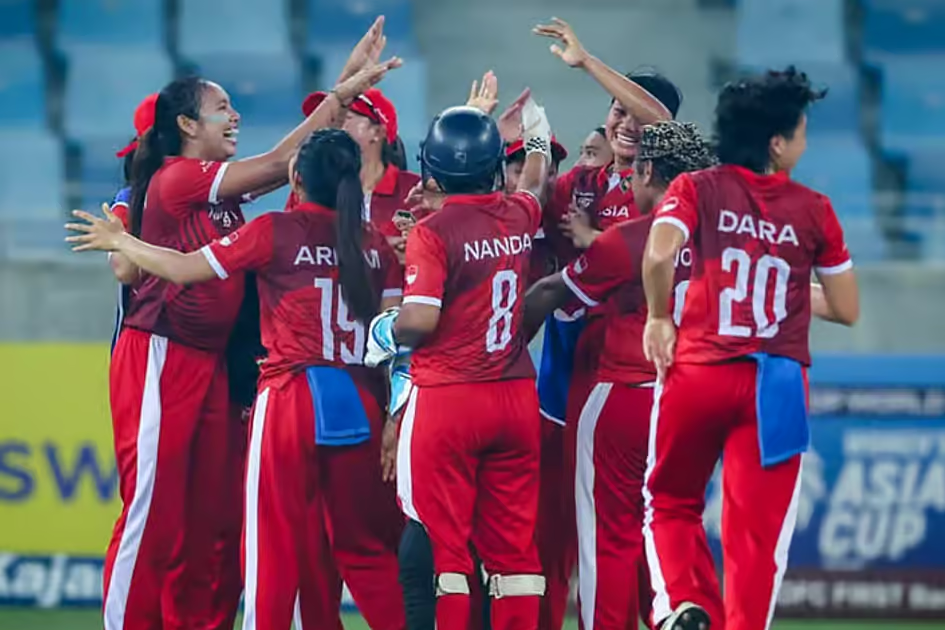
Like millions of young children in Indonesia, Ni Putu Ayu Nanda Sakarini was also obsessed with badminton in school.
Sakarini adored Liliyana Natsir, the former Olympic and world champion who sits elegantly alongside Susy Susanti, Taufik Hidayat and Hendra Setiawan in the pantheon of iconic Indonesian shuttlers.
Sakarini admits to dreaming of becoming a shuttler while she was in school. She played regularly with her friends until one day she saw some other girls play a very different kind of sport in school.
It was cricket, the game of bat and ball she had never heard of before.
But there was something about the sport she liked — the sound of the bat when it hit the ball from the sweet spot, with the batter in an elegant follow-through.
A friend then got her to play cricket, and she took to this new sport like a duck to water.
Then sometime later, Sakarini watched the first international live match on television. It was an India match in which MS Dhoni, the legendary Indian wicketkeeper-batter, pulled off one of his trademark helicopter shots.
The breathtaking stroke, played against the yorker, with Dhoni making room for himself in a split second to hit the seemingly unplayable ball over the leg-side boundary with his strong bottom hand and his bat swing completing a helicopter-like motion over his head, fascinated Sakarini.
From that day onwards, Sakarini had only one dream in her life. She wanted to be an international cricketer and put Indonesia on cricket’s world map.
Last month, Sakarini, 29, made history by captaining Indonesia in the country’s first-ever appearance at the Women’s Asia Cup in Dubai, underlining the slow and steady progress the sport has made in East Asian and South Asian countries like Japan, China, Thailand, Malaysia and Hong Kong, the special administrative region of China that participated independently in international sports events.
Sakarini, when she first fell in love with cricket, thought the sport could get her on a plane to travel around the world.
Now it was a surreal moment for her to be leading her country’s historic Women’s Asia Cup debut in India.
“It’s a big honour for me to be the leader of the national team at the Women’s Asia Cup and set a good example for the junior teams and grassroots cricket in the country,” Sakarini told the Khaleej Times.
Sakarini, who hails from Bali, says Indonesia has organised cricket tournaments in 21 of its provinces, with more than 200,000 registered local Indonesian cricketers.
Unlike in some countries where South Asian expat communities are driving the cricket projects, Sakarini is proud of her country’s success in drawing local Indonesian children to the sport.
“In both men’s and women’s cricket, we have local players, 18 of our provinces are very active in it. It’s becoming more popular in Bali and Jakarta,” she said.
“In terms of infrastructure, it is slowly developing, with provinces gradually building more facilities. We are also hoping to have our first turf ground in the future.”
The International Cricket Council’s efforts to spread the game are beginning to show results, with India’s star batter Shefali Verma even praising Thailand’s bowlers for delivering a superb performance against the strong Indian team at the Women’s Asia Cup.
Thailand, the UAE, Indonesia and Hong Kong China — all associate members of the ICC — qualified for the 2026 Women’s Asia Cup by finishing as the top four teams in the ACC Women’s Premier Cup.
“We didn’t expect to come this far. And it is very inspirational to see the Thailand team. We are from the same region,” Sakarini said.
“I’m very proud because now we are getting the opportunity to play at this level.”
Thailand’s road to the big stage
Unlike Indonesia, which is still trying to find its feet at the highest level, Thailand knows what it takes to trade punches with the top guns in international cricket.
Arguably the best team at associate level, Thailand’s success is built on homegrown Thai players. They hit global headlines in 2020 when they qualified for the T20 Women’s World Cup, a groundbreaking achievement for the Southeast Asian nation.
Since 2012, Thailand have also never failed to qualify for the Women’s Asia Cup and even reached the semifinals in the 2022 edition of the tournament in Bangladesh.
Hunny Singh, the manager of the team at the Asia Cup in Dubai, says Thailand is reaping the rewards of its investment in age-group cricket.
“We have established U19 women’s programmes and domestic competitions to identify and develop young talent. Expanding school participation and creating a larger player base remain important priorities,” he said.
Thailand’s women’s cricket programme, according to Singh, began in 2007.
“The progress has been built through years of dedication, structured training and international exposure. Many players were introduced to cricket through development programmes rather than growing up with the sport,” he said.
“Their commitment, together with the support of the association and coaching staff over the years, has helped Thailand establish itself as a competitive associate nation.
“And our qualification for the 2020 ICC Women’s T20 World Cup was a major milestone and demonstrated what Thailand could achieve despite limited resources.”
But Singh is under no illusion that cricket is already a mainstream sport in the country.
“Women’s cricket in Thailand has grown significantly over the years, particularly through the success of our national team. However, cricket is still a developing sport in Thailand and is not widely played in schools compared to football, volleyball or badminton,” he said.
“Cricket receives limited coverage in Thailand’s mainstream media, and we rely heavily on social media and digital platforms to promote the sport and share our team’s achievements. While awareness is gradually growing, cricket is still unfamiliar to much of the Thai public. Our goal is to build greater visibility, attract more media and commercial support, and inspire the next generation of Thai girls to take up cricket.”
Inspiring the next generation
Hong Kong China, which made its only second appearance at the Women’s Asia Cup this year following its debut in 2012, is also developing the game in schools.
But unlike Indonesia and Thailand, Hong Kong China relies on its expat communities for the growth of the sport.
“Cricket is widely followed among South Asian communities because of their backgrounds, family interests and fandom for countries such as India, Pakistan and Sri Lanka,” said Amna Noor, team manager at the Asia Cup.
But the cricket association, according to Noor, is making every effort to bring local girls to the sport.
“We want more locals to join the team, as it can be one of the ways for local players to learn more about cricket. For instance, Kerry Chan, our former captain, is still playing for the squad. She is quite popular among locals, especially from her time as captain, and she has inspired many young players in Hong Kong who are now playing for the U19 squad,” said Noor.
The senior cricket official hoped that playing against India at the Women’s Asia Cup and later getting an opportunity to interact with stars like Smriti Mandhana, Harmanpreet Kaur and Shefali Verma would inspire Hong Kong China players to keep improving their game.
“It was a proud moment and a valuable learning experience. It helped our girls grow and become more inspired and motivated,” she said.
“They had only seen these players on TV. We hope more girls would love to play cricket and get this opportunity to play big tournaments against top teams in the future.”
Sakarini also fell in love with cricket and became a wicketkeeper-batter after watching Dhoni keep and pull off those incredible helicopter shots with the bat.
For a girl who once wanted to follow in the footsteps of her country’s badminton legends, Sakarini eventually led her country on its historic march to the Asia Cup.
It may seem like a small step to many, but this was a giant leap for a team made up of local Indonesian girls.
These Indonesians should be as much an inspiration for Hong Kong China as the Mandhanas and Harmanpreets.
Source: Khaleej Times