

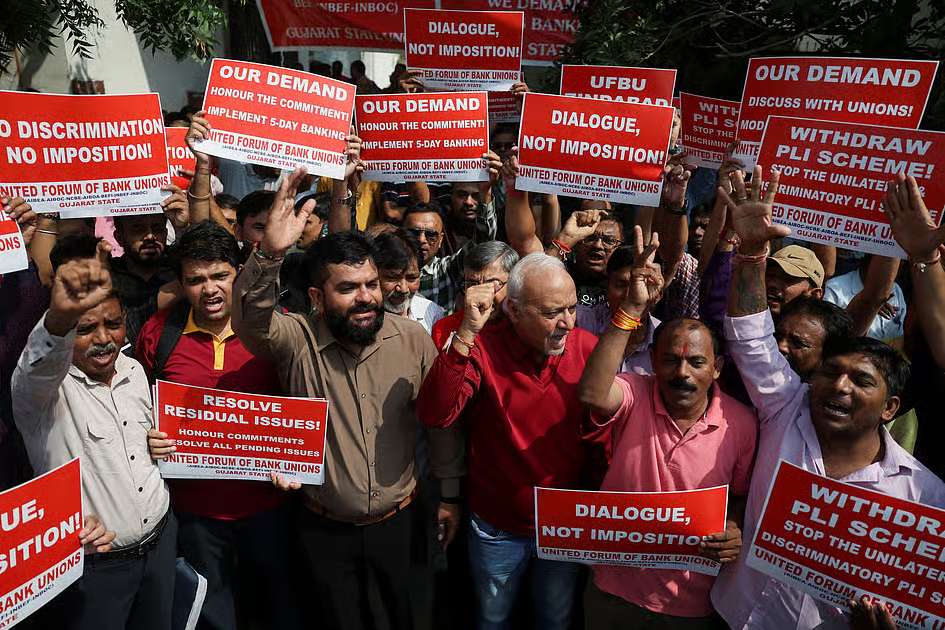
Banking services in India could face disruption for three days from September 28 to 30, after the United Forum of Bank Unions (UFBU) called a nationwide strike over its demand for a five-day working week.
The five-day banking proposal has been under consideration for more than two years after the Indian Banks’ Association (IBA), a representative body of banks in India, agreed to the demand and sent it to the government for approval.
For Indians living in the UAE, the main concern is whether the strike could affect money transfers back home, payments, withdrawals or banking services linked to accounts held with Indian banks. Here’s what customers need to know.
Stay up to date with the latest news. Follow KT on WhatsApp Channels.
Why have Indian bank unions called for a strike?
The UFBU, an umbrella body representing bank employee unions, and other associations in public sector banks, supported by regional rural banks, called for the strike primarily seeking implementation of a five-day banking week and withdrawal of the Performance Linked Incentive (PLI) scheme.
The Indian government said it had already decided to keep the PLI scheme in abeyance after discussions with the unions, thereby addressing one of their two principal demands. Despite several rounds of conciliation, a one-day strike was held on September 11, while a three-day strike has been scheduled from September 28 to 30. An indefinite strike has also been proposed from October 26 over the remaining demand for a five-day workweek.
At present, Indian bank branches are closed on the second and fourth Saturdays but generally operate on the first, third and fifth Saturdays, where applicable. The unions want all Saturdays to become holidays.
The unions’ other major demands include income tax exemption on the additional 4 per cent contribution made by banks to the National Pension System (NPS), a higher gratuity ceiling under the Gratuity Act, updation of pensions, a uniform Dearness Allowance (DA) on pensions, and a revision of the ex-gratia payment for pensioners effective from November 2022.
How will it affect banking operations?
Branch-based services are expected to be disrupted at public sector banks and regional rural Banks, which are directly covered by the strike call. Private-sector banks are not expected to be affected in the same way, but it is advised that customers should check with their banks.
The Indian government said the September 28-30 strike would coincide with the half-yearly closing of banks on September 30, which is significant for reconciliation, provisioning, and treasury and market operations.
It said the strike, together with the preceding weekend, could effectively result in a five-day closure of banking services, affecting customers, businesses, government transactions and international banking operations.
To provide an additional banking day before the strike, the Finance Ministry has said public sector banks and regional rural banks will operate on Sunday, September 27, with RBI approval for branches, offices, ATM-linked branches and currency chests to remain operational.
What NRIs in UAE need to know
Public sector banks have issued advisories urging customers to complete essential banking transactions in advance and to use digital services where possible to avoid inconvenience during the three-day strike.
Remittances from the UAE to India will not be disrupted by the strike. Al Ansari Exchange has said that their operations supporting remittances to India will continue as normal, while customers can use their digital channels 24/7 or visit their branches across the UAE during regular operating hours.
UAE is India’s second-largest source of remittances, accounting for 19.2 per cent of inward remittances reported by banks, according to Ali Al Najjar, CEO of Al Ansari Exchange.
Digital access to an account may continue, but services requiring a physical branch or employee intervention could be impacted.
What has the Indian government done for bank employees welfare?
Measures taken for the welfare of bank employees, including salary and allowance increases, expansion of executive posts and recruitment. Public sector banks recruited around 4.82 lakh employees between FY2014-15 and FY2025-26, with recruitment doubling over the last three years, it said. As of July 1, 2026, 95.84 per cent of officer positions and 92 per cent of subordinate/award staff positions were filled.
Other measures include improved transfer and promotion processes, special leave provisions for women employees, revised family pensions, enhanced medical insurance for retirees and higher conveyance allowance for employees with disabilities.
The government has also begun negotiations for the upcoming Bipartite Settlement ahead of the November 2027 deadline, saying the move is aimed at ensuring timely revision of bankers’ salaries and allowances.
The government said the remaining demand for a five-day workweek continues to be examined and urged employees to ensure uninterrupted banking services while resolving the issue through constructive engagement.
[With ANI inputs]
Source: Khaleej Times