

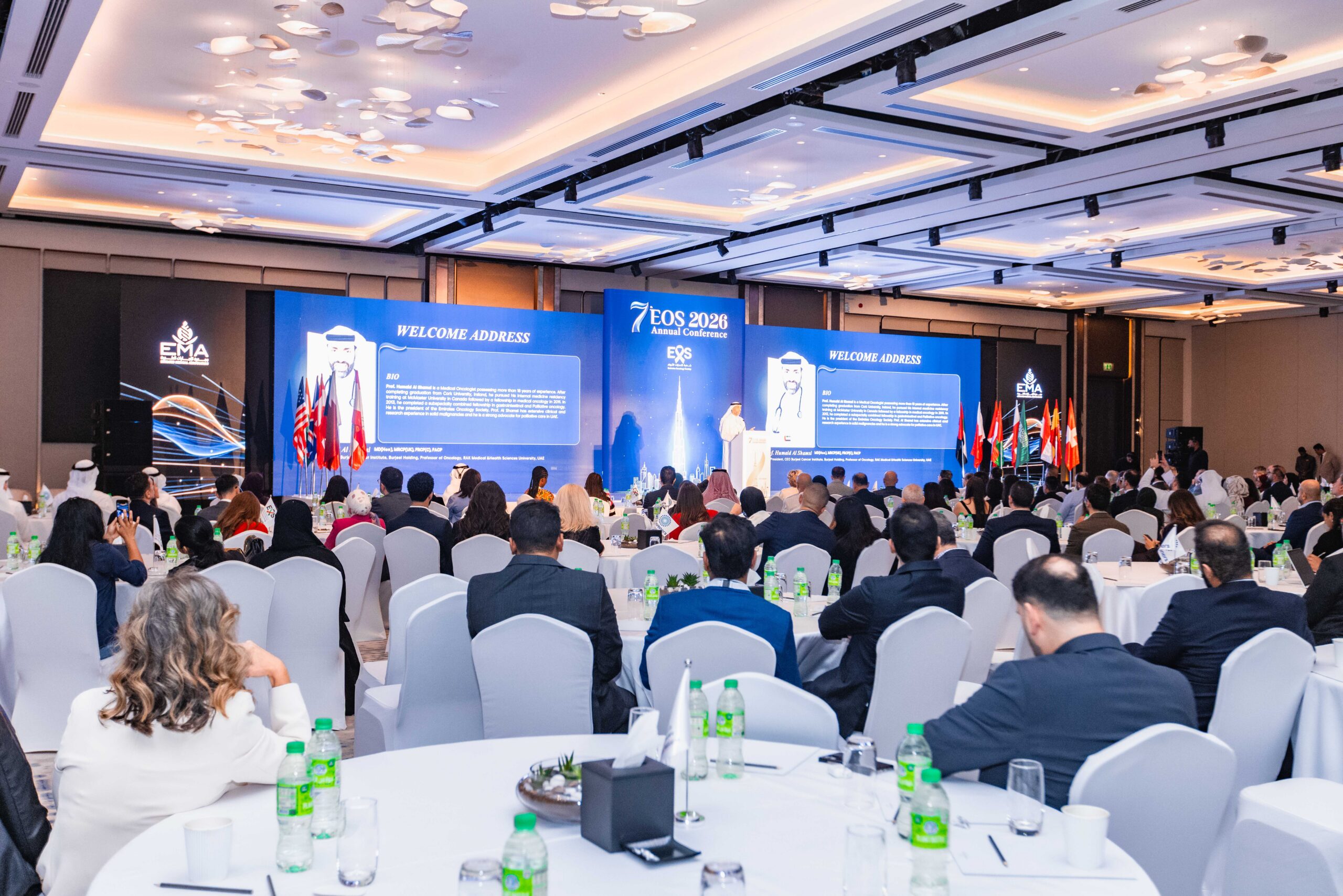
DUBAI, 3rd October, 2026 (WAM) — The 7th Emirates Oncology Society Annual Conference (EOS 2026), a member of the Emirates Medical Association, opened today, Saturday, in Dubai. The two-day conference is bringing together more than 800 doctors, specialists and researchers from 20 countries, along with 60 speakers from the UAE and various countries around the world.
The conference brings together leading local, regional and international oncology experts across a wide range of specialties as part of a scientific programme featuring seven main scientific sessions, more than 40 specialised lectures and discussions, and five workshops.
The programme aims to highlight the latest developments in cancer diagnosis and treatment, discuss scientific evidence and modern clinical practices, and explore the rapidly evolving advances in targeted therapies, immunotherapy and precision medicine.
The scientific programme of the seventh edition covers a broad range of oncology specialties, including breast cancer, genitourinary cancers, lung cancer, gastrointestinal cancers, gynaecological cancers, liver cancer, precision oncology and palliative care, in addition to specialised sessions and workshops examining the latest treatment strategies and innovations in cancer care.
Prof. Humaid Al Shamsi, President of the Emirates Oncology Society and Chair of the Conference, said: “The Emirates Oncology Society Annual Conference continues to serve as a scientific platform that brings together local, regional and international expertise and provides an opportunity to exchange knowledge and discuss the latest developments in cancer diagnosis and treatment.
In its seventh edition, we are focusing on translating the latest scientific evidence into clinical practice and strengthening collaboration across different disciplines, contributing to the advancement of the quality of care and improving treatment outcomes for cancer patients. We are also highlighting the role of artificial intelligence in data analysis and in supporting physicians in making precise medical decisions tailored to each patient.”
The first day of the conference featured a strong focus on the latest developments in breast cancer, with sessions discussing the latest approaches to the treatment of early and advanced breast cancer, developments in targeted therapies and antibody-drug conjugates (ADCs), as well as strategies for patient selection and treatment sequencing.
Experts also discussed therapeutic advances relating to different types of breast cancer, including modern treatment algorithms for hormone receptor-positive (HR+) breast cancer, HER2-positive breast cancer and triple-negative breast cancer, alongside the latest approaches in breast cancer surgery and the management of axillary lymph nodes.
The Innovation in Oncology session featured a keynote presentation on circulating blood biomarkers in breast cancer, a lecture on KRAS in oncology, and another on the role of social media in oncology. The session also featured a discussion on the integrated healthcare system and the link between the global vision for cancer care and the local impact of screening programmes, with the participation of Prof. Humaid Al Shamsi and a number of experts and specialists. The discussion addressed the importance of integration between advances in cancer care and screening and early detection programmes.
During the first day, participants also discussed the latest developments in genitourinary cancers, including kidney, bladder and prostate cancers. Experts reviewed advances in modern therapies, challenges in the management of bladder cancer, and the role of PARP inhibitors and homologous recombination repair (HRR) mutations in applying the principles of precision medicine to cancer treatment.
The sessions also included specialised discussions on modern treatment algorithms for bladder cancer, prostate cancer and renal cell carcinoma, with the participation of local and international experts, providing an opportunity to exchange experience on how the latest scientific evidence and research findings can be translated into clinical practice.
The conference is also hosting a series of workshops and parallel sessions that allow for more specialised discussions of clinical cases and treatment strategies, including workshops on hormonal therapy for advanced HR+/HER2- breast cancer and advances in the treatment of ovarian cancer.
The conference is also dedicating significant attention to the rapidly evolving developments in immunotherapy, targeted therapies and precision medicine, which are playing an increasingly important role in designing treatment plans according to the biological and molecular characteristics of each tumour.
The programme includes a specialised session on the latest developments in the treatment of hepatocellular carcinoma (HCC), covering the principles of disease management, the role of dual immunotherapy, and how to select the optimal immunotherapy regimen in the first-line setting, in addition to a panel discussion bringing together a number of medical oncologists and specialists.
Source: Emirates News Agency