

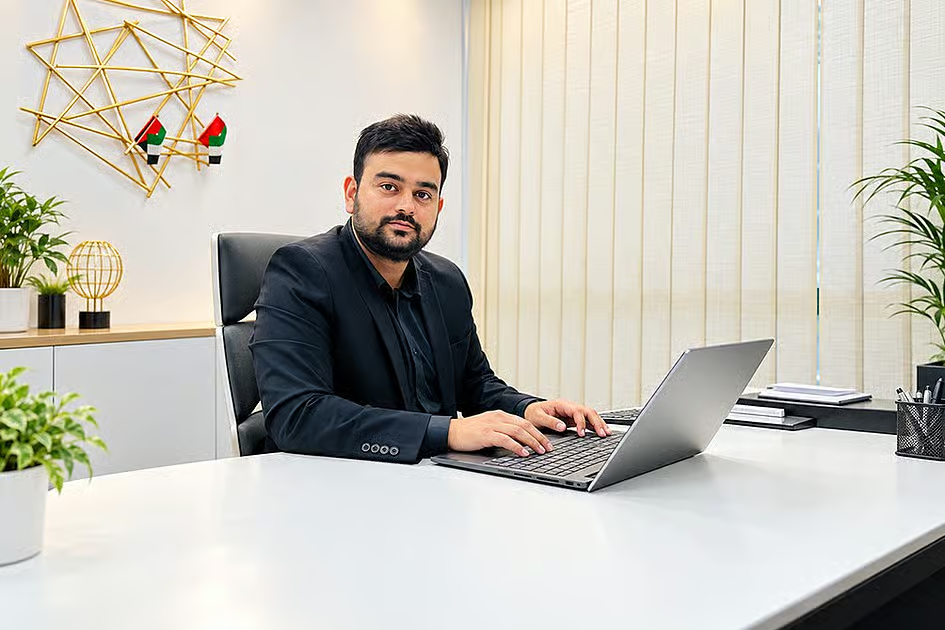
As Faateh Group expands into student accommodation, its managing director and co-founder explains why real estate growth in uncertain times is less about avoiding risk and more about choosing the right one
For Adil Faridi, uncertainty has never been a reason to stand still. The managing director and co-founder of Faateh Group has built his career around taking calculated risks, accepting challenges early and moving towards demand before the opportunity becomes obvious.
Faridi’s own journey in Dubai began in 2015, when he arrived with limited resources, no established network and first-hand experience of how difficult it could be to find affordable, well-managed accommodation. He began in telecom sales before eventually moving into entrepreneurship and real estate.
That experience continues to shape the way he looks at business today. “The biggest risk in business is not uncertainty. It is failing to adapt when the market is telling you what it needs,” Faridi said.
It is a philosophy that feels particularly relevant now.
Regional geopolitical tensions have created periods of caution across Gulf markets and tested investor sentiment, including in real estate. Reuters has reported pressure on property confidence following regional conflict, even as Dubai Land Department data continued to show strong transaction and rental activity during 2026.
For Faridi, the response is not to ignore uncertainty, but to build around fundamentals. Real estate, in his view, becomes more resilient when it is driven by actual demand: people who need somewhere to live, businesses that require managed accommodation and investors looking for assets that can maintain occupancy and generate long-term value.
That thinking has helped shape Faateh Group’s evolution from a real estate business into a broader operating ecosystem spanning property management, leasing, investment solutions, interiors, maintenance, project management and accommodation.
The group’s latest move may be its clearest example yet. Through Homeleez, Faateh Group is expanding its focus on flexible accommodation into the student segment, offering furnished, affordable and community-oriented housing designed for students, expatriates and young professionals.
At a time when some businesses may choose to become more conservative, Faateh is moving in the opposite direction, but selectively.
Student accommodation is not simply another property category for Faridi. It represents a shift towards a demand-led model built around affordability, convenience, occupancy and community.
It also brings his story full circle. The entrepreneur who once struggled to find suitable accommodation after arriving in Dubai is now helping build housing solutions for people beginning their own journey in the city.
For Faridi, that is what calculated risk ultimately looks like. “Not betting on certainty. Betting on a need that will still exist when the noise settles,” Faridi said.
Source: Khaleej Times