

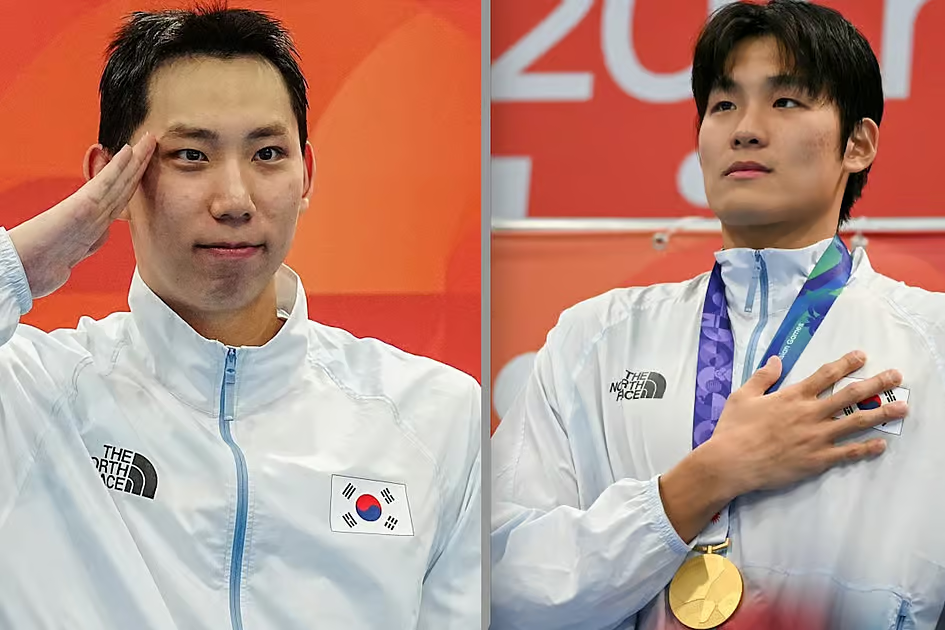
Winning an Asian Games gold medal can bring a South Korean athlete more than sporting glory. For decades, sports has also offered a route out of the country’s regular mandatory military service.
But the long-standing privilege is now facing renewed scrutiny after South Korea’s men’s football team won gold at the 2026 Asian Games and several players made comments celebrating their military exemptions.
The backlash has reached the government, with both the defence and culture ministries saying the system should be reviewed and could ultimately be scaled back or abolished.
So who actually qualifies, does an athlete completely avoid military duty and why has the system become so controversial?
Stay up to date with the latest news. Follow KT on WhatsApp Channels.
Who has to serve in South Korea’s military?
Military service is mandatory for most able-bodied South Korean men. They generally serve between 18 and 21 months, depending on the branch of the armed forces.
The system remains a major part of life for young men in the country, which technically remains at war with North Korea because the 1950-53 Korean War ended with an armistice rather than a peace treaty.
Most men are expected to begin their service by the age of 28, although some can receive limited deferments.
Which athletes can avoid regular military service?
Under the current system, South Korean athletes can qualify for alternative service if they win a gold medal at the Asian Games or any medal, gold, silver or bronze, at the Olympic Games.
The programme dates back to 1973 and was designed to recognise athletes and artists whose achievements were considered to enhance South Korea’s national prestige.
That means an athlete who finishes second at the Asian Games does not qualify, while an Olympic bronze medallist does.
The rule has made Asian Games gold medals particularly valuable for male South Korean athletes who have not yet completed their service.
Are athletes completely exempt?
Not exactly. Although the system is commonly described as a military exemption, qualifying athletes do not simply walk away from all obligations.
Instead of serving the regular 18 to 21 months, they are registered as arts and sports personnel. They must complete three weeks of basic military training and 544 hours of community service over 34 months.
During that period, they are also expected to continue working in their professional field. The benefit therefore allows elite athletes to continue their careers without the long interruption caused by regular military service.
Who received the benefit at the 2026 Asian Games?
Several high-profile South Korean athletes qualified this year. Golfer Kim Joo-hyung, widely known as Tom Kim, secured the benefit after winning the men’s individual golf gold medal.
South Korea’s men’s football team also defeated Japan 1-0 in the final, leaving 20 of its 23 players eligible for supplementary service. Sixteen baseball players and three esports competitors also qualified after winning gold, according to reports.
Government data released this week shows just how significant the Asian Games have become as a route to the benefit. Of 80 athletes incorporated into the sports personnel system between 2022 and August 2026, 65 qualified through Asian Games gold medals. The remaining 15 qualified through Olympic medals.
Why did the latest controversy start?
The debate intensified after comments made by members of South Korea’s gold medal-winning football team.
Yang Min-hyeok said after the final that the medal and championship were not what mattered most to him and that he had played with the military service benefit in mind.
Captain Lee Gi-hyuk also held up his medal and said he would not be going to the military. Another player, Park Seung-soo, posted a photograph of himself wearing a cap associated with people who have completed their military service.
The players later apologised, but their comments triggered criticism from politicians and members of the public who argued that they appeared to make light of an obligation faced by millions of other South Korean men.
Why is the system considered unfair by some?
The controversy goes beyond what the footballers said. Critics have long questioned why success in certain sporting events should allow someone to avoid regular military service while achievements in other fields do not.
The debate has often included comparisons with BTS, one of South Korea’s most internationally successful cultural exports.
Despite years of debate over whether the K-pop group should receive special treatment because of its contribution to South Korea’s global influence, all seven members completed or began completing their military duties.
Critics argue that the concept of “national prestige” has become increasingly difficult to apply consistently.
There are also demographic concerns. South Korea’s shrinking birth rate means fewer young men are available for military service, increasing pressure to review alternative service programmes.
Could the rules now change?
Yes. South Korea’s defence ministry said this week that it is considering reducing or abolishing supplementary service programmes, including the system for athletes and artists.
The ministry said fairness, the shrinking pool of people available for military service and public opinion would be considered.
Culture, Sports and Tourism Minister Chae Hwi-young also told lawmakers on Wednesday that his ministry would review the system with the defence ministry and the Military Manpower Administration.
He acknowledged that the programme had helped talented athletes and artists continue developing their careers, but said public perceptions of military service and fairness had changed considerably.
No final decision has been announced.
Would current gold medallists lose their exemption?
There has been no announcement suggesting that athletes who have already qualified under the current rules will lose the benefit.
The government’s discussion is focused on how the system should operate in the future. That means the latest Asian Games champions remain eligible under the existing rules unless authorities announce otherwise.
But the controversy surrounding their victories could ultimately change what winning gold means for the next generation of South Korean athletes.
For decades, an Asian Games gold medal has offered some athletes a way to continue their careers without spending up to 21 months in regular military service.
Now, amid changing views on fairness and a shrinking pool of military recruits, South Korea is asking whether sporting success should still come with that reward.
Source: Khaleej Times