

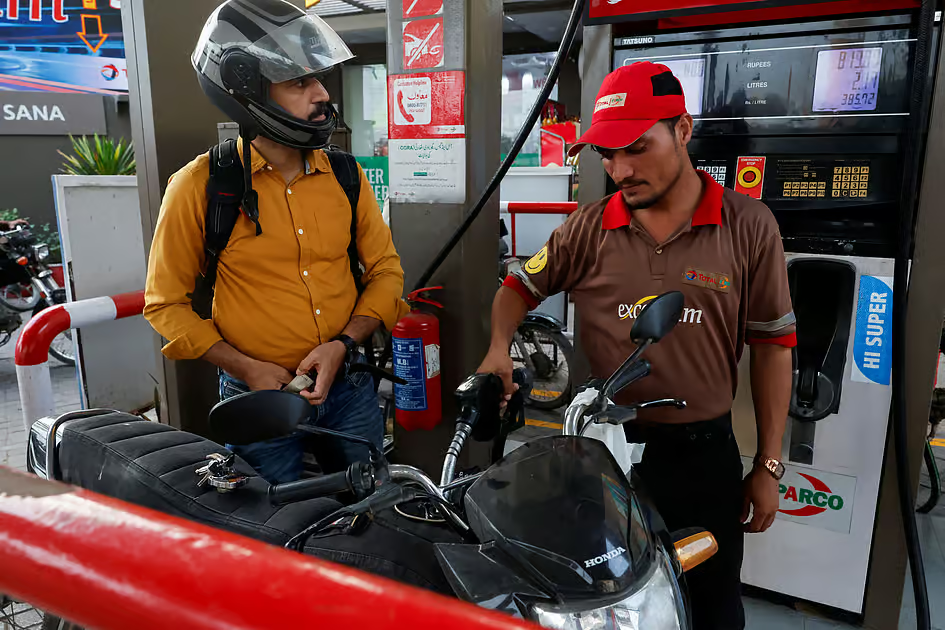
The International Monetary Fund (IMF) has urged Pakistan to phase out its fuel support scheme, citing its high cost and broad coverage, and called for any future assistance in response to rising oil prices to be temporary and targeted at vulnerable households.
The fund said such support should be channelled through existing social assistance programmes and accommodated within the fiscal year 2026-27 budget.
Pakistan introduced fuel support measures to cushion consumers from the impact of rising international oil prices, which have increased pressure on household budgets and transport costs.
The recommendation came as the IMF completed its 2026 Article IV consultation with Pakistan and reached a staff-level agreement on the fourth review of the country’s $7 billion Extended Fund Facility (EFF) and the third review of its Resilience and Sustainability Facility (RSF).
Stay up to date with the latest news. Follow KT on WhatsApp Channels.
Subject to approval by the IMF Executive Board, Pakistan will receive about $1 billion under the EFF and $210 million under the RSF, bringing total disbursements under the two programmes to approximately $5.7 billion.
The IMF also stressed the need for Pakistan to maintain exchange rate flexibility to absorb external shocks, gradually liberalise its foreign exchange regime and build reserves.
It said a flexible exchange rate would help the economy withstand geopolitical tensions, volatile energy prices, tighter global financial conditions and trade disruptions.
“Further reserve accumulation, gradual liberalisation of the foreign exchange regime, and deeper domestic financial markets will strengthen resilience and support private sector development,” the fund said.
Pakistan’s foreign exchange reserves reached $26.8 billion on October 2, 2026, up from $15.5 billion in 2021-22. The increase has helped support the Pakistani rupee, which was trading at 75.5 against the UAE dirham and 277.5 against the US dollar. The currency has remained broadly stable since early 2024, gaining slightly against both.
Energy sector reforms
The IMF said timely tariff adjustments and cost-reduction measures were essential to prevent a renewed accumulation of circular debt in Pakistan’s energy sector while protecting vulnerable consumers.
Priorities include improving operational efficiency, encouraging private-sector participation in electricity distribution, increasing competition in electricity markets, maintaining cost recovery in the gas sector and reducing unaccounted-for gas losses.
The fund also highlighted the need to strengthen climate resilience through reforms supported by the RSF. Progress includes incorporating climate considerations into public investment planning and improving disaster risk financing and coordination.
Further measures include reforms to irrigation water pricing and collection, better-targeted electricity subsidies, stronger energy-efficiency standards and transport decarbonisation.
The IMF said deeper structural reforms were needed to shift Pakistan’s economy towards higher-value-added activities and narrow the gap with peer countries.
These include strengthening competition, reducing regulatory and trade barriers, advancing privatisation, improving governance and transparency at state-owned enterprises, and reinforcing anti-corruption institutions.
A simpler tax system, greater investment in human and physical capital, a more cost-efficient energy sector and deeper financial markets would help boost productivity, create jobs, increase labour force participation and encourage private investment and exports.
Inflation and economic growth
Pakistan has maintained broad economic stability despite the impact of the Middle East conflict, supported by policies implemented under the IMF programme.
Real gross domestic product (GDP) grew by 4 per cent during the first three quarters of fiscal year 2025-26, while full-year growth is estimated at 3.6 per cent. Higher energy prices and supply disruptions, however, have weakened economic momentum.
Headline inflation eased to around 10.3 per cent in September after peaking in May, while core inflation remained contained, according to the IMF.
The fund said sovereign credit rating upgrades and renewed access to international markets reflected stronger policy credibility. However, it warned that risks remained elevated because of geopolitical tensions, energy price volatility, tighter global financial conditions and trade disruptions.
The IMF urged Pakistan to implement its 2026-27 budget consistently, targeting an underlying primary surplus of 2 per cent of GDP to put public debt on a sustainable downward path.
Tax policy changes and improvements in revenue administration will be critical to meeting fiscal targets. Proposed measures include risk-based audits, digital invoicing and greater use of third-party data to improve compliance.
The fund also called for a comprehensive medium-term tax reform strategy to make the system fairer, simpler and more supportive of economic growth while protecting government revenues.
Pakistan is working to improve public financial management, including budget transparency, public investment, procurement and government cash management. The IMF said reducing debt rollover risks and borrowing costs would remain important given the country’s substantial financing needs.
Higher spending on health and education
The IMF said Pakistan had reversed the long-term decline in health and education spending, with expenditure rising from 2.2 per cent of GDP in 2024 to 2.5 per cent in 2026.
The authorities aim to increase this to 2.8 per cent of GDP in 2027, with implementation closely monitored and resources reallocated where necessary.
Planned increases in targeted cash transfers, wider beneficiary coverage and improvements to payment systems are expected to strengthen support for vulnerable households.
Source: Khaleej Times