

The UAE’s non-oil economy is forecast to grow by 6.1 per cent in 2027 after contracting this year, Fitch Ratings said, as global institutions expect economic activity across the Gulf to recover following the disruption caused by the US-Iran conflict.
The ratings agency expects the UAE’s non-oil economy to contract by 3.7 per cent in real terms in 2026 before rebounding next year. Growth is then forecast to reach 4.3 per cent in 2028, although this would remain below the average recorded between 2022 and 2025.
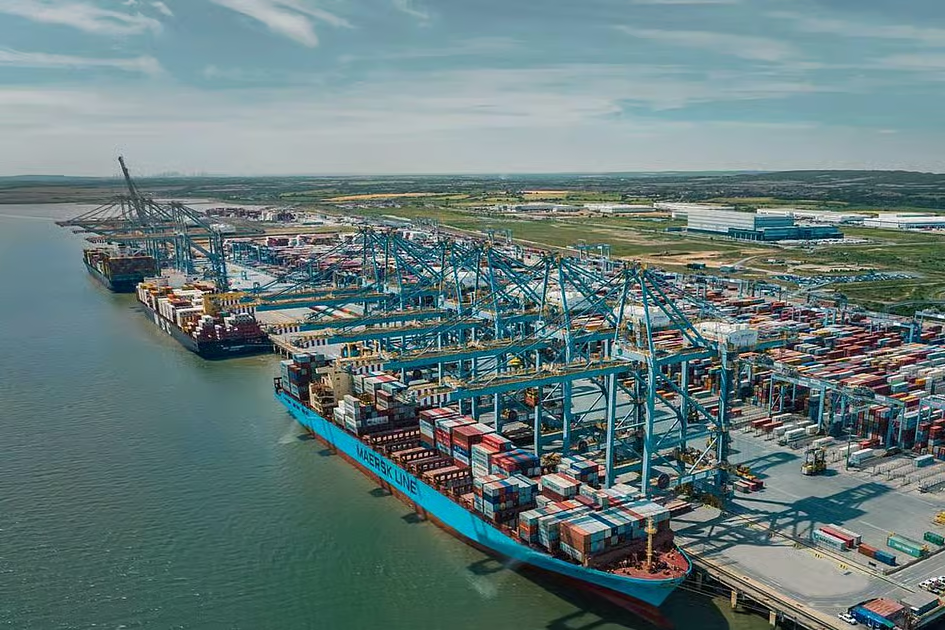
The outlook comes as the conflict disrupts shipping through the Strait of Hormuz, affects energy production and weighs on trade, tourism and investment across the region.
Stay up to date with the latest news. Follow KT on WhatsApp Channels.
GCC economy set to rebound
The Gulf Cooperation Council (GCC) economies are expected to contract by 4.3 per cent in 2026, compared with growth of 4.5 per cent in 2025, according to the World Bank’s October Middle East, North Africa, Afghanistan and Pakistan (Menaap) Economic Update.
However, economic activity is expected to rebound in 2027 to 10.3 per cent as hydrocarbon production and exports gradually recover. The UAE’s economy is projected to recover 9.5 per cent after contracting 1.6 per cent this year, as per the report.
It attributed the downturn to sharp reductions in hydrocarbon production and exports following the closure of the Strait of Hormuz, alongside the impact on tourism, logistics and aviation.
The regional outlook assumes the conflict continues through the end of 2026 without a sustained further escalation, with conditions gradually normalising from early 2027 as production recovers and shipping routes reopen.
Non-oil economy
Fitch said the UAE’s non-oil economy has benefited from its position as a hub connecting Asia and Europe, supported by a favourable operating environment, government policies and its ability to attract foreign workers and visitors.
The agency expects further measures to improve the business environment, including smoother administrative procedures for companies and residents. Higher spending and financial support at the government and government-related entity levels could also support economic activity.
However, prolonged regional insecurity could undermine the UAE’s logistical advantages and its appeal as a commercial and financial centre and tourism destination, Fitch warned.
Disruptions to the Strait of Hormuz could complicate logistics, while security risks could affect the country’s ability to attract foreign companies and residents. The UAE’s reliance on foreign workers is also a key vulnerability for its non-oil growth model, the agency said.
Fitch added that the UAE’s sovereign credit rating of AA- with a Stable outlook, and Abu Dhabi’s AA rating with a Stable outlook, are supported by the emirate’s exceptionally strong balance sheet. The ratings appear resilient to developments in the non-oil economy, given the UAE’s light taxation.
For Ras Al Khaimah, rated A+ with a Negative outlook, the pressures are greater because anticipated improvements in economic growth and fiscal metrics depend heavily on tourist arrivals, Fitch said.
Source: Khaleej Times