

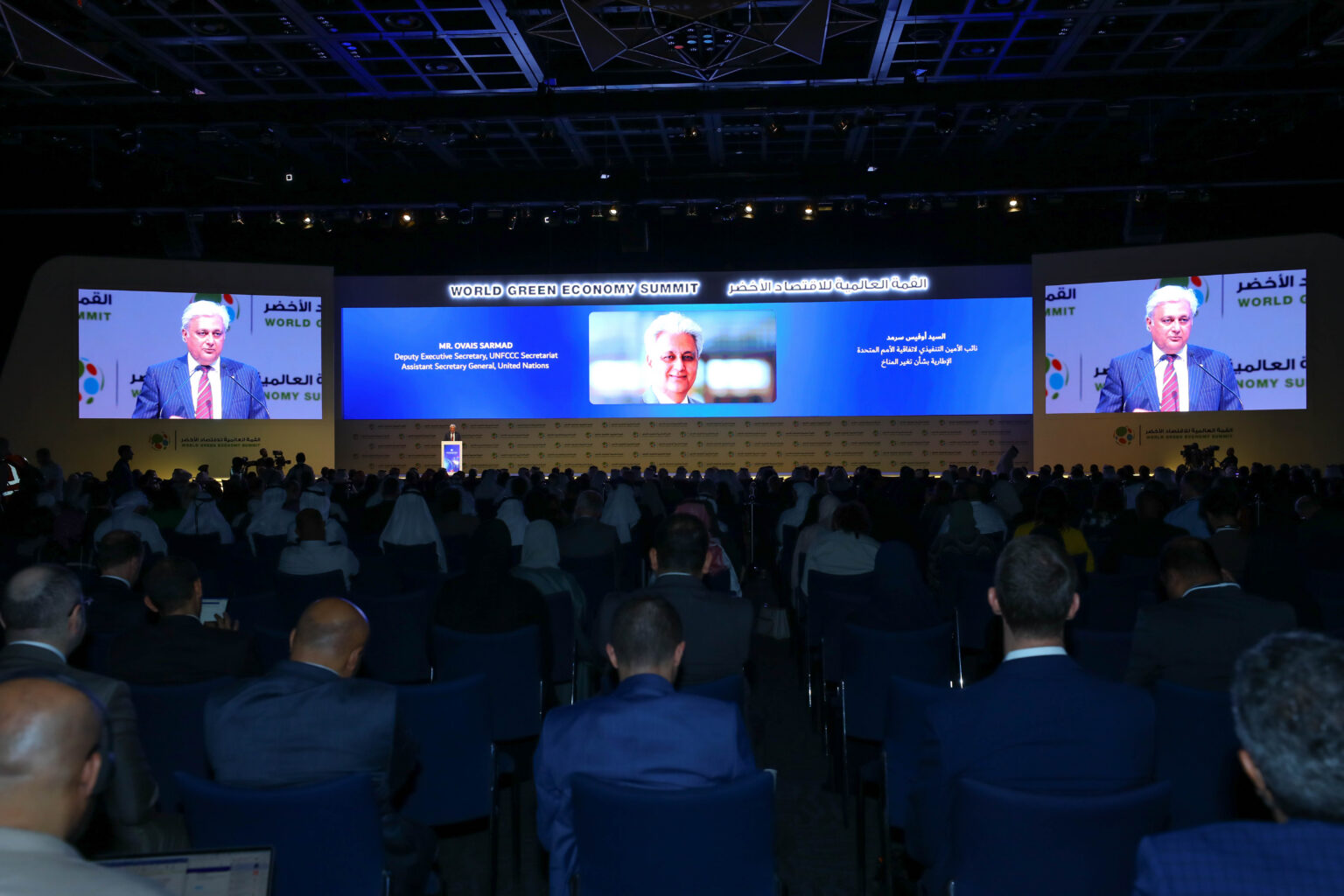
DUBAI,18th October, 2026 (WAM)– Under the patronage of His Highness Sheikh Mohammed bin Rashid Al Maktoum, Vice President, Prime Minister and Ruler of Dubai, the Dubai Supreme Council of Energy, Dubai Electricity and Water Authority (DEWA) and the World Green Economy Organisation (WGEO) will organise the 12th World Green Economy Summit (WGES) on 21st and 22nd October 2026 at the Dubai World Trade Centre.
The summit will bring together officials, decision makers, infrastructure developers, business leaders, resilience experts and project financiers to highlight experiences that have proved successful and the factors needed to scale them.
This year’s theme, ‘From Success to Scale: Showcasing the Green Economy’, carries practical significance that goes beyond celebrating success stories. Technologies that were experimental a few years ago have developed into large commercial projects in solar and wind power, batteries, electric vehicles and energy efficiency, while other solutions are rapidly moving towards economic viability at greater scale. At this stage, the key questions concern speed of implementation, cost of capital, infrastructure readiness, policy maturity, the availability of skills and supply chains, and the ability of successful projects to attract the financing required to replicate them across different markets. The World Economic Forum (WEF) notes that, on average, companies generating revenues from green markets are seeing those revenues grow twice as fast as those from conventional business lines. Companies with green revenues also typically benefit from a lower cost of capital, while those generating more than half their revenues from green markets often enjoy valuation premiums of 12% to 15% in capital markets, reflecting investor confidence in their long-term resilience and sustainable profitability.
“The world today has a substantial base of successful models and viable solutions that have demonstrated their ability to support economic development, reduce emissions and enhance resource efficiency. The priority for the next phase is to scale these solutions and accelerate their implementation by strengthening partnerships between governments, the private sector and financial institutions, and developing regulatory and financing frameworks that stimulate investment and enable innovations to be transformed into practical, scalable projects. The UAE and Dubai demonstrate how visions and strategies can be translated into tangible projects and achievements. WGES 2026 provides a global platform for exchanging expertise and connecting capital with technology and promising projects, supporting the development of a greener economy that is more resilient, competitive and sustainable,” said Saeed Mohammed Al Tayer, Vice Chairman of the Dubai Supreme Council of Energy, MD & CEO of DEWA and Chairman of WGEO.
Al Tayer noted that the global green economy has surpassed USD 5 trillion in annual value, making it one of the world’s fastest-growing sectors after technology, while projections indicate that its value will exceed USD 7 trillion by 2030. At the same time, the pace of climate finance remains well below the level required to match stated ambitions. This shifts the priority from demonstrating that green solutions can succeed to identifying ways to scale and finance them and replicate viable models across different economies, sectors and markets.
WGES addresses this challenge through four interconnected main thematic pillars: Energy Technology & Infrastructure, Business Strategy & Transition, Water & Food Security and Finance. These are complemented by three cross-cutting themes that affect all sectors: Artificial Intelligence (AI), Governance and System Enablers: Supply Chains & Circular Economy. This structure gives the scaling discussion a dimension that extends beyond technology itself. Transitioning to a green economy at scale requires infrastructure capable of accommodating growth, organisations that view sustainability as a source of value, finance that turns projects into investable assets, and economic systems capable of providing the materials, skills and services required to sustain that growth.
The Energy Technology & Infrastructure pillar examines the evolution of global energy demand amid increasing electrification, industrial growth and the rapid expansion of AI-driven data centres, alongside the rapid deployment of clean power and the importance of energy storage in strengthening the reliability of renewable energy systems.
Discussions also address emerging technologies, from green hydrogen to nuclear energy, and their role in building the diversified, low-carbon energy mix required to meet the needs of economies that are becoming increasingly electrified and digitalised.
These issues are gaining importance as the regional transition accelerates. Operational renewable energy capacity in the Middle East and North Africa (MENA) reached 43.7 gigawatts (GW) by the end of 2025, an increase of 13.4 GW in just one year, representing growth of around 44%. Solar photovoltaic (PV) capacity accounted for 34.5 GW of the total, alongside 7.4 GW of wind capacity. Meanwhile, the project pipeline reached around 202 GW, up 54% from the previous year. These figures show that the region now has an established base of operational projects, as well as a development pipeline that could fundamentally reshape the renewable energy market if announced projects proceed according to their targeted schedules.
Regional experience also demonstrates how falling technology costs have become an enabler of scaling. The MENA Energy Outlook 2026 highlights record-low prices for electricity generated from solar and wind projects in the region, alongside rapid growth in batteries and storage projects. This aligns with a broader global trend: the WEF estimates that the cost of solar PV and lithium batteries has fallen by around 90% since 2010, bringing a significant share of decarbonisation solutions into the realm of direct commercial competitiveness.
Source: Emirates News Agency