

[Editor’s note: This article is part of Villages of the UAE, a Khaleej Times editorial series that looks beyond the country’s skylines to the quieter communities nestled in its mountains, deserts, wadis, and along its coast. Through the voices of residents and the rhythms of everyday life, the series explores how tradition, place, and people continue to shape the UAE’s social fabric.]
To understand the ancient coastal village of Qidfa, one must first look at its geography. Trapped beautifully between the towering Hajar Mountains to the west and the warm waters of the Gulf of Oman to the east, it is a place where the UAE’s deepest history breathes through the soil.
“We are confined between the mountain and the sea,” explains Dr Amna Ahmed Saber, an Emirati historian, author, and researcher born and raised in Qidfa. “But it is this exact geography that gave our ancestors everything they needed to survive and thrive for millennia.”
Stay up to date with the latest news. Follow KT on WhatsApp Channels.
Long before the modern UAE was formed, Qidfa was a bustling agricultural and trading hub, blessed with fertile land and abundant fresh water. It is a village that has witnessed the sweep of history, from Bronze Age settlements to the early days of the Union, maintaining an unbroken connection to its past.
Qidfa’s history carved in stone and soil
According to Dr Amna, the historical significance of Qidfa cannot be overstated. The village is home to four major archaeological sites that chronicle human settlement dating back to 3,500 BC.
“People don’t realise how old this place is,” she notes. “There are collective tombs and burial grounds from the Bronze and Iron Ages. We have remnants of pre-Islamic settlements and a continuous presence through the Islamic era.”
Among the most striking historical features was an ancient walled city that once stood in the village. “I lived to see parts of it,” Dr Amna recalls. “It was an old city with a fort, watchtowers, and four massive gates for protection. It also housed one of the oldest mosques in Fujairah, built before the famous Al Badiyah Mosque.
The mystery of the name, Qidfa
The origin of the name Qidfa has its own folklore; the most widely accepted story among the elders centres on the village’s agricultural past.
“The most common narrative is that Qidfa was famous for growing cotton,” Dr Amna explains. “Once, a local merchant travelled to India to trade. When asked about the state of the cotton crop back home, he replied, (Qad faa) in Arabic, meaning the cotton flower had finally bloomed. The phrase stuck, and the village became known as Qidfa.”
Another local legend suggests the name comes from the sheer force of the natural springs (yndafa’, meaning to gush or push forth) that once defined the area. “Our elders used to tell us that the water would literally burst from the ground,” she adds. “The late Ruler of Fujairah, Sheikh Mohammed bin Hamad Al Sharqi, used to call Qidfa ‘The Second Basra’ because of its incredibly dense palm groves.”
The rhythm of the seasons
Life in old Qidfa was dictated by a strict seasonal rhythm, divided between the winter homes near the coast and the summer Areesh (palm-frond) dwellings in the date palm farms.
The village was entirely self-sustaining. While the men farmed the land in the summer and took to the sea for fishing in the winter, the women were the backbone of daily survival.
“The women would wake before dawn,” Dr Amna remembers. “By the time the sun rose, they had already prepared the coffee, baked the bread, and tended to the livestock. Twice a week, groups of ten to fifteen women would hike up the mountains before sunrise to gather firewood, carefully cutting only the dry branches of the Samr trees to preserve the environment.”
This deep sense of community was the village’s greatest strength. Homes were built close together, connected by bloodlines and marriage. “If someone was in trouble, the neighbour heard it immediately,” she says. “There was no such thing as a closed door.”
A crossroads of trade
Unlike many coastal villages that relied solely on pearl diving, Qidfa’s wealth came from its diverse resources. The villagers grew wheat, barley, and citrus fruits, and produced date syrup (dibs).
This agricultural bounty made Qidfa a vital stop on the ancient trade routes. “The main road connecting the northern regions to Dubai and Sharjah passed right through our village,” Dr Amna says. “Nomads coming from the mountains of Oman and caravans heading to the markets of Dubai would stop here to rest and trade.”
Villagers would load their camels with dried fish, citrus, and dates, embarking on gruelling multi-day journeys to Dubai to barter for sugar, rice, and fabrics.
The Union
The announcement of the UAE’s formation in 1971 brought a wave of relief and hope to Gidfah. Dr Amna, who was around eight years old at the time, vividly remembers the day the news arrived.
“A man named Abdullah bin Bakhit came to the village and said, ‘There is no more conflict. The army is one, the country is one, and Sheikh Zayed is our ruler,’” she recalls. “The feeling was indescribable.”
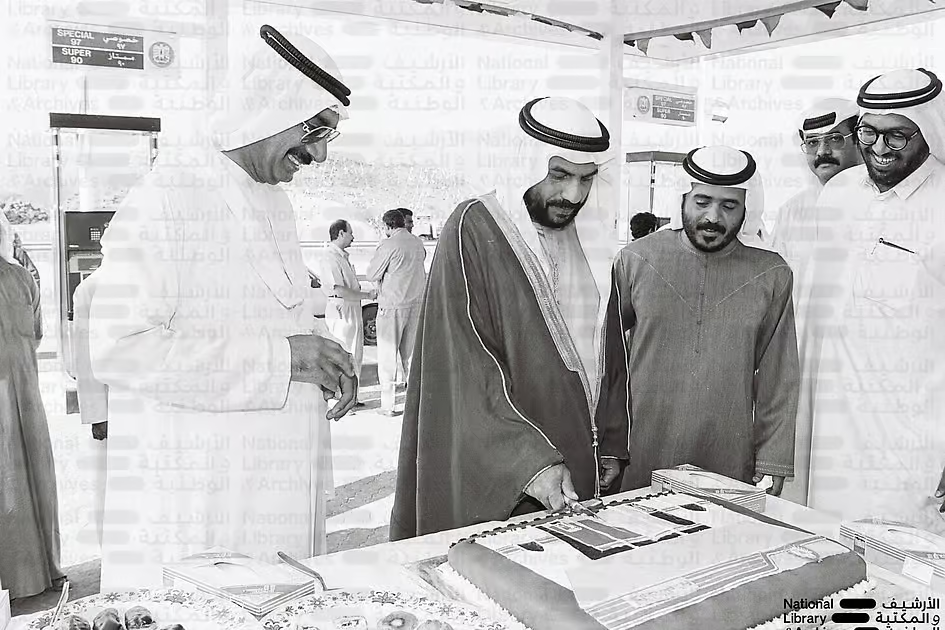
The transformation was swift. By 1974, Sheikh Zayed bin Sultan Al Nahyan visited Fujairah and inaugurated the first water desalination and power plant in Qidfa.
“I remember standing on the street as a little girl, waving palm fronds as Sheikh Zayed’s car passed by,” Dr Amna smiles. “We watched them lay the pipes for fresh water. We saw the wooden electricity poles go up. In 1972, the first television arrived in our neighbourhood, and the whole village would gather in one courtyard to watch it at night.”
A legacy preserved
Today, while modern villas have replaced the stone and mud houses, the soul of Qidfa remains intact. Unlike other agricultural areas that were abandoned as modernisation swept the country, the people of Qidfa refused to leave their farms.
“My father is nearly 98 years old, and if you go to his farm today, you will find him walking among his palm trees, checking the water and the dates,” Dr Amna says proudly. “When the groundwater turned salty, the families didn’t give up. They laid pipes from their homes to pump desalinated water to their farms just to keep the trees alive.”
For Dr Amna and the generations raised between the mountain and the sea, Qidfa is more than just a spot on the map.
“It is a place of memory,” she concludes. “Our roots are deep in this soil, and no matter how much the world changes, the people of Qidfa will always hold on to their land.”
Source: Khaleej Times