

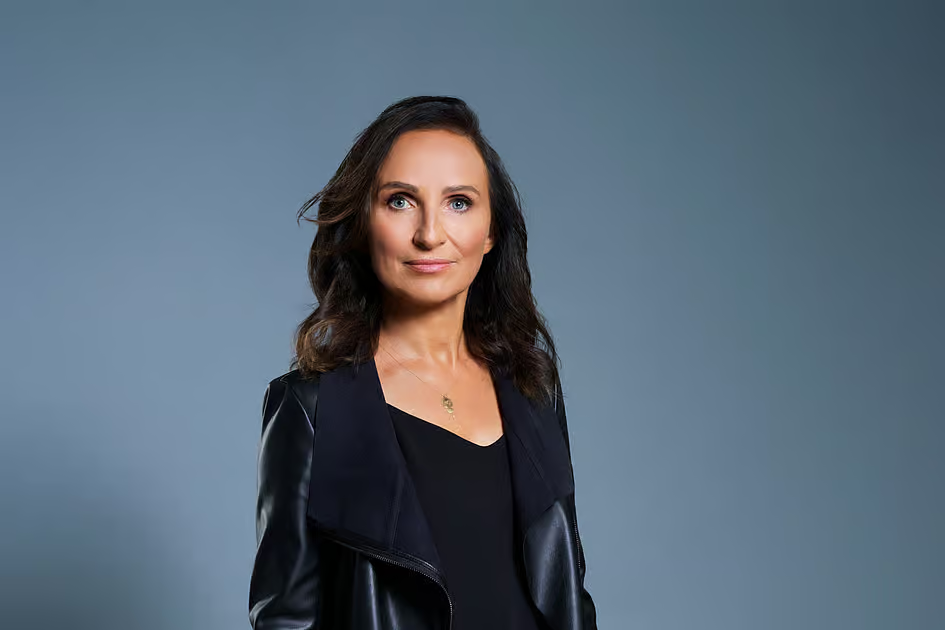
The general manager for Central & Eastern Europe, the Middle East and Africa (CEEMEA) discusses leading across diverse markets, building a culture of trust, and how connected care is shaping the future of healthcare
Healthcare transformation is often associated with advances in technology, from connected medical devices to digital health platforms and data-driven care. But while innovation continues to reshape the industry, lasting progress depends just as much on the people leading that change. As healthcare systems evolve, organisations are placing greater emphasis on collaboration, strong partnerships and leadership that can adapt to the unique needs of different markets while keeping patient care at the centre of every decision.
For Beata Karasińska, general manager for Central & Eastern Europe, the Middle East & Africa (CEEMEA) at Baxter, that means balancing innovation with local insight, empowering diverse teams and working closely with healthcare providers across a region that spans a wide range of healthcare systems and priorities. With more than 25 years of experience in the healthcare industry, she has held leadership roles across global organisations before taking on her expanded CEEMEA role earlier this year.
In this interview, Karasińska reflects on the leadership principles that have shaped her career, the lessons she has learned from managing teams across different regions and cultures, and why she believes trust, transparency and collaboration remain essential to navigating an increasingly complex healthcare landscape. She also shares her perspective on connected care, healthcare transformation and Baxter’s role in helping providers build more resilient, patient-focused healthcare systems.
Question:
You assumed responsibility for Baxter’s CEEMEA region earlier this year after leading Central & Eastern Europe & Israel. What have been the biggest learnings from this transition, and how has your perspective evolved as you take on a region spanning such diverse healthcare systems and markets?
Answer:
Taking on responsibility for Central and Eastern Europe, Middle East and Africa (CEEMEA) has been both energising and humbling. While I was already leading a diverse region of Central and Eastern Europe and Israel, expanding the scope to include the Middle East and Africa has reinforced just how different healthcare realities can be, even when the ultimate goal remains the same: improving patient outcomes and expanding access to care.
One of my biggest learnings has been the importance of listening before acting. Every market has its own healthcare priorities, regulatory environment, maturity level of infrastructure, and patient unmet medical needs. What works in one country may not necessarily work in another. My priority has therefore been to spend time understanding local perspectives, learning from our teams, and engaging with healthcare stakeholders across the region.
At the same time, I have been struck by how many common challenges unite these markets. Across CEEMEA, healthcare systems are looking for ways to improve efficiency, expand access, strengthen resilience, and deliver better patient outcomes with finite resources. That creates significant opportunities for collaboration, innovation, and knowledge sharing across borders.
The transition has also broadened my perspective as a leader. When you oversee a region of this scale and diversity, success is less about having all the answers yourself and more about creating an environment where talented leaders can thrive, make decisions, and leverage their deep local expertise. It has reinforced my belief that leadership starts with trust, empowerment, and openness to different viewpoints.
What excites me most about CEEMEA is its potential. These are dynamic markets with growing healthcare ambitions, strong talent, and an increasing willingness to embrace innovation.
Question:
With more than 25 years of experience across the healthcare industry, what leadership principles have remained constant throughout your career, and how do they influence the way you lead teams today?
Answer:
While healthcare has evolved significantly over the past 25 years, the leadership principles that matter most to me have remained remarkably consistent: authenticity, trust, and a genuine commitment to people. Throughout my career, I have learned that strong results are achieved not only through strategy and execution, but through the relationships we build and the environments we create for others to succeed. My leadership style is deeply rooted in open communication and empowering people to contribute their best work, but I must admit that I am also a very demanding person.
I demand from myself and from my teams. I often say that before making any decision, we should ask ourselves whether we would make the same decision if Baxter was our own company.
One principle I have always believed in is leading with transparency. Whether discussions are easy or difficult, people deserve honesty and clarity. When teams understand the ‘why’ behind decisions and feel their voices are heard, they are more engaged, more resilient, and better equipped to navigate change.
Another constant has been the importance of trust. Trust is not something that comes automatically with a title; it is built over time through consistency, credibility, and mutual respect.
I have also learned the value of staying curious and continuing to learn. Some of the most important milestones in my career came from stepping outside my comfort zone, taking on unfamiliar challenges, and embracing opportunities for growth. That experience has shaped how I support others today. I encourage my teams to be ambitious, to take calculated risks, and to view change as an opportunity rather than an obstacle.
Ultimately, healthcare is a people business. We may work with advanced technologies and innovative therapies, but our purpose is improving patients’ lives. Keeping that purpose at the center of every decision helps create alignment, inspires teams, and reminds us why our work matters. That sense of purpose continues to guide me today just as much as it did when I started my career.
Question:
You are known for a leadership style centered on trust, transparency, and empowerment. How do you foster a strong and inclusive culture across teams operating in different countries, cultures, and healthcare environments?
Answer:
Building a strong culture across a region as diverse as CEEMEA starts with recognising that inclusion is not about creating uniformity; it is about creating a sense of belonging while valuing different perspectives. Our teams operate in many different countries, cultures, and healthcare systems, and that diversity is one of our greatest strengths.
For me, trust is the foundation. People perform at their best when they feel respected, heard, and empowered to contribute. I therefore place a strong emphasis on open communication and creating opportunities for dialogue, where individuals feel comfortable sharing ideas, challenging assumptions, and bringing forward different viewpoints.
At the same time, fostering an inclusive culture requires intentional effort. As leaders, we need to be conscious that not every voice is equally represented in every discussion. I try to create an environment where participation is encouraged, where diverse experiences are valued, and where people feel confident contributing regardless of their background, function, or location. Inclusive leadership is about ensuring that everyone believes they have a seat at the table and an opportunity to make an impact.
Empowerment is another critical element. In a region of this scale, success is not achieved through centralized decision-making. It comes from trusting local leaders and teams who understand their healthcare environments best. My role is to provide direction, support, and alignment around our shared purpose, while empowering teams to make decisions that reflect local needs and realities.
What ultimately unites us across Baxter CEEMEA is our mission to save and sustain lives. Regardless of where we work, we are all focused on helping healthcare professionals deliver better care and improving outcomes for patients. When people are connected by a common purpose, differences become a source of innovation, learning, and strength rather than a barrier. That is the culture I strive to build every day.
Question:
Having worked extensively across Central & Eastern Europe and now the wider CEEMEA region, are there any lessons or best practices from those markets that you believe can help healthcare systems and organisations navigate transformation more effectively?
Answer:
One of the most important lessons I have learned is that successful healthcare transformation is rarely driven by technology alone. The most effective transformations happen when innovation is combined with strong partnerships, a clear long-term vision, and a relentless focus on patient needs.
Across Central and Eastern Europe, we have seen healthcare systems make remarkable progress over the past two decades. Many countries have modernised infrastructure, expanded access to advanced therapies, and embraced new models of care, such as telemedicine and home-based care. What made these transformations successful was the willingness of governments, healthcare providers, industry, and other stakeholders to work together toward common goals. Collaboration remains one of the most powerful catalysts for change.
Another lesson is the importance of adaptability. No two healthcare systems are identical, and there is no universal blueprint for transformation. The organisations and healthcare systems that navigate change most effectively are those that remain agile, learn continuously, and are willing to adapt solutions to local realities rather than simply replicating approaches from other markets.
I also believe that investing in people is just as important as investing in infrastructure. Sustainable transformation depends on empowered healthcare professionals, strong leadership, and a culture that embraces continuous learning. Technology can accelerate progress, but people are ultimately the ones who make change successful.
Across CEEMEA today, there is enormous momentum around healthcare modernisation – from digitalisation and data-driven decision-making to expanding access and improving healthcare resilience. What encourages me most is seeing how different countries are learning from one another. Innovation does not flow only from mature markets to emerging ones; some of the most creative and effective solutions come from markets that have learned to do more with limited resources. This exchange of knowledge will continue to play a critical role in shaping the future of healthcare.
Question:
Healthcare systems worldwide are increasingly focused on improving efficiency, patient outcomes, and access to care. How is Baxter helping healthcare providers address these priorities through its integrated portfolio of therapies, medical devices, and digital solutions?
Answer:
Healthcare systems around the world are facing a common challenge: delivering better outcomes for more patients while managing increasing demands on resources, workforce capacity, and healthcare costs. At Baxter, we believe addressing these challenges requires a connected approach that combines medical innovation, digital capabilities, new ways of delivering healthcare, and deep clinical expertise. Our mission is not only to provide products and services but also to deliver innovative solutions that span the continuum of care throughout hospitals and clinics — from the ER to the OR, from the pharmacy to the ICU, while also advancing patient care in the home and contributing to the sustainability of the healthcare ecosystem.
What makes Baxter unique is the breadth of our portfolio. We provide therapies, medical devices, and technologies that support patients across critical care, surgery, medication delivery, nutrition, and chronic disease management. This enables us to help healthcare providers improve clinical outcomes while simplifying workflows and enhancing operational efficiency across multiple care settings.
Digital innovation is also playing an increasingly important role in healthcare transformation. Providers are looking for smarter ways to manage patient care, optimise resources, improve clinical decision-making processes, and enhance connectivity across the healthcare ecosystem. By combining digital solutions with our medical technologies, we help clinicians access meaningful insights that support timely, informed decisions and more efficient care delivery.
In the Gulf region, and particularly in markets such as the UAE and Saudi Arabia, healthcare systems are making significant investments in digital transformation, advanced care delivery models, and healthcare infrastructure. Baxter is committed to being a trusted partner and proud to support this journey through innovative solutions, connected technologies, and partnerships that help providers improve efficiency, expand access, and ultimately deliver better outcomes for patients.
Question:
Looking ahead, what are your key priorities for Baxter across the CEEMEA region, and where do you see the greatest opportunities to create long-term impact for patients, healthcare providers, and healthcare systems?
Answer:
CEEMEA is an incredibly dynamic region, with healthcare systems evolving at different speeds but sharing many common ambitions: improving access to care, embracing innovation, strengthening healthcare resilience, and delivering better outcomes for patients. As we look ahead, my priority is to ensure that Baxter continues to be a trusted partner in helping healthcare systems achieve those goals while staying true to our mission of saving and sustaining lives.
One of our key priorities is expanding access to innovative therapies, technologies, and solutions that address the most pressing healthcare needs across the region. We know that patients, regardless of where they live, deserve access to high-quality care. By working closely with healthcare providers, governments, and other stakeholders, we aim to help improve access while supporting the sustainability of healthcare systems.
A second priority is supporting healthcare transformation through innovation, digitalisation and switch to home care. Across CEEMEA and particularly in parts of the Middle East, we are seeing strong investments in healthcare modernisation, data-driven decision-making, and more connected models of care. We see significant opportunities to support providers through our portfolio of connectable medical devices, and digital solutions that help improve efficiency, enhance clinical outcomes, and simplify healthcare delivery. On top of that, I truly believe that, in the future, healthcare will increasingly be delivered in patients’ homes rather than in hospitals. That should have a positive impact on healthcare costs while also improving patients’ quality of life.
Another area of focus is partnerships. Some of the most meaningful progress in healthcare happens when industry, healthcare providers, policymakers, and professional communities work together. We want to continue building strategic collaborations that help address local healthcare challenges, advance clinical excellence, and ultimately improve patient outcomes.
Finally, I believe one of the greatest opportunities lies in people. Whether within Baxter or across healthcare systems, sustainable progress depends on talented, committed individuals who are empowered to drive change. Investing in talent, developing future leaders, and fostering a culture of collaboration and innovation will remain critical to creating long-term impact.
Source: Khaleej Times