

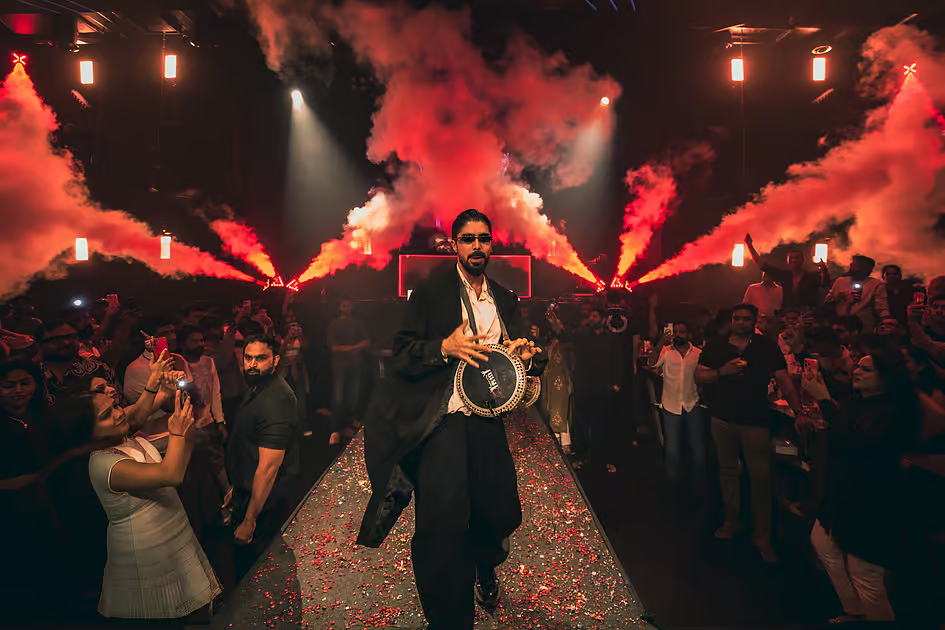
Lebanese-Armenian percussionist Rodolphe Manoukian has spent years bringing the darbuka into electronic music and live club performances.
Born in Beirut, he began playing the instrument at nine before performing at Geneva’s Victoria Hall with the LEBAM Orchestra by the age of 14.
His sound today brings Middle Eastern percussion together with Afro house, tribal rhythms and electronic music.
His darbuka version of the Punjabi track Mundian To Bach Ke later introduced his music to a wider audience, particularly in India.
Now, following his Dubai performance at Troy on September 26, Manoukian speaks about the influence of Beirut on his music, performing for different crowds and why no two of his live shows are ever quite the same.
Edited excerpts from an interview:
You’ve got a really distinctive mix of percussion, electronic music and different cultural influences in your sound. Where did that come from for you?
It comes from who I am. I grew up in Beirut, in a Lebanese-Armenian family, where you hear Arabic rhythms, Armenian melodies, Western pop and club music all in the same street. The darbuka was my first language, but I never wanted to keep it in a museum. I wanted to take something ancient and put it at the centre of today’s dance floor. When the darbuka meets an electronic beat, something new is born, and it belongs to everyone.
Was percussion always the direction you wanted to take, or did your style evolve into that over time?
Percussion was always my path. I started at the conservatory at nine and was playing with an orchestra on stages like Victoria Hall in Geneva by fourteen. That discipline gave me my foundation. But the real evolution came when I left the classical world and taught myself to break the rules: mixing genres, experimenting, finding a sound where the darbuka leads and the electronic world follows.
Your live sets feel very connected to the crowd. How much does the energy in the room change what you end up playing?
Everything. For me the crowd is part of the band. I watch the faces, I feel the room, and the darbuka lets me answer them instantly. If they want to go harder, I push. If they want to groove, I give them space. That’s the magic of live percussion: every night is written together with the people in front of me, so no two shows are ever the same.
Do you approach a show in Dubai any differently from playing in other cities?
Dubai is the perfect city for what I do, because it’s the whole world in one room. Arabs, Indians, Europeans, Africans, all dancing together. My music is about exactly that: taking rhythms from different cultures and showing people they speak the same language. At TROY I want to take everyone on a journey, from Middle Eastern roots to Afro house to sounds they’ve never heard together before.
How much of your set is planned before you go on, and how much do you just go with in the moment?
I build the structure, the tracks and the big moments in advance, but the percussion is always live and always improvised. The plan is the skeleton; the crowd gives it a heartbeat. Some of my favourite moments on stage are ones I could never have planned.
Is there a particular show or moment in your career that really changed things for you?
When my darbuka version of Mundian To Bach Ke travelled across the world. A Lebanese musician playing a Punjabi classic, and suddenly people from India, the Middle East and everywhere else were sharing it and dancing to it together. That’s when I understood my music could build bridges. It opened the door to India and to a whole new family of fans, and it showed me the direction I want to keep going in.
What would you say have been the biggest influences on your sound, whether that’s certain artists, places or styles of music?
Beirut, first and always. The Middle Eastern percussion traditions I grew up with, Armenian music from my roots, and then Afro, tribal and electronic sounds that I fell in love with later. Working with musicians from all over the world at intercultural creation sessions in France and Italy changed the way I listen. It taught me that every culture has a rhythm, and when you let them meet, something powerful happens.
What do you think live percussion brings to electronic music that a more traditional DJ set can’t?
Soul. A track is fixed, but a drum breathes. When people see someone playing live on top of the music, they feel it in their chest, not just their ears. It turns a set into a performance and a crowd into a community. I believe that’s where live music is heading: human energy and technology together, and I want to be part of leading that change.
Source: Khaleej Times