

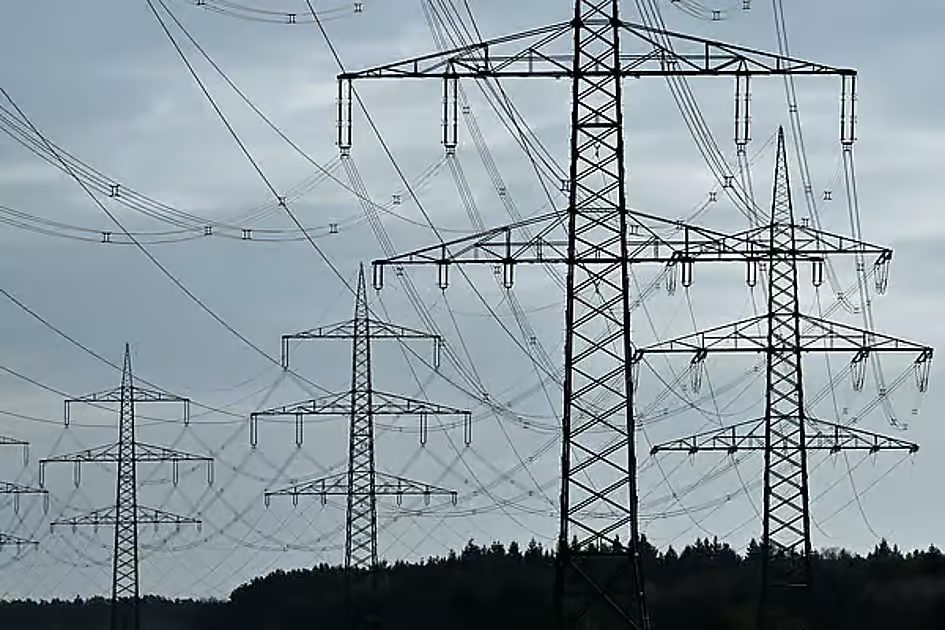
While several countries across the region experienced disruptions to energy supplies and essential services during recent geopolitical tensions, Dubai’s electricity and water networks continued to operate without interruption, demonstrating the emirate’s preparedness and resilience, according to Saeed Mohammed Al Tayer, MD and CEO of Dubai Electricity and Water Authority (DEWA).
Speaking during a Dubai Press Club session on Tuesday, Saeed Mohammed Al Tayer, CEO of DEWA, said Dubai’s power network remains among the most reliable in the world, with less than one minute of electricity outages per customer annually, even as several countries in the region faced disruptions during recent geopolitical tensions.
“Dubai today has one of the strongest electricity networks in the world,” Al Tayer said. “The reliability indicators achieved by Dubai are among the best globally.”
Stay up to date with the latest news. Follow KT on WhatsApp Channels.
Less than one minute of outages annually
Al Tayer said Dubai recorded less than one minute of electricity interruption per customer annually, significantly outperforming many leading cities worldwide.
“Outage duration is less than one minute per customer each year. These are numbers that are difficult to find anywhere else,” he said.
He attributed the performance to the vision of the UAE leadership and decades of investment in smart grids, digital infrastructure, and preventive maintenance systems.
Dubai was among the first utilities globally to introduce artificial intelligence into its operations, beginning in 2017, enabling predictive maintenance and faster responses to technical faults.
No disruptions despite regional tensions
The DEWA chief noted that while several countries experienced interruptions in electricity, water, and fuel supplies during recent regional events, Dubai maintained uninterrupted services.
“We did not witness electricity outages during the recent crisis,” Al Tayer said. “This reflects the strength of our infrastructure and the readiness of our emergency and contingency plans.”
He explained that the utility maintains alternative scenarios for electricity and water supply, allowing services to continue even during emergencies.
Smart systems and cybersecurity
Cybersecurity has become one of the utility’s top strategic priorities, according to Al Tayer, who revealed that DEWA faces thousands of attempted cyberattacks daily.
“We monitor our systems around the clock,” he said. “There are specialised teams operating 24 hours a day to protect our infrastructure.”
The authority employs more than 2,000 engineers and specialists across energy, information technology, artificial intelligence, and cybersecurity.
He said advanced monitoring systems can detect faults before they occur, allowing engineers to intervene before service disruptions happen.
“Today, technology can tell us where a fault may occur before the customer even notices,” he added.
Diversifying Dubai’s energy mix
Al Tayer highlighted the Mohammed bin Rashid Al Maktoum Solar Park as a key pillar of Dubai’s future energy strategy.
The project is expected to reach 5,000 megawatts by 2030, while large-scale energy storage projects are being developed to ensure supply during periods of declining solar generation.
Dubai also operates one of the world’s largest thermal energy storage projects using molten salt technology, allowing renewable energy to be stored and used for extended periods.
Hydrogen was identified as another strategic priority.
“We began investing in hydrogen early because we believe it will become one of the clean fuels of the future,” Al Tayer said.
Preparing for future growth
With Dubai’s population and visitor numbers continuing to grow, Al Tayer said the authority constantly studies future demand and develops new projects accordingly.
“We know that Dubai often experiences stronger growth after every crisis,” he said. “That is why our planning is based not only on today’s needs but also on future requirements.”
He added that Dubai maintains strategic reserves of both water and electricity, ensuring sufficient supplies for emergencies and future expansion.
‘Dubai does not tolerate delays’
Al Tayer said the emirate’s service model is built around efficiency, innovation, and customer satisfaction.
“Dubai does not tolerate delays. Services must always be excellent,” he said.
According to him, DEWA’s customer happiness rate exceeds 98 per cent, supported by digital services and smart payment channels that allow customers to complete transactions remotely.
He concluded that resilience, innovation, and preparedness remain central to Dubai’s approach.
Source: Khaleej Times