

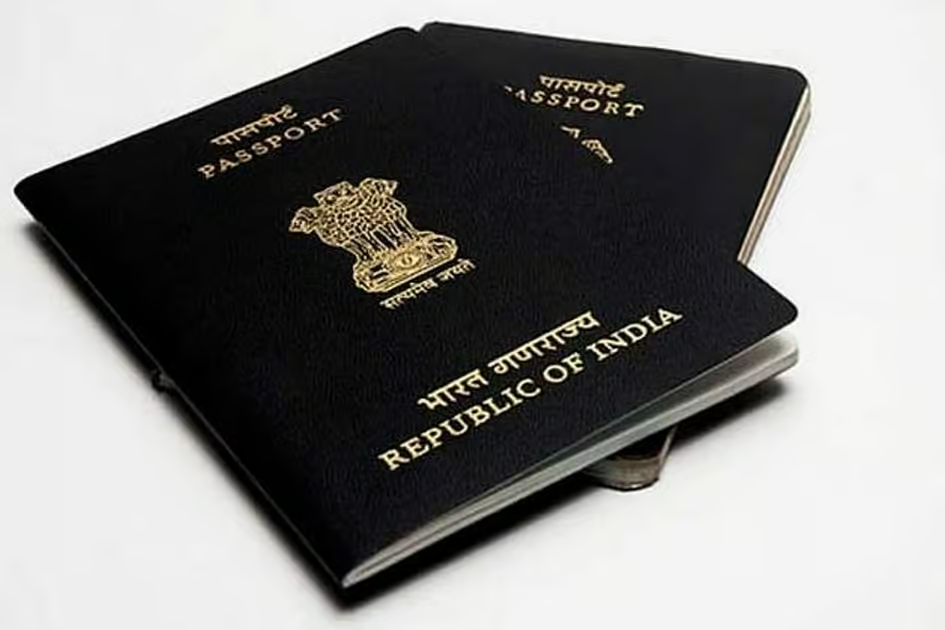
A legal tussle is at the center of the delay in rolling out Indian consular services in the UAE, leaving scores of expats in limbo.
The dispute pits two failed bidders against the Indian government’s decision to award the contract for consular services in UAE, Saudi Arabia, Kuwait and Australia, and it is now being fought in India’s Supreme Court. This comes as the rollout of Indian passport renewals and other services in the UAE is temporarily being undertaken by the Consulate General of India (CGI), Dubai and the Indian Embassy in Abu Dhabi starting Thursday.
Earlier this year, the Embassy of India, Abu Dhabi, announced that it would replace BLS, which had been handling passport, visa, and consular services for over a decade. The new contract was awarded to Alhind Tours & Travels after a competitive bidding process in November 2025. Alhind was chosen because it offered the lowest financial bid among four shortlisted companies.
Stay up to date with the latest news. Follow KT on WhatsApp Channels.
However, the transition, originally scheduled for July 1, has been delayed by the Indian mission in the UAE citing “administrative reasons”. In an announcement on their social media channels, the mission said it would start providing consular services “in limited manner” from July 2. Two of the unsuccessful bidders have jointly challenged the tender process and decision in court, claiming that they were disqualified “without assigning any reasons.”
What the petitioner claims
The failed bidders have questioned why they were eliminated at the technical evaluation stage, despite submitting a proposal that met all the requirements. One company scored 67.5 per cent in the technical evaluation, just short of the 70 per cent qualifying mark. But it says the scoring was “arbitrary.”
In court documents, the company points to several examples of what it calls “patently arbitrary” scoring. For instance, under a criterion related to turnaround time for processing applications, the bidder was awarded zero marks. Yet, the company had explicitly committed to completing applications within 30 minutes — the exact benchmark the tender required. According to the evaluation rules, zero marks were supposed to be given only if a bidder proposed a turnaround time exceeding 30 minutes.
Similarly, the company was awarded “disproportionately low marks” under other criteria, including application facilitation services, grievance redressal mechanisms, and the company’s market reputation. It argues that it submitted “detailed proposals” for each of these areas, yet the evaluation committee provided “no reasons” for the low scores. The bidder claims the “continued refusal to disclose reasons” renders the decision “non-speaking, opaque and violative of principles of fairness and transparency.”
The court battle so far
The case has already gone through India’s Delhi High Court. On June 5, the High Court adjourned the matter to July 13 without stopping the transition. This meant the new provider could proceed with taking over operations, even while the legal challenge remained unresolved.
The failed bidders have now approached the Supreme Court, arguing that allowing the handover to go ahead before the court examines the evaluation records would create “irreversible” consequences. Once the takeover is done and applications processing begins, the company warns, “contractual rights would crystallise” and “third-party equities would arise,” making it difficult to undo the decision even if the court later finds the tender process was flawed. In other words, the legal challenge would become “substantially infructuous.”
The Supreme Court has previously directed the government to provide the failed bidder with a break-up of the marks it received. But the company says “the underlying reasons for the disqualification are still being kept secret,” violating “the principles of transparency that should govern public procurement.”
What happens now?
The Supreme Court is expected to hear the case soon. Depending on the outcome, the rollout of consular services could proceed as planned, be delayed further, or even be sent back for re-evaluation.
For now, the Indian mission in the UAE has announced limited walk-in consular services from July 2, offering passport, visa, and attestation services on a first-come-first-serve basis between 9am and 12.30pm. But for scores of expats waiting to renew passports, apply for visas, or obtain certificates for their children’s college admissions, the uncertainty is far from over.
Source: Khaleej Times