

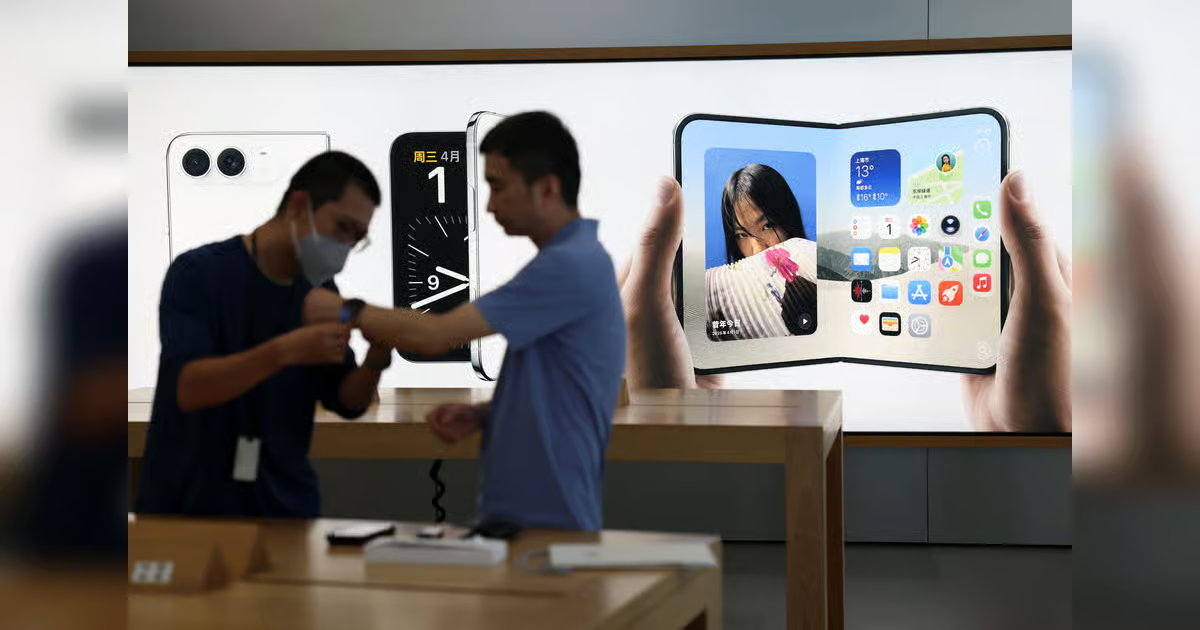
Apple’s “Surprise and shine” event on September 9 was the first iPhone launch under John Ternus, who took over from Tim Cook on September 1. The thin line cutting the Apple logo on the invitation turned out to be exactly what it looked like: a fold. The iPhone Duo, Apple’s first foldable, opens for pre-orders in the UAE on October 16 at 4pm, from Dh8,499.
The leaks had most of it months ago, from the passport shape to the price, and Apple made a few promises of its own on stage. With supply reportedly tight and the Duo the priciest iPhone yet, both are worth checking before you commit.
So what did Apple actually fold?
On the hardware, the leaks were close to perfect. The passport shape, the 7.6in inner and 5.4in outer screens, the two 48MP cameras with no dedicated telephoto lens and Touch ID in the side button in place of Face ID all arrived as described. So did the price: leak-based forecasts worked out at Dh8,500 to Dh9,800 here, and Apple landed Dh1 under the bottom of the range, at Dh8,499. The one clear miss was the name: leakers had it as the iPhone Ultra.
Stay up to date with the latest news. Follow KT on WhatsApp Channels.
The crease is less clear-cut. Leakers said Apple chased a near-invisible fold “regardless of cost”, with a depth under 0.15mm. Apple has made no such claim. Its own description is more careful: a matte nano-texture finish it says makes the crease less visible. Making a crease less visible still leaves one. Whether that is enough will be clearer once the Duo is in buyers’ hands on October 23, a week after pre-orders open.
Where Apple’s own promises fall short
The bigger test is what Apple said itself. On stage, Ternus mocked rival foldables for making a big screen feel small, with movies “boxed in by oversized black bars”. The Duo does not escape that. Its 1:1.4 inner screen leaves roughly a fifth of the panel black around a standard 16:9 video. That is less than on squarer foldables, but the bars are still there. Apps have the same issue: many will sit between black bars until they are updated for the new iPhone, and developers only got the tools to do that after the launch event.
The software promises carry a UAE catch. Siri AI, the headline feature, is still an English-only beta, with five more languages due later this month. Apple Intelligence as a whole covers 16 languages. Arabic is in neither list. Apple’s small print sets daily limits on the cloud-based features, with expanded access “for a fee in the future”. Apple Pencil support is also due later this year, not on day one.
Will there be enough iPhone Duos to go round?
Getting one may be the harder part. Analyst Jeff Pu now expects Apple to ship six million units this year, down from his earlier seven million, and blames hinge production rather than demand. The UAE is in the first wave of more than 70 countries, but it shares a smaller pool of phones with every other first-wave market. If you don’t want to wait long after launch, pre-ordering might be the only route.
Trade-ins can soften the blow, with Apple offering Dh160 to Dh3,260 off for an iPhone XS or newer. The iPhone Duo is also eSIM only. That is not an issue in the UAE, where all network providers support eSIM, but travellers used to picking up a local SIM card on arrival will need a travel eSIM instead.
So, is it worth setting an alarm for?
Is the iPhone Duo all we were promised? The hardware largely is, and at Dh8,499 it landed where the leaks said it would. The gaps are elsewhere: the crease is there, apps and video still sit in black bars and the AI features do not work in Arabic. And it arrives late. If these issues are deal breakers for you, a Galaxy Z Fold8 or even an Honor Magic V6 is worth considering. Both cost less and are already on sale, and the Fold8’s Galaxy AI works in Arabic. If it has to be an iPhone, set an alarm for 4pm on October 16.
Source: Khaleej Times