

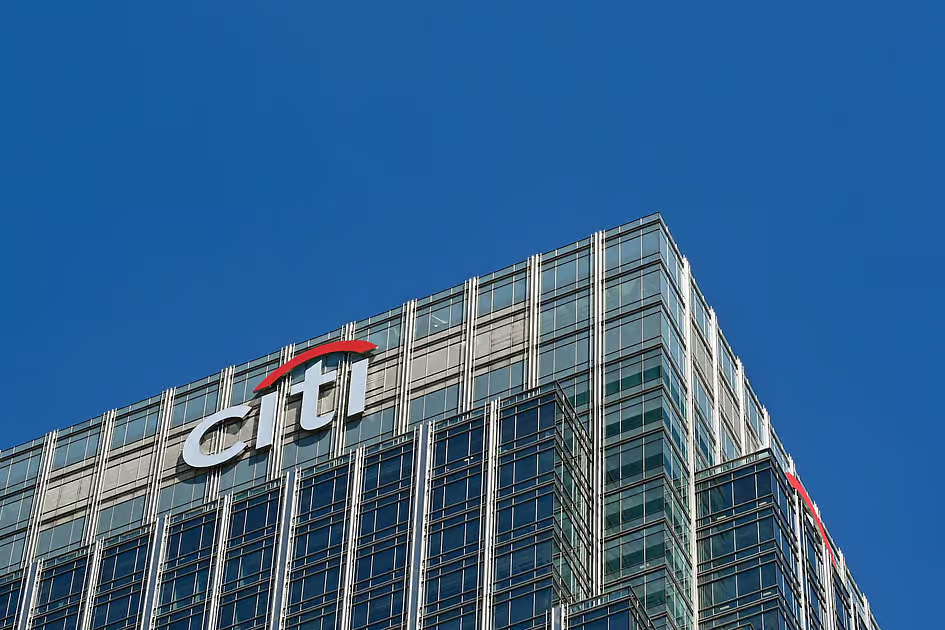
The Middle East conflict has strengthened the UAE rather than weakened it, and the country remains well placed to be a global financial capital, a top Citi bank official said.
“The conflict has strengthened the UAE. It turns out that the UAE was a lot stronger than what people believed, and incredibly quick in adapting to this new reality. That adaptation will become a source of strength for the UAE,” Ernesto Torres Cantú, Head of International at Citi, told Khaleej Times in an interview.
He said some sectors would take longer to return to pre-March conditions. “They will recover. I have no doubt,” he said.
Citi raised its financial commitment to the country by raising $28 billion (Dh102.76 billion) in the UAE alone to support clients. Across the Gulf region, the bank’s financing reached $75 billion (Dh275 billion) during the first eight months of 2026.
UAE at the centre of global flows
At the same time, the UAE sits at the centre of global flows. “Those flows can change, but not the role the UAE plays,” he said.
As an example, he said a company that supplies goods to the GCC used to ship through the Strait of Hormuz but now uses three other ports, with cargo coming via the Mediterranean.
“The flows change, the direction may change, but it will remain in the centre. I think the UAE is in a very privileged position to continue to be at the centre of trade and the financial system globally.”
The bank has operated globally for more than 200 years and in the UAE for 62 years.
“We always shine when it’s time of challenges, because this is where we really stand up close to our clients,” he said. The UAE remains an important market, with “no relocation or any sort of things”.
Torres Cantú said he sees the UAE as the bank’s largest franchise in the region. He added that this is Citi’s 62nd year in the UAE and the bank is “absolutely committed” to growing with the country.
“It’s continuous adaptation to the world and the needs of our clients. I think it’s a necessary condition for companies and for countries. And the UAE has proven to be at the very top of that,” he added.
People first during the crisis
Torres Cantú’s UAE visit was aimed at meeting the teams and clients to show support in the wake of the regional conflict.
He said the bank wanted to reaffirm its commitment “not only in terms of words, but in terms of actual commitments, in capital”. He added: “I do think doing it in person is better.”
Citi’s first concern during the conflict was its staff, Torres Cantú said.
“The first question I asked is how is our people doing? And after that, how are we supporting clients? We never stopped, never,” he said.
The bank could not use its offices for a period, and staff worked from home. Around 300 employees across the region were asked to return to their home countries and were helped to do so, he said. The number in the UAE was “minimal”.
UAE-US Investments
Citi recently announced the integration of the UAE into Citi Token Services, which Torres Cantú described as “instantaneous blockchain-based transference of money”. The network also includes United States, United Kingdom, Ireland, Japan, Hong Kong, and Singapore.
“That gives you an idea of the way we think about the UAE,” he said.
He said growth would come from new sectors and from deeper ties with clients.
“It’s more than new sectors; it’s further integration with other markets,” he said, adding that the global bank serves every sector, and that the most global clients, including sovereign wealth funds, get the most value from the bank the more locations that Citi serves them in.
Torres Cantú said Citi is working with the UAE’s sovereign wealth funds on the investment commitments announced during US President Donald Trump’s visit in 2025, which were reported at $1.4 trillion. Priority sectors include artificial intelligence, infrastructure, engineering, and data centres.
“We’re playing a major role,” he said in response to a question about Citi’s role in facilitating investment in both directions between the Gulf and the US.
Global outlook
On the global economy, Torres Cantú said supply chains began shifting during Covid-19, when countries realised that concentration in one place meant greater risk. Tariffs and wars have since accelerated the shift.
“It’s valid for countries, but it’s also valid for companies. You have to be resilient, which means you can have Plan A, Plan B, Plan C, Plan D.”
Global growth this year is tracking at around 2.7 per cent this year according to Citi, down from the close to 3 per cent that had been anticipated.
“The equilibrium that is being reached is an inefficient equilibrium for the world. High oil prices have pushed inflation up, and interest rates with it. Interest rates are the price of money,” he said, stressing that the higher cost of capital would hurt some sectors and countries more than others.
AI: efficiency, security and skills
Torres Cantú outlined three strands to Citi’s use of AI: efficiency, cybersecurity and staff skills.
“Things that took days or weeks now take minutes,” he said of efficiency gains from the new-age technology.
He said staff who actively use AI in certain tasks can double their productivity.
“In this context, a person that actively uses AI in their daily tasks will be the equivalent of hiring two. Increasing your own productivity is incredibly important and we are facilitating that for all our colleagues worldwide.”
On data protection against AI threats, he said: “We get the models before they are released and we make sure that our systems are adequately protected before they become widely available, and that will continue to be the case.”
Source: Khaleej Times