

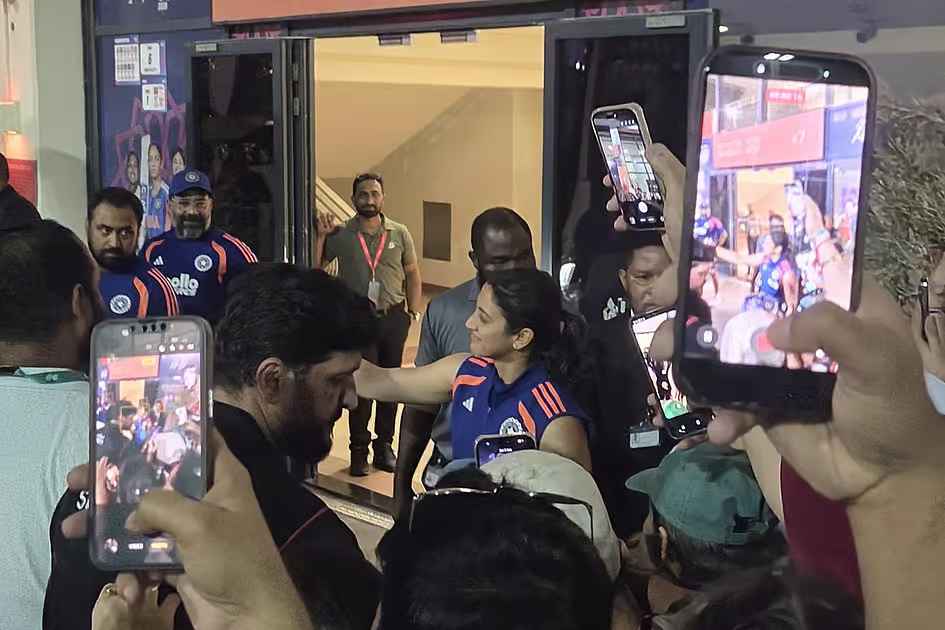
The air in the Dubai heat was heavy with anticipation as around 200 fans kept waiting with placards, flags, posters and an incredible spirit, long after the end of the Women’s T20 Asia Cup match between India and Pakistan at Dubai International Stadium last Saturday.
The vast majority of the more than 12,000 spectators were battling a traffic bottleneck outside the majestic stadium. It was around 10pm, nearly an hour after India had clinically dismantled Pakistan on the field.
But those 200 fans had not got behind the wheel yet.
Not because they were looking for an escape route. They were standing with their eyes fixed on the players’ exit gate — each one guarding their place in the first, second or third row behind the barricades, waiting for a glimpse of their heroes.
With each passing moment, the nervous excitement grew. Then the team bus pulled up right in front of them, sending expectations and the cheers soaring.
Among the crowd was a group of four teenage boys, one of whom was draped in the Indian tricolour. When Smriti Mandhana finally emerged from the gate, the boy wearing the flag let out a big roar and jumped into the air, turned in mid-air and landed with one arm raised towards the sky.
It was as though Cristiano Ronaldo had just unleashed his famous ‘Siuuuu!’ celebration.
Amid the deafening noise, Mandhana, in an almost Lionel Messi-like understated body language, kept her head down and slowly walked into the bus.
As Mandhana disappeared behind the tinted glass, a few Indian players obliged some of the fans with selfies and autographs, especially bringing big smiles to the faces of the young fans.
The crowd was happy, but they wanted more. They began a chant with the same tune that used to reverberate around stadiums across India until around 13 years ago.
That iconic, goosebump-inducing chant was: ‘Saaaachin… Saaaachin, Saaaachin… Saaaachin’.
There was no Tendulkar on that Saturday night in Dubai. But there was Mandhana, arguably the first global superstar of women’s cricket.
To get a glimpse of her, the crowd started chanting her name with that ‘Saaaachin’ energy: ‘Smriiiitiii… Smriiiitiii, Smriiiitiii … Smriiiitiii.’ The chants got louder and louder, and the noise reached a crescendo when Mandhana finally relented, getting off the bus to exchange high-fives with a few lucky fans in the front row before taking a few quick selfies.
To see those scenes unfold was incredible for someone like this reporter who, in the early and mid-2000s, had covered India’s premier men’s domestic matches — Ranji Trophy final and Irani Trophy — in Delhi at empty stadiums where sometimes stray dogs brought play to a temporary halt.
Until around 10 years ago, most international matches of India’s women’s cricket team rarely attracted a decent crowd. The best female cricketers of the country never really made front-page headlines despite their impressive performances, reaching the ODI World Cup semifinals in 1997 and 2000 as well as finishing as the runners-up in 2005.
Elite players of that era, Neetu David, Anjum Chopra, Mithali Raj and Jhulan Goswami, never knew what it felt like playing at packed stadiums at home.
Among the 200 fans on Saturday night was long-time Dubai resident Umesh Agarwal, who witnessed the incredible intensity of emotions for Mandhana, Harmanpreet Kaur, Shafali Verma and the rest of the players in the current team.
Agarwal credited the Women’s Premier League (WPL) — launched in 2023 — for the newfound success of Indian women’s cricket.
“I think the WPL has done an incredible job to popularise women’s cricket in India. The engagement level is just huge now, I mean, I never thought it would be this big,” Agarwal said.
“The Indian cricket board is doing a lot of good things now to grow women’s cricket. And India winning the 2025 ODI World Cup was massive, a landmark moment for the women’s game in India. I think for India it was as big as the men’s team winning the 1983 World Cup, which changed cricket in our country.”
When Dubai was named as the 2026 Women’s Asia Cup host, Agarwal knew he had to book tickets and support the team with his teenage daughter, Dyuti.
“I have watched so many Indian men’s team matches in Dubai. But we had never seen the Indian women’s team play, and this was our chance,” he said.
Anjum Chopra, a former India captain and a key player of the team that reached the 2005 World Cup final, says her heart fills with happiness to see people coming to the ground to support women’s cricket now.
“Crowds coming in and watching women’s matches is always a healthy sign. It’s obviously very different from when our seniors played, or compared to when I played,” Chopra told the Khaleej Times.
“At least I can clearly say that I might have played in a few empty stadiums, but I’ve still had some crowds coming in wherever I’ve played, be it in India or abroad.
“But going from a few thousand to big numbers — 30,000 to 40,000 (in India) people coming in — that’s obviously a stark difference.
“So it’s always nice to see people coming in and appreciating the women’s game, coming to the stadium, watching and witnessing a game. I think it’s always a very positive sign.”
Chopra credits a combination of factors for the incredible growth of women’s cricket in recent years.
“This rise is obviously a result of a combination of all the factors — media coverage, digital reach, etc. So I won’t say that it’s just television, because television has been there. From the time that I played until my last game, every game was televised on the networks,” she said.
“But, yeah, digital media has definitely played a massive role. I guess all this gets magnified when India wins. You win in India or you win abroad, and then the matches are covered anywhere in the world and streamed or broadcast in India. That also makes a big difference.
“And to top it all, the Indian team has earlier made it to the semifinals of T20 World Cups, and then in the 2025 World Cup, they obviously won the final. So, all those things play a massive role.”
The emergence of Mandhana, 30, as a world-class batter who recently became the highest run-scorer across formats only amplified the rise of women’s cricket.
“Look, the game needs heroes. Anyone who consistently does well and is constantly performing obviously gets that kind of attention,” Chopra said of Mandhana.
“There are a few players who have been consistently performing as well. But I guess Smriti Mandhana, obviously, with the kind of strokeplay she has — and as a batter, you always get more attention.
“I think scoring 10,000-plus runs across all formats of the game, playing franchise leagues as well, and doing it consistently over the years for India, obviously means fans connect well with such performers. That’s one of the big reasons.
“But at the end of the day, you need to be a performer for anyone to connect with you, and Smriti Mandhana is obviously that. She is a performer, she has won matches for India.
“Plus, she’s the RCB (Royal Challengers Bengaluru) captain who won two WPL titles. So, performance is obviously essential, and that’s one of the big reasons (for her superstar status).”
Umesh Agarwal’s daughter, Dyuti, draped in India colours, said she would never forget the moment when the raw emotions of the fans got Mandhana off the bus to share a few moments with them.
“She’s the biggest star. I think it feels great that she understands how much people like her and how much we want to meet her and appreciate everything she’s done for women’s cricket in India,” she said.
Dyuti’s love for cricket was born from her father’s passion for the sport as the two would ‘spend the weekends watching the IPL and the WPL’.
Across the length and breadth of the country, now a myriad of fathers and daughters spend their weekends cheering for Mandhana, Harmanpreet and Jemimah Rodrigues — a cricketing revolution that inspired Uma Chetry, who hails from a nondescript town in Assam, to defy the odds and become the first women’s international cricketer from the northeast region of India.
Source: Khaleej Times