

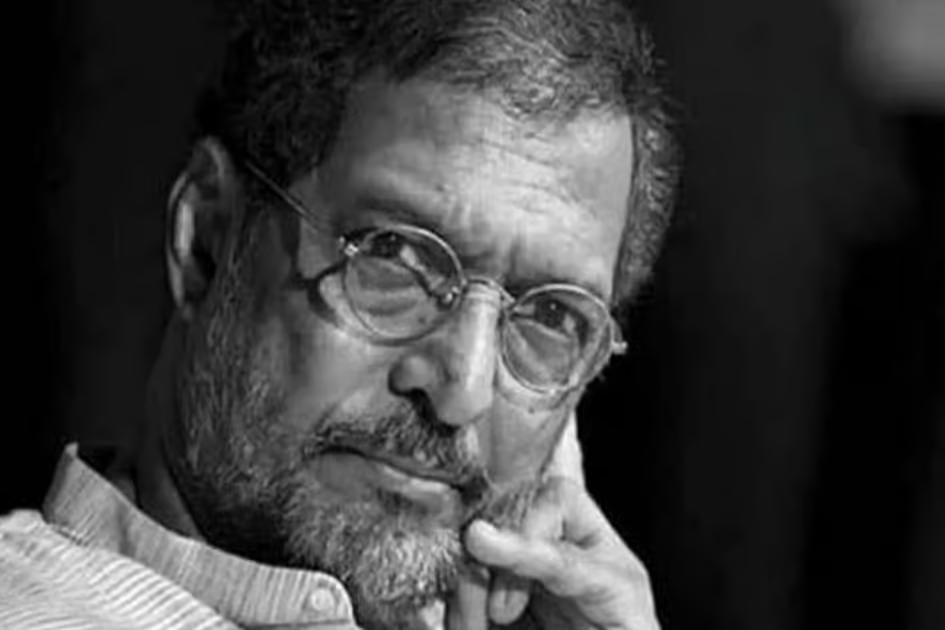
For 24-year-old Yash Daval, his introduction to Nana Patekar was not through the actor’s intense performances in Krantiveer or Parinda, nor through his celebrated work in Marathi theatre. It was through Uday Shetty, the eccentric gangster with a penchant for acting in the 2007 Bollywood comedy Welcome.
He was barely five or six years old when he first watched the film. And like an entire generation that grew up laughing at Patekar’s impeccable comic timing, he was instantly hooked.
“I went crazy looking at Uday Bhai’s character,” recalls Daval, co-founder of Zeroth Act, a UAE-based Marathi theatre group. “Then, when I watched his older films, I realised what an amazing range he had. From playing those fierce characters to someone like Uday Bhai, who was silly and comic, yet still had that fierceness.”
Years later, another performance would leave an equally lasting impression. This time, it was Natsamrat, the Marathi drama in which Patekar portrayed Ganpatrao Belwalkar, a celebrated theatre actor confronting the painful realities of ageing, family relationships and life beyond the spotlight.
For Daval, the two performances represent vastly different sides of the same extraordinary artist.
On October 8, as news emerged of Patekar’s demise at the age of 75, members of the UAE’s Marathi theatre community found themselves mourning an actor whose influence extended far beyond the characters he played.
From young performers discovering his work through Bollywood comedies to seasoned theatre artists who remember his commanding presence on stage, the grief was shared across generations. So, too, was the recognition that Patekar had left behind something far greater than a filmography.
A ‘treasure box’ for young actors
Daval remembers waking up to the news this morning and struggling to believe it. He had always associated Patekar with a disciplined, relatively simple lifestyle, making reports of his sudden death following a cardiac arrest particularly shocking.
But even amidst the sadness, the young actor finds another way to look at the loss. “We won’t be able to see him on stage again. That is a huge loss,” he says. “But the work he has left behind is like a treasure box for upcoming young artists. We can look up to him, study his performances and learn from them.”
It is perhaps Natsamrat that offers one of the most important lessons for aspiring performers. “We always talk about struggling actors and how they achieve success. But nobody really talks about what happens after you become successful,” Daval explains. “That film resonates because it is not just about an actor. It is about an actor who is also a family man, who has to maintain his reputation, look after his family and face the challenges that come at that stage of life.”
For a young actor still discovering the possibilities of theatre, the film offered a glimpse into a reality rarely discussed in conversations about artistic ambition. What happens when the applause fades away?
And thousands of kilometres from Maharashtra, that theatrical inheritance continues to find new expression. Through groups such as Zeroth Act, young Marathi artists in the UAE are creating their own space for performance, while drawing inspiration from the actors who shaped the art form long before them.
The performance that united generations
Interestingly, one film repeatedly emerged in conversations with Marathi theatre artists across the UAE: Natsamrat.
For Vaibhav Pingale, who co-founded Zeroth Act alongside Daval, the film’s final moments remain particularly haunting. “Natsamrat holds a special memory in my heart because his portrayal of Ganpat Belwalkar connects with every theatre artist,” he says. “The last scene, where he performs on the burnt theatre stage, will always keep echoing in my ears.”
Dubai resident and theatre enthusiast Pradeep Shantaram Daval shares that sentiment. “The ease with which he portrayed an aggressive, sensitive, cunning and ultimately devastated actor is something only Nana could do,” he says, describing the role as one that will remain etched in his memory.
For the older generation, however, Patekar’s legacy stretches back much further. Abu Dhabi-based Marathi actor Shripad Pande remembers first encountering the actor in the Marathi play Purush, long before younger audiences would come to know him through his Bollywood roles.
Pande remembers the unsettling intensity of Patekar’s performance in Parinda, followed by his portrayal of a psychologically disturbed husband in Agni Sakshi. “Whenever Nana appeared on screen, there was an unpredictability to his performance that kept you on edge, wondering what he might do next,” he says.
Yet what impressed him equally was the actor’s ability to abandon one character entirely and inhabit another.
In Sanjay Leela Bhansali’s Khamoshi: The Musical, Patekar played a deaf father, a striking departure from the volatile husband he had portrayed opposite Manisha Koirala in Agni Sakshi. “The two characters were so distinct that it was hard to believe they had been portrayed by the same actor,” Pande recalls.
A ‘walking acting university’
For Dubai-based project manager and Marathi actor Praveen Pujari, the news was almost impossible to process. Pujari, who has performed extensively in English and Hindi theatre productions in Dubai and won Best Supporting Actor at the 2026 Junction Awards for the Hindi play Baarah, describes Patekar as far more than an accomplished performer.
“He was a walking acting university. Many actors, both older and younger, learnt so much from him. Even watching him on television was a learning experience,” says Pujari. “Those who had the opportunity to interact and work with him were truly fortunate to experience that aura.”
For artists practising their craft thousands of kilometres away from Maharashtra, such figures also serve as an important connection to the theatrical traditions they have inherited.
And Patekar’s work offered an unusually wide spectrum to learn from. Whether it was the controlled menace of Parinda, the emotional complexity of Khamoshi, the fiery dialogues of Krantiveer or the comic absurdity of Welcome, each performance demonstrated a different dimension of his craft.
Beyond the stage, a man connected to his roots
Yet as the UAE’s Marathi community reflects on Patekar’s life, another aspect of his legacy emerges just as strongly, which was his commitment to ordinary people, particularly farmers in rural Maharashtra.
“My immediate thought was that we had not just lost a great actor, but a person who fought for rural and common people,” says Pingale. “A person who never lost his connection with his roots.”
Through the Naam Foundation, which he co-founded with actor Makarand Anaspure, Patekar worked to support farmers and communities affected by drought and agricultural distress.
For Pingale, the philosophy behind that work was particularly meaningful. “I liked his philosophy of not just waiving farmers’ loans, but restoring the conditions under which they could live with dignity,” he says.
Pujari similarly hopes younger Marathi artists growing up outside Maharashtra will look beyond the actor’s screen persona. “Many people are not aware of his simple, human side,” he says, recalling Patekar’s connection to farming and the land. “Simple living, high thinking and giving back to society are what made Nana Patekar different.”
Pradeep Daval also believes that a sense of social responsibility is inseparable from the actor’s artistic achievements. “An artist should not be limited to art alone, but should also repay his debt to society,” he says, identifying it as one of the most important lessons younger generations can carry forward.
‘There will never be another Nana’
What makes Patekar’s legacy particularly remarkable is that different generations remember entirely different versions of the same man.
For some, he will forever be the fiery voice of Krantiveer. For others, the frighteningly unpredictable presence in Parinda. For theatre lovers, the ageing performer in Natsamrat. And for a generation raised on Bollywood comedies, the unforgettable Uday Shetty, whose “Control, Uday! Control,” continues to find new audiences.
Yet beneath these vastly different characters was an actor whose unmistakable individuality remained constant.
For Yash Daval, even Patekar’s voice was enough to leave an impression on childhood memories. He recalls hearing the actor’s distinctive vocal style in cartoons and imitations, long before he fully understood the breadth of his career.
For older artists such as Pande, the memories go back to the stage, where that voice, combined with his piercing gaze and instinctive command of a character, could hold an audience’s attention.
And for those who knew his work beyond the spotlight, there was the man who continued to speak about the struggles of ordinary people. Pingale believes that is how Patekar should ultimately be remembered. “I think Nana must be remembered as an actor who played his own character in real life with courage. A Krantiveer who stood among ordinary people and refused to remain silent.”
For the UAE’s Marathi theatre community, the loss is not simply of a celebrated actor, but of a performer whose work will continue to travel across generations and geographical boundaries.
The young will discover him through a film or perhaps a scene shared online. The older generation will remember the first time they saw him command a stage. And somewhere between those memories, his legacy will continue to live.
Citing a tribute he read in Marathi to Patekar, Pande sums up the loss felt by the Marathi theatre community. “With your departure, we have lost both the human being within the actor and the actor within the human being,” he shares. “There will never be another Nana.”
Source: Khaleej Times