

Artificial intelligence is moving beyond experimentation and hype in the UAE, with investors and founders increasingly backing technologies that deliver measurable business outcomes rather than promising future potential.
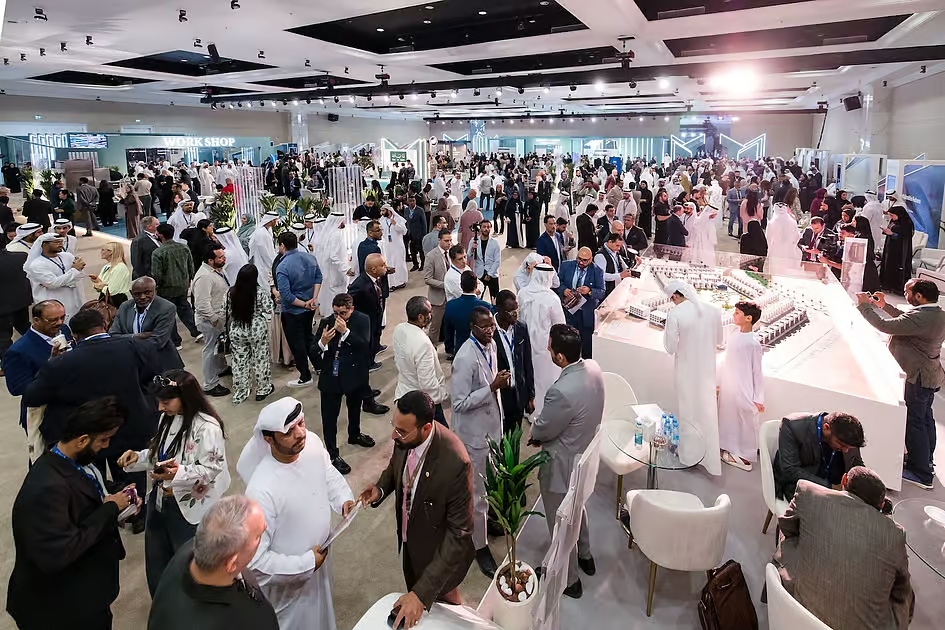
That was the consensus emerging from discussions at the ninth Sharjah Investment Forum (SIF 2026), where entrepreneurs, investors and technology leaders said the UAE has positioned itself at the forefront of the global AI economy by combining supportive regulation, digital infrastructure and a willingness to adopt emerging technologies at scale.
Participants argued that the region’s AI landscape has evolved rapidly from pilot projects to real-world applications that improve productivity, increase sales and attract capital.
For Pablo Charron, founder and chief executive of UAE-based startup Ayan, the true test of AI lies in commercial results rather than technical sophistication. His company helps brands understand how AI assistants influence consumer buying decisions.
“AI impact has to be measured where the sale happens, online and in store and the UAE is the right place to build this,” Charron said. “Leaders here decide fast, and AI is already part of how the country runs every day. Nobody needs convincing, it matters. They want to know what it changes.”
The growing focus on returns is reflected in investment flows. AI and AI-enabled companies in the Middle East and North Africa raised $678 million in the first half of 2026, up 81 per cent year-on-year, with the UAE accounting for 93 per cent of the total, according to figures cited during the forum. The country’s ambitions received another boost when the UAE Cabinet approved a plan earlier this year to run half of government services on agentic AI within two years.
Industry leaders said AI is already reshaping sectors ranging from finance and healthcare to media and marketing.
Jigar Sagar, founder of Triliv Holdings, said adoption is accelerating because organisations are starting to see tangible value. “The value comes when it is applied to a real problem. Traditional sectors such as financial services, education and healthcare have been quick to adapt to AI, and that will change how society functions,” he said.
The impact is particularly visible in content creation. Varun Mayya, founder and chief executive of Aeos, told delegates that AI has dramatically altered production economics, citing examples where content creation costs have fallen from about $1,000 to $50 per hour. His company now produces around 2,000 videos a month using AI-powered workflows.
Yet Mayya warned that technology alone cannot guarantee success. “There is one thing AI cannot do. It cannot create distribution,” he said. “AI makes products easier to build. Attention is scarce to gain. The owner of the audience wins.”
Others argued that the UAE’s advantage extends beyond technology. Saqr Ereiqat, secretary general of the Dubai Digital Asset Association, said the country had invested early in building the foundations required for a digital economy.
“We are just at the beginning of this curve when it comes to the digital economy powered by AI,” he said. “Trust is the new currency, and the UAE is using it to attract capital and talent.”
Source: Khaleej Times