

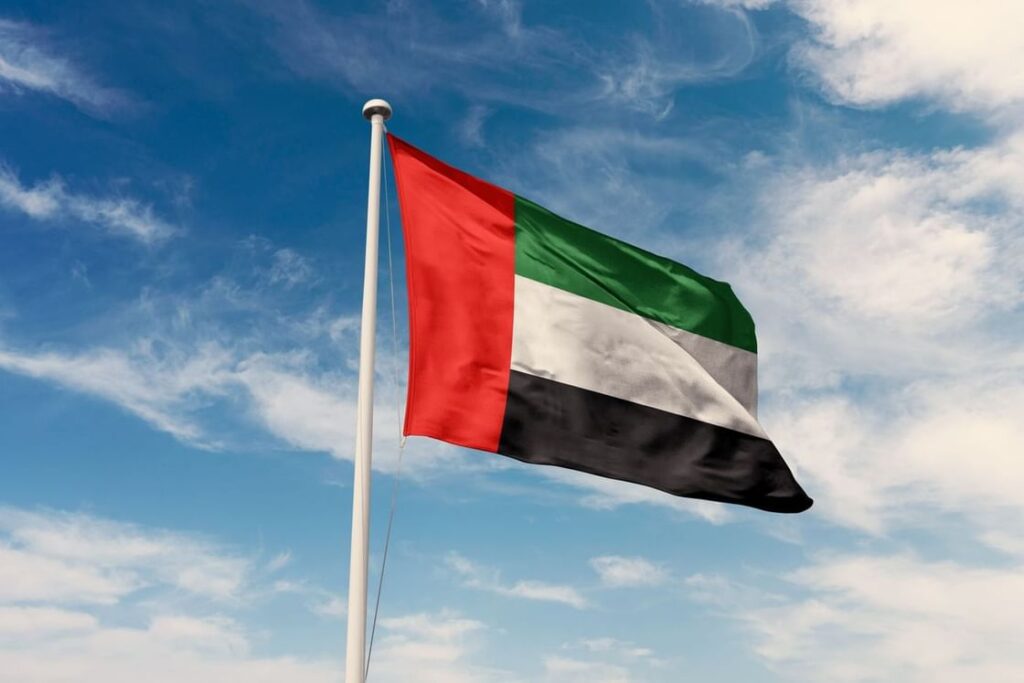
KUWAIT, 8th July, 2026 (WAM) — The UAE topped the list of Arab destinations for foreign direct investment (FDI) in 2025, attracting US$48.2 billion, representing 40.4 percent of the total. It also ranked first in the Arab world and 17th globally in Dhaman’s 2025 Composite Investment Climate Index, improving by two places compared with the 2024 index.
According to UNCTAD estimates cited in Dhaman’s annual report, FDI inflows to Arab countries fell 10 percent to US$119.3 billion in 2025. More than 80 percent of total inflows were concentrated in three Arab countries, while the region’s share of global FDI declined to 7.3 percent and its share of FDI to developing economies fell to 13.3 percent.
Dhaman revealed that the average Arab ranking remained stable at 102nd place globally in its composite index of investment climate components for 2025. This reflects the continued gap from the global average ranking of about 23 places, despite 13 Arab countries recording an improvement in their rankings within the index.
In its 41st Annual Investment Climate Report 2026, launched on Wednesday from its headquarters in Kuwait, the corporation recommended adopting integrated and flexible programmes to enhance the Arab investment environment.
These recommendations focus on four key areas: political and security; institutional, legislative, and procedural; economic; and the production elements; this comes particularly after the Capex of FDI projects in the Arab world declined by 9 percent falling to $112 billion in 2025 due to geopolitical developments.
At the political and security levels, the corporation underscored the importance of intensifying peaceful efforts to resolve conflicts and strengthening regional coordination to combat terrorism, organised crime, and external interference. It also emphasised the need to modernise security systems, de-escalate civil unrest, and reinforce the rule of law.
As for the institutional, legislative, and procedural environment, the report recommended updating and simplifying investment and business laws to keep pace with developments transparently, with digitising and automating procedures and reducing their duration, with the need to strengthen governance, quality control systems, and develop the justice and law enforcement system to protect investors and their rights through local legislation, international agreements, and advanced arbitration services, in addition to providing insurance against political and commercial risks.
With respect to the economic environment, the institution stressed the adoption of policies to curb inflation to enhance currency stability, reform the tax and customs systems, and develop infrastructure and logistics.
It also called for empowering the private sector and stimulating its participation and diversifying economic resources by offering additional benefits and incentives to targeted sectors.
Concerning the production elements, the report emphasised the importance of developing human capital and bridging the skills gap through education and training, increasing labour market flexibility, making industrial and service land available and accessible, diversifying and facilitating direct financing channels, and activating the role of banks and financial institutions.
The demands also included localising knowledge, stimulating research and development in the production and service sectors, and securing local supply chains, intermediate inputs, and essential components.
The organisation called for several points to be considered, most notably: learning from the experiences of countries that have successfully improved their investment environment and rankings in international indices; starting with the easiest and most effective; relying on technology and e-services; and taking into account the differences between countries in terms of resources, capabilities, and challenges.
The report also highlighted the ranking of Arab countries in the 2025 Composite Investment Climate Index, revealing that the GCC countries, Jordan, and Morocco led the Arab world. The UAE ranked first regionally and 17th globally, followed by Qatar in second place regionally and 38th globally, then Saudi Arabia in third place regionally and 40th globally.
Oman came in fourth regionally and 51st globally, followed by Kuwait in fifth place regionally and 52nd globally. Bahrain ranked sixth regionally and 57th globally, then Jordan in seventh place regionally and 74th globally, and finally Morocco in eighth place regionally and 75th globally.
Tunisia and Egypt also achieved better rankings than the Arab average, placing 95th and 100th globally, respectively.
In contrast, 11 other Arab countries ranked near the bottom of the list, ranging from 104th to 158th globally, respectively.
Source: Emirates News Agency