

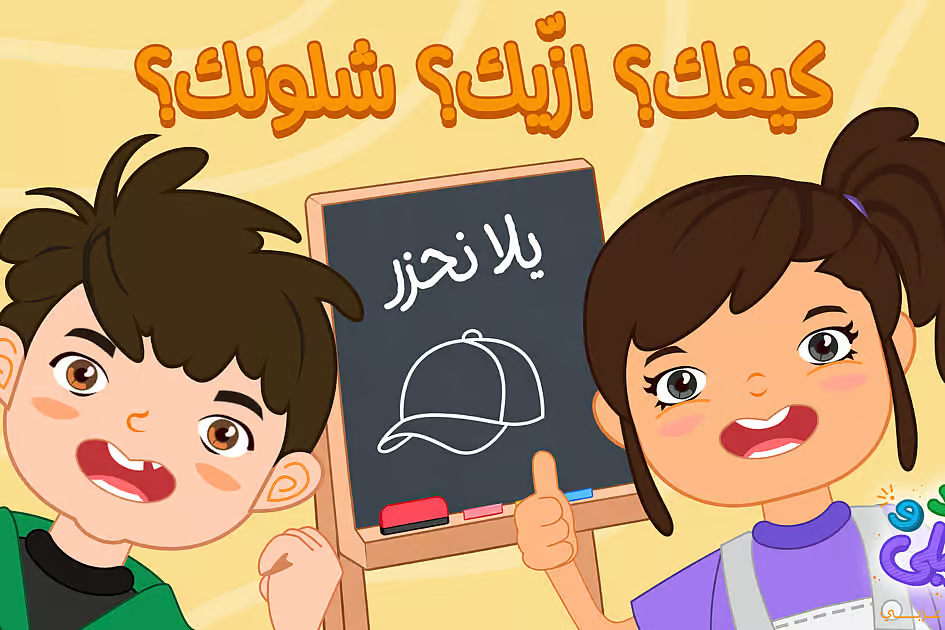
When Dubai-based parents Mira Chlala and her husband George struggled to find modern Arabic cartoons for their children, they decided to create their own.
A year later, their animated series Jad w Laila has attracted more than 80 million views on YouTube.
The Lebanese couple launched The Feb Kids in October 2025, hoping to create entertaining and educational cartoons in Lebanese Arabic, the language their children speak at home.
“Every time we looked for something in Arabic for the kids to watch, we’d end up back on English cartoons,” Mira told Khaleej Times.
“After a while the conversation shifted from ‘why isn’t there anything?’ to ‘what if we made it ourselves?'”
The studio’s name also has a personal connection to their family.
Both children were born in February, and George explained that “Feb Kids” had already become a nickname used for everything from family schedules to streaming profiles.
Keeping Arabic alive at home
Raising their children in Dubai, the couple noticed how easily English became their preferred language, even when the family continued speaking Arabic at home.
“You speak to them in Arabic and they answer in English, they start reaching for English words first, and their Arabic sentences get shorter,” George explained.
For the couple, maintaining their children’s connection to Arabic was about more than learning another language. It was also a way to preserve family traditions and help them communicate with their grandparents.
“And we didn’t want Arabic to feel like a duty. We wanted it to feel like fun,” Mira added.
Their solution was to create Jad w Laila, a cartoon following two children through everyday experiences, from playdates and doctor’s appointments to family road trips.
The episodes combine humour, music and animation with lessons about handling emotions, learning new things and overcoming fears.
“Our test is simple: would our own kids ask to watch it again?” Mira said.
From family idea to 80 million views
The couple never expected their project to reach so many families.
“We launched in October 2025 hoping other parents had the same problem as us, and that maybe a few thousand families would find us,” Mira recalled.
“When we saw how far it had reached, we just looked at each other. I got emotional. More than any number, it told us we weren’t the only parents looking for this.”
Creating the series has also become a family effort. Mira develops story ideas from moments with her children before working with independent Arab writers, artists, animators and voice actors.
Their children even contribute to the show. In Season 2, Jad receives a robot named Zaki, a character designed by the couple’s son.
The second season features seven episodes, all now available on YouTube, including a visit to the UAE.
“The UAE episode is special for us, because this is where our kids are growing up, and we wanted families here to see their own home on screen,” Mira explained.
Parents share their reactions
Beyond the view count, the couple say some of their most meaningful moments come from messages sent by other parents.
One message in particular stayed with Mira.
“One message that really stayed with me was from a parent who told us their child spoke to their grandmother in Arabic for the first time after watching the show,” she said.
“That’s exactly why we started.”
The couple are now working on a third season of Jad w Laila while expanding Nour Super Sun, another series designed for toddlers in Lebanese Arabic and Modern Standard Arabic.
They also hope to make their characters accessible to more families through schools, digital activity books and other platforms.
“Our biggest dream is for Jad and Laila to be in every Arab home, wherever in the world that home may be, and in every dialect, whether it’s Khaleeji, Egyptian, Levantine, Iraqi or Maghrebi,” George said.
For Mira, however, the family’s involvement remains central to the project.
“And we want to keep making it the way we started: around our kitchen table, with our kids as the first audience.”
Source: Khaleej Times