

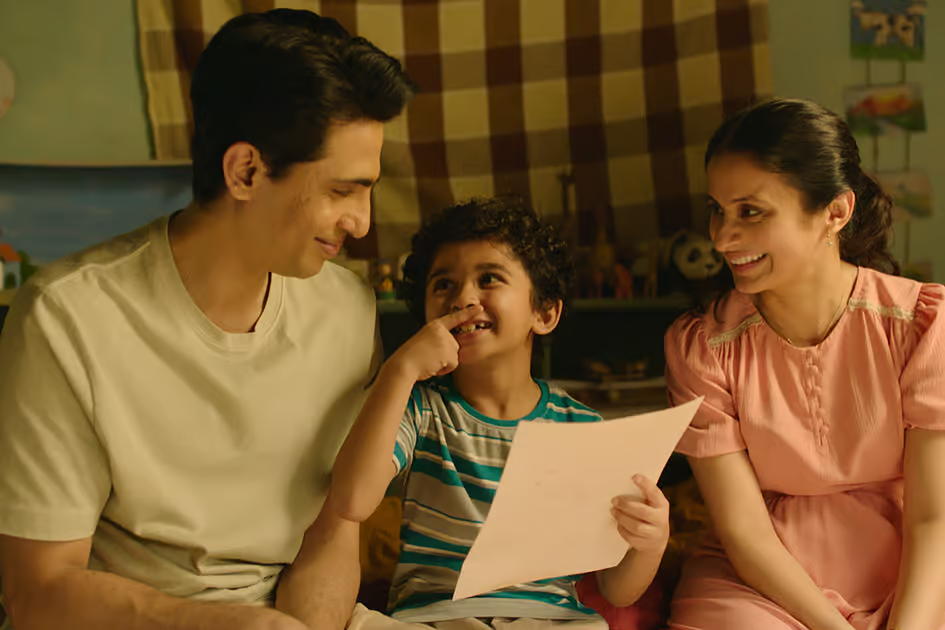
Gulshan Devaiah, who stars in the heartwarming Little Thomas, which releases this week in UAE cinemas, has an inherent connection to flower gardens. And likes to cultivate his career in cinema.
First the name. Gulshan (flower garden) was named so by his parents who were ardent cinema buffs. “As per a wrong horoscope calculation, they had to name me from the letters Ga and Gu and they chose Gulshan after Gulshan Bawra, the famous Indian lyricist,” he told Khaleej Times. “I first thought they named me after Tabassum jee’s famous show Phool Khile Hain Gulshan Gulshan and a film by the same name that was released the year I was born, but my parents knew better,” he adds.
The movie is set in the coastal state of Goa, famous for its beaches and resorts, but reminds you of the idyllic Indian television show of the 1980s, Malgudi Days.
The story revolves around a young couple and their son Thomas, who has a sincere request for his squabbling parents—he wants a sibling and he naively thinks that if he gets them to kiss, he can fulfill his aim. The story also meanders into the disappearing landscapes of quaint old bakeries and shops, once symbiotic to traditional neighbourhoods in villages of India.
Gulshan admits that he loves his name and likes to curate his “career garden”. Seen in films like Shaitan, The Girl in Yellow Boots, Goliyon ki Raas Leela-Ram Leela, Dum Maro Dum, Kantara and more, Little Thomas is unlike any role he has accepted.
“Producer Ranjan Singh called me during the second wave of Covid and sent me writer/director Kaushal Oza’s earlier work. After connecting to Kaushal, I read the script and was hooked. The film resonated with my own childhood. Thomas (played by child actor Hridansh) is an only child in the film and I am one too.”
He states that his character of Desmond is an older version of Thomas who lives in his own world of childhood formulas of solutions in an adult world. When Desmond sees his son being a younger version of him, he is a bit fearful for him. “He worries that Thomas is very naive like him and the fathers protective instinct kicks in,” Devaiah said. “His idealism comes from his innocence. He doesn’t want his son’s dreams to crash or get hurt though the child is unmindful of all the father thinks.”
As a child I too was like Thomas. I was a shy, introverted child who lived in a make believe parallel universe. I spent a lot of time in my imagination. Of course I didn’t ask my parents the questions that Thomas asks.
Gulshan Devaiah, Indian actor
So how did the introverted child take to a profession that is the right opposite. “My school was really helpful. My teachers noticed that I became another person onstage and encouraged me. Stage brought out another version of me that was very different from what I am in real life.”
Gulshan grew up in a township in the south Indian metropolis of Bengaluru, which had people from all over India- the reason he is comfortable in several languages. “I am a Kodava—apart from my mother tongue Koda takk, I speak Kannada, Hindi, English and Tamil. I follow Malayalam and can manage Telugu. But you hand me out something in Bengali and Marathi and I can pull that off effectively too.”
His parents were connoisseurs of Hindi film music and it was a normal affair for him to wake up to Mohammed Rafi songs of the 50’s and 60’s. He recounts the song, O Duniya ke Rakhwale, and films songs from Baiju Bawra, Jugnu, Leader and more. “While my parents took to the music in the films, I enjoyed watching them.”
Gulshan owned an audio cassette of the 1973 Bollywood cult classic Yaadon ki Baraat audio that had a figure of the late Dharmendra on its cover. “He was dressed in denim and brandishing a Rampuri (a dagger) and that image stayed with me. I did use that as an influence in my role in Guns and Gulabs (the Netflix series).”
On working with child actors
Is working with child actors challenging. “Not with Hridansh but I have had other experiences where it was not easy. It is challenging. Actors are very technical, some manage well around kids and some don’t. Sometimes when I see infants on sets, I almost feel guilty. But the directors and assistant directors deal with them. I don’t have to necessarily befriend kids. An actor is in his/her zone and it could be an added pressure to befriend a child. It comes with a lot of responsibility—because you cannot be inconsistent with them.”
Gulshan was also seen in the character of the king Kulashekhara in the film Kantara—a character with so much of overweening pride and entitlement that he becomes laughable. “Folk theatre forms in Karnataka like Yakshagana have a tradition of comedy in terse situations. In the middle of serious scenes characters like Duryodhana and Ravana crack jokes and get goofy,” he said. “Since Rishab Shetty (the director of Kantara) is from the same tradition, he envisioned my character like that.”
Does he see himself going back to the theatre some day. “No. I am happy with my time in front of the camera. Theatre takes a lot of time and dedication. Right now I am having fun with my cinema roles.”
An NIFD graduate, does he take care of how he appears off screen? “I’m a clothes horse and curate my appearance. On screen I go with what the character wears but off screen, I unleash a lot of what I want to say,” he said.
“The extroverted version of me comes out. I am fond of vintage clothing and I frequent thrift shops and fish out pretty unique things.. like Versova (a locality in Mumbai) ka Versace,” he laughs.
Little Thomas is produced by Kaushal Oza, Anurag Kashyap, Ranjan Singh, Akshay Thakker, and Anushka Shah and backed by banners, including Luminoso Pictures, Civic Studios, Good Bad Films, and Flip Films.
Source: Khaleej Times