

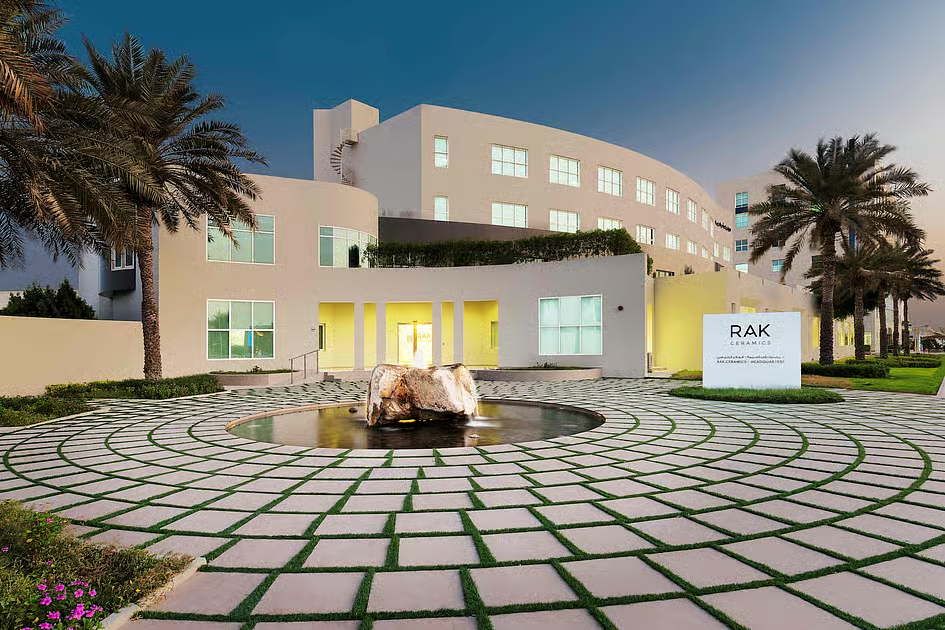
RAK Ceramics, listed on the Abu Dhabi Securities Exchange, reported a 15.5 per cent rise in third-quarter net profit after tax to Dh78 million, up from Dh67.5 million a year earlier, as strong demand in the UAE, the Middle East and India lifted sales.
Revenue for the quarter ended September 30 rose 4.4 per cent year-on-year to Dh861.5 million, from Dh824.9 million in Q3 2025. Profit before tax climbed 13.4 per cent to Dh98.3 million, while EBITDA rose 4.7 per cent to Dh175.7 million.
Stay up to date with the latest news. Follow KT on WhatsApp Channels.
Gross profit margin was broadly stable at 40.3 per cent, against 40.5 per cent a year earlier, despite higher material and energy costs.
“We delivered a strong performance in Q3 2026, with revenue growth and double-digit profit growth despite continued geopolitical uncertainty, supply chain disruptions and elevated logistics costs,” said Abdallah Massaad, CEO of RAK Ceramics.
The quarter’s gains lifted a year-to-date picture that is otherwise steady.
For the nine months to September 30, revenue edged up 0.7 per cent to Dh2,445.1 million, and net profit after tax rose 1 per cent to Dh184.5 million. Profit before tax was broadly stable at Dh237 million, while EBITDA declined 0.8 per cent to Dh460.5 million. Gross margin held at 40.3 per cent.
Net debt stood at Dh1.59 billion at the end of September, up 4.7 per cent from the end of June. The net debt to EBITDA ratio rose to 2.56x from 2.48x at June 30. Net debt was 3.1 per cent lower than a year earlier.
UAE leads growth
Tiles, the group’s largest segment, saw revenue rise 8.4 per cent to Dh519.9 million, driven by growth in the UAE, the Middle East and India. The company said strong project demand and constrained imports supported sales in the UAE and Middle East.
In the UAE, revenue from tiles and sanitaryware surged 32.5 per cent to Dh313.8 million, driven by robust construction activity, project sales and demand for slabs. Import disruptions helped the company gain market share. In the wider Middle East, excluding the UAE and Saudi Arabia, revenue rose 38 per cent to Dh41.6 million.
India revenue rose 12 per cent to Dh92.8 million, supported by dealer network expansion.
Not all markets performed well. Revenue in Saudi Arabia fell 17.2 per cent to Dh43 million, mainly due to delays in SABER approvals that affected deliveries. In Europe, revenue declined 19.9 per cent to Dh68.2 million, hit by higher logistics costs, competition and shipment delays. Bangladesh revenue fell 11.7 per cent to Dh54.7 million because of gas shortages.
Among the other segments, sanitaryware revenue fell 7.3 per cent to Dh114.8 million, as growth in GCC markets only partly offset weaker sales elsewhere.
No price increases
In an interview with Khaleej Times, Massaad said the company’s multi-country manufacturing and distribution network gave it a hedge against disruption in any single market.
He said the company had held back from raising prices.
“We said we do not want to benefit from the situation and increase our prices, which we could have done,” he said, adding that the company kept supplying customers throughout.
He said technical teams developed alternative formulations using locally sourced raw materials, which also supported the company’s sustainability focus, though some imported material is still needed. The company also used alternative logistics routes and inventory buffers to maintain supply.
Massaad said the Kludi acquisition had helped the company win hotel and large-project business by offering a full package of tiles, slabs, sanitaryware, faucets and tableware.
Saudi plant on track
The company’s greenfield tiles project in Yanbu, Saudi Arabia, remains on track for completion in the second quarter of 2027.
Massaad said the company is also upgrading its UAE factories, including its sanitaryware facility, where it is adopting energy-efficient technologies and initiatives to cut carbon emissions.
Capital expenditure for the nine months fell 24.6 per cent to Dh162.5 million. Massaad said some planned capex this year had been delayed in response to market conditions. “The whole plan has not changed, but it gets adjusted and adapted,” he said.
On growth, he described the company’s approach as a blend of organic expansion and acquisitions, pointing to Kludi and the more recent purchase of tableware brand Cookplay, which strengthened its position with Michelin-starred restaurants and hotels. “We do sustainable growth,” he said.
Massaad said the company, which he described as among the world’s top five tile producers, does not compete with Chinese and Indian manufacturers on price. “We are not a commodity… we are a global brand focusing on innovation and differentiation,” he said.
Looking ahead, Massaad said the company would stay agile, strengthen its core markets and progress value-creation initiatives in Europe, India and Bangladesh, while continuing to invest in the Saudi facility, retail expansion and higher-value products. “We remain confident in RAK Ceramics’ long-term growth prospects,” he said.
Source: Khaleej Times