

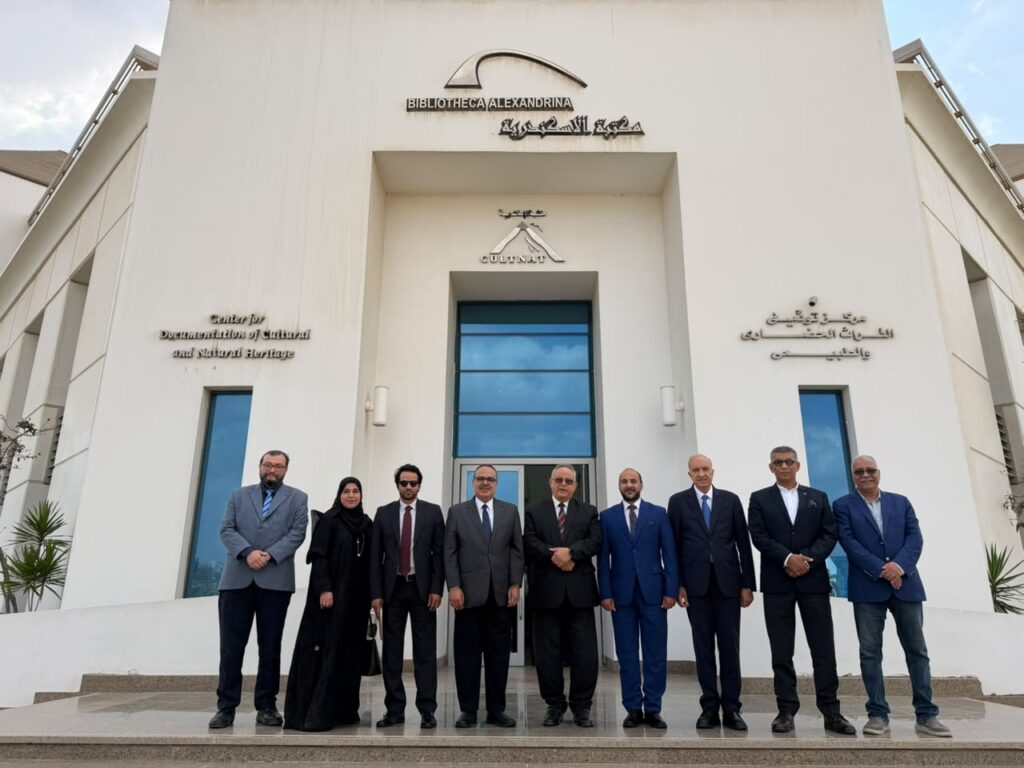
ALEXANDRINA, 25th October, 2026 (WAM) — The Sharjah Institute for Heritage has held a series of meetings with scientific and academic institutions in Egypt, led by the Bibliotheca Alexandrina, to explore opportunities for cooperation, exchange expertise and develop joint initiatives in cultural heritage documentation, digitisation, publishing and library development.
As part of its efforts to strengthen scientific and academic partnerships and advance the preservation, protection and accessibility of cultural heritage, the institute was represented by a delegation headed by Dr Abdulaziz Al Musallam, Chairman of the Sharjah Institute for Heritage. During a visit to the Bibliotheca Alexandrina, Dr Al Musallam met Professor Ahmed Zayed, Director of the library.
The meeting focused on three key areas of cooperation: completing and developing the electronic portal for the Thesaurus of Intangible Cultural Heritage in the Arab World; strengthening joint publishing programmes; and developing the Sharjah Institute for Heritage’s libraries. The discussions also explored how the institute could benefit from the Bibliotheca Alexandrina’s expertise in knowledge management, digitisation, archiving and the use of modern technologies to preserve and provide access to knowledge resources.
Dr Al Musallam emphasised the institute’s commitment to expanding its partnerships with Egyptian scientific and academic institutions to promote the exchange of expertise and strengthen Arab cooperation in safeguarding, documenting and disseminating cultural heritage.
He highlighted the importance of working with the Bibliotheca Alexandrina and drawing on its scientific and technological experience to develop systems for preserving heritage and making it accessible, while keeping pace with rapid digital transformations in knowledge management.
Dr Al Musallam praised the Bibliotheca Alexandrina’s scientific and intellectual contribution to documenting and preserving cultural heritage.
He noted that cooperation between the two institutions would open up opportunities to develop distinctive initiatives and projects serving researchers and specialists, strengthening the presence of Arab heritage in the digital sphere and broadening access to its knowledge resources and content.
He explained that the meeting had resulted in an agreement on a range of joint scientific programmes and knowledge-based activities, which are expected to be implemented in phases from 2027 onwards. The two sides also agreed to accelerate work on completing the electronic portal for the Thesaurus of Intangible Cultural Heritage in the Arab World.
The portal will make its content accessible to researchers and specialists while helping to organise, document and disseminate heritage-related terminology and concepts in accordance with specialised scientific and methodological standards.
Dr Al Musallam added that the institute continues to develop its scientific and knowledge-based projects, drawing on a publishing portfolio of more than 1,300 titles covering various aspects of cultural heritage. Its ongoing work in digitisation, documentation and publishing further supports access to heritage knowledge for researchers, experts, academics and other interested audiences, while enhancing its presence in the cultural and scientific landscape.
For his part, Professor Ahmed Zayed, Director of the Bibliotheca Alexandrina, welcomed the Sharjah Heritage Institute delegation and praised the existing cooperation between the two institutions, highlighting the opportunities it offers for exchanging expertise and developing joint scientific and knowledge-based projects.
He expressed his hope that the agreed programmes and plans would be implemented more swiftly, contributing to efforts to preserve and safeguard cultural heritage and achieve the institutions’ shared knowledge and research objectives.
The visit forms part of the Sharjah Heritage Institute’s broader strategy to build effective partnerships with Arab cultural and scientific institutions, develop tools for documenting and safeguarding heritage, and strengthen integration between scientific expertise and modern technologies. These efforts aim to support scientific research, preserve Arab cultural memory and ensure the sustainability of heritage knowledge and its transmission to future generations.
Source: Emirates News Agency