

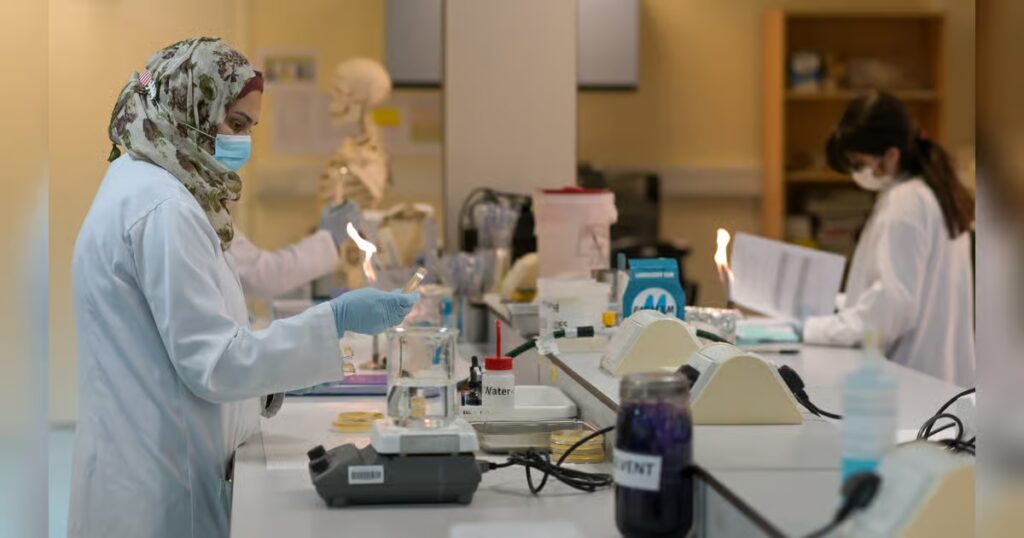
UAE researchers are developing an experimental way to deliver chemotherapy directly to breast tumours, using tiny capsules that recognise cancer cells and release their drug payload when exposed to ultrasound.
The approach, being developed by a team at the American University of Sharjah (AUS), is designed to concentrate chemotherapy at the tumour site while limiting the amount of the drug reaching healthy parts of the body, potentially reducing some of the side effects associated with conventional treatment.
The team has secured its third US patent for the technology, with the latest patent covering capsules designed to recognise a protein found on some breast cancer cells that could not be targeted by the team’s earlier version.
Stay up to date with the latest news. Follow KT on WhatsApp Channels.
Dr Ghaleb Husseini, Associate Vice Chancellor for Research and Professor of Chemical and Biological Engineering at AUS, and Dr Mohammad Al Sayah, Professor of Biology, Chemistry and Environmental Sciences, told Khaleej Times that the system uses tiny fat-based capsules, known as liposomes, to carry chemotherapy through the bloodstream.
The capsules, measuring about 100 to 200 nanometres across, are coated with antibodies that act like an address label, helping them recognise proteins on the surface of cancer cells.
For the earlier version, the researchers attach trastuzumab, commonly known as Herceptin, to target HER2-positive breast cancer cells. The newly patented version uses cetuximab to recognise EGFR, a protein found in some breast cancers, including certain cases of triple-negative breast cancer.
Once the capsules reach the tumour, focused ultrasound is applied to disrupt them and release the chemotherapy at the targeted site.
How ultrasound triggers the release
The researchers said the approach combines two mechanisms: antibodies that help direct the capsules towards cancer cells, and ultrasound that triggers the release of the drug when it reaches the intended area.
This differs from conventional chemotherapy, which circulates through the body, and from some existing liposomal drugs that release their contents gradually rather than in response to an external trigger.
The chemotherapy drug used in the experiments is doxorubicin, which is widely used in cancer treatment but can cause damage to the heart.
The researchers said focused high-frequency ultrasound can target an area just a few millimetres in size, allowing the drug to be released primarily around the tumour while aiming to minimise exposure to surrounding healthy tissue.
In laboratory experiments, low-frequency ultrasound triggered the release of about 92 per cent of a model substance called calcein from the antibody-coated capsules, compared with 86 per cent from capsules without antibodies. Calcein was used to test the release mechanism and was not the chemotherapy drug itself.
The researchers also found that the antibody-targeted capsules had a significantly stronger effect on HER2-positive cancer cells than on HER2-negative cells in laboratory tests. Neither empty capsules nor ultrasound alone caused significant cell damage in those experiments.
What animal studies have shown
The earlier Herceptin-targeted version is undergoing animal testing. The researchers said an initial study involving 100 mice showed a reduction in tumour size when the antibody-coated capsules were combined with ultrasound.
They are now repeating the experiments with appropriate control groups to validate the findings. The studies are being conducted at the University of Sharjah’s animal facility, with approval from its Animal Care and Use Committee.
The researchers said the animal studies are examining whether the approach can improve drug delivery to tumours while reducing exposure to healthy tissue. Further work is needed to establish its safety and effectiveness.
The newly patented cetuximab-targeted version is at an earlier stage. Experiments examining ultrasound-triggered drug release and cell responses are already under way, with the next step being tests on EGFR-positive triple-negative breast cancer cells.
If those results are positive, the researchers plan to move to animal studies examining tumour response, drug distribution and possible effects on the heart and other organs.
Still years away from human trials
The researchers stressed that neither version has been tested in human patients and that the technology remains several years away from clinical trials.
Before either approach could be considered for human testing, it would need further preclinical studies, formal toxicology and safety assessments, manufacturing to pharmaceutical quality standards and regulatory approval.
Producing the antibody-coated capsules consistently at a larger scale is among the challenges. The team also needs to establish how effectively ultrasound can reach deeper tumours and confirm the findings in larger animal models.
The researchers said the aim is to improve treatment effectiveness while reducing side effects, but whether this can be achieved in patients remains to be established.
The three US patents are owned by AUS. The first, granted in 2020, covered the Herceptin-targeted capsules, while the second, granted in 2024, added further ultrasound frequencies and power levels. The latest patent, granted on June 23, 2026, covers the cetuximab-targeted approach.
The team is now working with AUS Technology Portfolio Manager Soumya Tiwari to approach pharmaceutical and biomedical companies for potential licensing and commercialisation partnerships.
The researchers said the platform could eventually be adapted to other cancers by changing the antibody on the capsule to recognise a different cancer-cell marker, while retaining the same basic drug-delivery system.
Source: Khaleej Times