

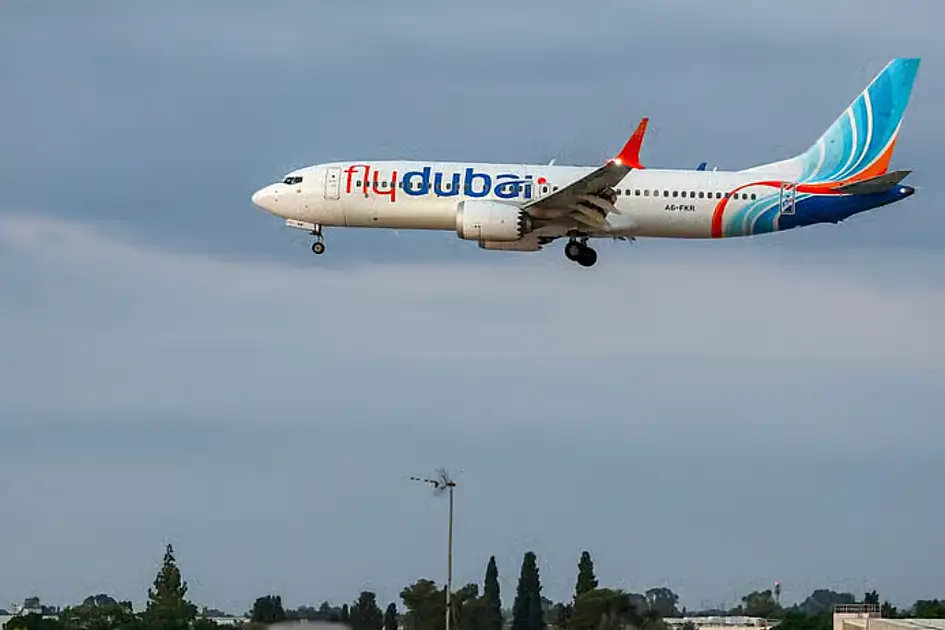
After a “terrorist act” on September 30 in a flydubai FZ1073 flight from Dubai to Tel Aviv, many questioned how the co-pilot of the plane was able to bring in a weapon. But the weapon wasn’t brought in; it was a crash axe, a safety tool required in the aircraft in case of emergencies. When required, the crash axe can be used as tool to break through windows, doors or panels.
Are crash axes required on every flight? Here’s what UAE law has to say.
UAE GCAA regulations: Which planes require crash axe?
According to a 2025 update of UAE General Civil Aviation Authority regulations, aeroplanes must be equipped with at least one crash axe or crowbar, if they meet any of the following conditions:
-
A Maximum Certified Take-off Mass (MCTOM) of more than 5,700kg
-
A Maximum Operational Passenger Seating Configuration (MOPSC) of more than nine
The crash axe or crowbar must be located in the flight crew compartment. In case of an MOPSC of more than 200, an additional crash axe or crowbar shall be installed in or near the rearmost galley area. Any crash axe or crowbar, if located in the passenger compartment, should not be visible to passengers, according to the GCAA document.
Stay up to date with the latest news. Follow KT on WhatsApp Channels.
Was crash axe required on Flydubai FZ1073?
Yes.
Crash axes are required on planes with an MOPSC of over nine passengers; Flydubai FZ1073 flew 174 passengers from Dubai to Tel Aviv.
Flydubai operates a single fleet-type of Boeing 737 aircraft. These include the Next-Generation Boeing 737-800, Boeing 737 MAX 8 and Boeing 737 MAX 9 aircraft.
Each of these have a MCTOM of well over the 5,700kg specified in the GCAA regulation.
-
Next-Generation Boeing 737-800: MCTOM of 79,010kg (174,200 lb)
-
Boeing 737 MAX 8: MCTOM of 82,640kg (182,200 lbs)
-
Boeing 737 MAX 9: MCTOM of 88,310kg (194,700 lbs)
What happened on, and after FZ1073?
Flydubai initally said that an “incident” on board led to the diversion of the FZ1073 Dubai-Tel Aviv flight, which landed safely in Saudi Arabia’s Tabuk Airport, later confirming that an “altercation” had occurred.
All passengers were accounted for, and flydubai deployed two replacement aircraft to Tabuk. On the same day, flydubai said its Israel flights will be suspended; Emirates also suspended its codeshare flights with flydubai to and from Tel Aviv.
In its first statement, UAE’S GCAA said the “security incident” had been brought under control, and that some members of the aircraft crew were injured and taken to hospital in Saudi Arabia for medical treatment.
The following day, on October 1, UAE’s Attorney-General Counsellor Dr Hamad Saif Al Shamsi ordered the formation of an investigation team comprising specialised members of the Public Prosecution to examine the FZ1073 incident.
An official Saudi source said preliminary investigations by Saudi authorities, conducted in coordination with a UAE security team, found that the co-pilot had assaulted the captain, resulting in injuries to both. Earlier, Israeli Prime Minister Benjamin Netanyahu had identified the injured captain as Indian national Captain Smit Machchhar.
On October 1, Indian embassy in UAE confirmed that the pilot “is in good health and recovering well” in the UAE, adding that India’s ambassador to the UAE Deepak Mittal visited Machchhar and his family at the hospital.
On October 2, the injured pilot gave his first public statements since the incident, speaking to Indian Prime Minister Narendra Modi, and describing how he managed to open the cockpit door despite his wounds, because he “couldn’t let everyone die”.
That same day, UAE presidential diplomatic adviser Anwar Gargash joined the outpouring of acclaim for the flydubai pilot, calling him a “true hero”, and saying he “embodied the meaning of courage and responsibility in the face of a dangerous terrorist act”.
Flydubai CEO Ghaith Al Ghaith also expressed “deep gratitude” to the captain, crew and pilots who secured the aircraft and landed it safely, as well as passengers who assisted the crew; he confirmed that the captain had returned to the UAE after receiving medical clearance.
On October 3, the UAE investigation found that the flydubai FZ1073 flight’s co-pilot attempted to carry out a “terrorist act”. The country’s Attorney General Counselor said the co-pilot launched the attack while the aircraft was in flight, assaulting the pilot inside the cockpit with a crash axe and attempting to take control of the aircraft.
The official stressed that investigations are still underway to establish the full circumstances of the incident, including the motive and any related connections, Al Shamsi said. Final findings will be announced once the necessary procedures are completed.
On Saturday, Dubai Crown Prince Sheikh Hamdan bin Mohammed bin Rashid Al Maktoum visited the injured flydubai pilot, who he said had demonstrated the “highest levels of courage, responsibility, and care for people’s lives”. He also expressed appreciation for the pilot on behalf of the UAE’s leadership, describing him as a source of pride for the country.
Source: Khaleej Times