

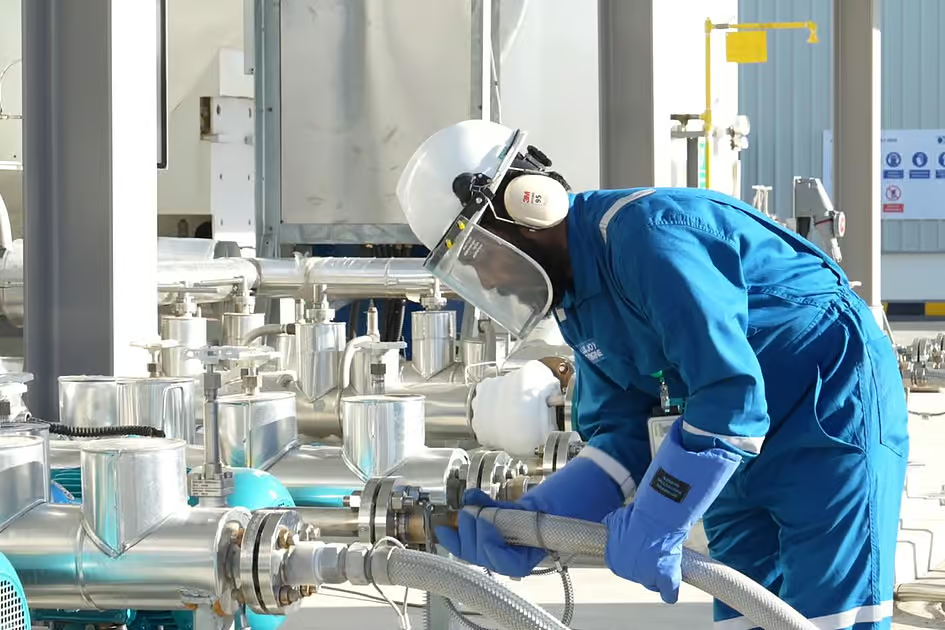
Demand for carbon dioxide is rising across the Gulf, driven by population growth, industrial expansion and the region’s reliance on imported food and desalinated water, according to the head of the region’s largest liquid CO₂ provider.
Ranjith Nair, CEO of Gulf Cryo, said the global CO₂ market was valued at $11.9 billion in 2025. The Middle East market is projected to grow 5.6 per cent a year to reach $2.29 billion by 2034, according to Polaris, with food and beverage accounting for 41 per cent of demand.
Stay up to date with the latest news. Follow KT on WhatsApp Channels.
“CO₂ is an essential input for food and beverage production, water treatment, healthcare and a wide range of industrial processes. We have built our capacity to meet local and regional demand today and secure future requirements,” he said.
What is driving demand
Nair said demand depends on several factors, starting with population. As the population grows, consumption of carbonated drinks and bottled water rises. Industrial growth adds to this, as sectors such as welding require CO₂.
Food security is another driver as about 80 per cent of the region’s food is imported, and greenhouses use CO₂ to boost plant growth. Hospitals also depend on it.
Water security is a further factor.
Nair said about 80 per cent of drinking water in the UAE is desalinated, and the GCC accounts for a third of global desalination capacity. Desalination, he said, cannot be done without CO₂.
Energy is also a source of demand. In enhanced oil recovery, CO₂ is pumped into maturing wells to improve yields, and Gulf Cryo supplies CO₂ captured from refineries for this purpose.
Nair said the push to cut emissions will add to demand. New industrial plants will be expected to emit less than older ones, creating more CO₂ to capture and process.
Forecasting the next five years
Declining to give a five-year demand forecast for the GCC, but Nair said the global CO₂ industry typically grows 1.5 to two times faster than GDP, though this varies by application. Gulf Cryo models demand country by country, he said.
Gulf Cryo is expanding to meet that demand. Regional capacity currently stands at 695 metric tonnes per day (MTPD) and will reach 1,300 MTPD by the end of 2026, or more than 470,000 metric tonnes a year. The expansion comes as several global markets face pressure on CO₂ supply.
By the end of the year, capacity will stand at 200 MTPD in the UAE, 750 MTPD in Saudi Arabia and 350 MTPD in Kuwait. These production centres also supply the wider GCC.
Nair said Gulf Cryo’s strategy is to secure each market with its own production first. The wider regional network then acts as backup during plant turnarounds, seasonal peaks or upstream disruption. A further 750 MTPD can be activated from existing facilities, taking total capacity beyond 2,000 MTPD, or around 750,000 metric tonnes a year.
He said the company has historically invested ahead of requirements. He cited the recent regional conflict, saying Gulf Cryo still served key sectors because it draws on five sources in three countries. Europe, by contrast, faced a major CO₂ shortage when its fertiliser-based sources stopped, he noted.
UAE supply
The largest step change is in the UAE, where capacity will quadruple to 200 MTPD, with room to add a further 150 MTPD. Central to this is Gulf Cryo’s second carbon capture facility in the country, in Abu Dhabi, due to become operational by the end of the year.
The facility will significantly reduce reliance on imports from the company’s plants in neighbouring countries. It will also fully secure the UAE’s CO₂ requirements for the foreseeable future, Nair said. It has been designed to scale up quickly whenever the market requires.
The project comes as the UAE, the first Gulf state to commit to net zero by 2050, issued its national Carbon Capture Policy in January 2026. ADNOC targets 10 million tonnes a year of capture by 2030.
Gulf Cryo’s carbon recovery operations rest on long-term agreements with industrial partners. These include RAK Ceramics in the UAE, Equate in Kuwait, and Petro Rabigh and Ma’aden in Saudi Arabia. New partners will be announced soon.
The company brought carbon capture technology to the region in 2014 at Equate, where annual output has grown to 127,750 metric tonnes, more than double the original 54,750.
Nair said the region’s capture build-out is accelerating. More than 98 per cent of Mena capture projects are in the GCC, Saudi Arabia targets 44 million tonnes a year by 2035, and the Jubail hub is set to capture up to 9 million tonnes a year from 2027.
Source: Khaleej Times