

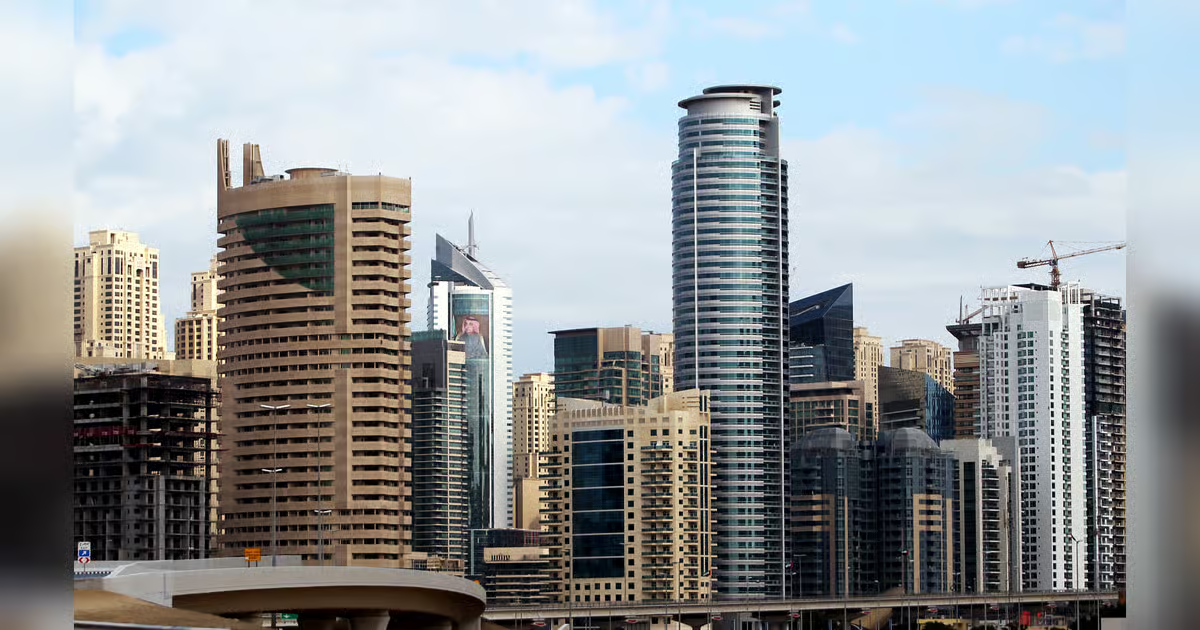
Dubai’s surge in population growth this year is driving property values, although the impact on residential prices may take time to fully emerge, according to Dubai-based real estate consultancy Cavendish Maxwell.
According to a Dubai census, more than 161,000 people moved to Dubai since the beginning of the year until July-end, which leaves the population at 4.74 million.
While the consultancy found that population growth and residential property prices generally move in the same direction over the long term, it said the relationship is only moderate, with prices also shaped by factors such as liquidity, supply, credit conditions and investor sentiment.
In Dubai, the strongest link between population growth and home prices typically emerges after a one- to two-year lag, suggesting migration pressures take time to filter through the housing market.
Stay up to date with the latest news. Follow KT on WhatsApp Channels.
Residential transactions down
Data by Chestertons revealed that residential transactions in Dubai fell 19 per cent quarter-on-quarter, while total sales value fell 36 per cent to Dh87.9 billion. Off-plan properties continued to be the main market driver, accounting for 76 per cent of transaction volume and 74 per cent of value. However, off-plan activity still saw a steep decline by around 15 per cent, compared with a sharper 30 per cent fall in the secondary market.
The London-based real estate agency said demand for high-quality space, set against constrained supply in several segments, is expected to keep Dubai’s fundamentals resilient into the second half of this year. This is, however, dependent on whether regional conditions stabilise and business confidence improves.
Average apartment sale prices stood at Dh1,814 per sq ft in Q2 2026, easing 3.1 per cent from the previous quarter but holding marginally above the same period last year. The quarterly correction varied across communities, with declines ranging from 0.3 per cent to 7.7 per cent, according to its market report.
Its data showed that the villa and townhouse segment remained the market’s standout performer, with average values reaching Dh2,339 per sq ft, up 7.7 per cent year on year, as constrained low-density supply continued to meet sustained demand. Annual gains were led by Jumeirah at 33.3 per cent, Victory Heights at 31.6 per cent, Al Barari at 22.9 per cent, Emirates Hills at 18.0 per cent and Jumeirah Village Circle at 15.5 per cent.
Housing prices expected to ease
Nagham Hassan, Market Analyst at etoro, said that rent prices, though they increased over the quarter, are starting to ease. While the regional instability brought along with it rising fuel and food prices, Hassan said that housing prices is one area where residents are getting some relief.
“For years, people arrived in the UAE faster than new homes could be built, and prices climbed to match, rising sharply across both cities” she said. “However, real estate firms are now reporting an influx of supply, taking pressure off housing costs.”
In Dubai, REIDIN’s index shows rents down 2.16 per cent month-on-month in June and 2.55 per cent year-on-year, with Cavendish Maxwell counting about 24,800 homes completed in the first half, the strongest in years as earlier projects reached handover. Abu Dhabi follows, with rents down 1.79 per cent month-on-month but still 3.61 per cent higher year-on-year, but all rental increases have been temporarily suspended in the emirate since June.
“New leases are already getting cheaper, but most current tenants may not feel the relief until they renew their annual contracts and find themselves being able to renegotiate for a lower rate” Hassan said, adding that the central bank is now pointing to easing housing costs as one reason it expects inflation to stay contained this year.
Source: Khaleej Times