

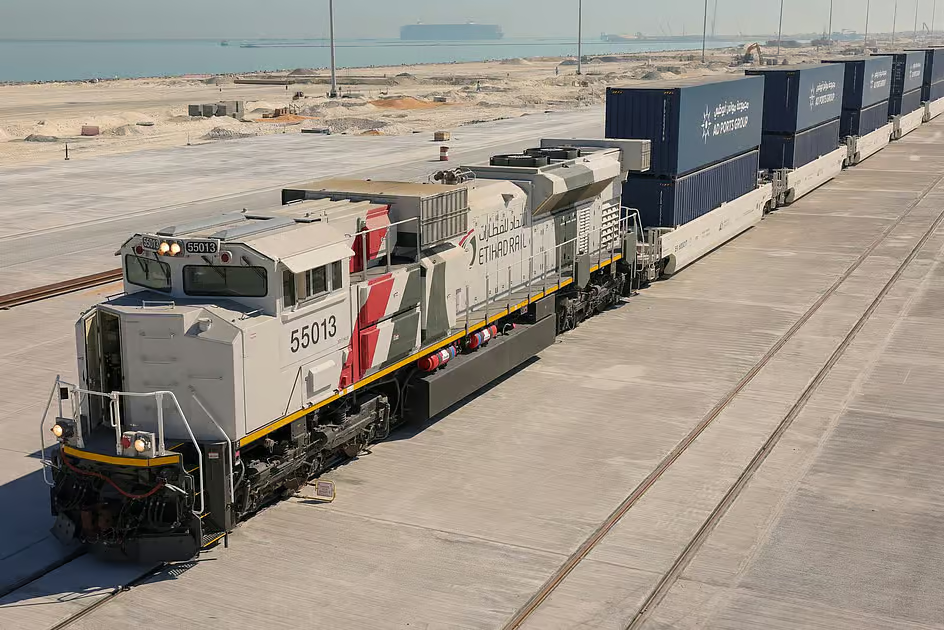
Etihad Rail and AD Ports Group on Sunday launched a direct rail freight service linking Fujairah Terminals on the Gulf of Oman with the Industrial City of Abu Dhabi (ICAD).
The service runs three times a week. It combines a dedicated rail freight link with a customs-enabled inland cargo gateway at ICAD, allowing containers landed in Fujairah to travel about 200km by rail for inspection, clearance and release.
Stay up to date with the latest news. Follow KT on WhatsApp Channels.
ICAD has been given its own UN Locode (AECAD), which makes it a recognised logistics location in global shipping and trade systems. For the first time, shipping lines, freight forwarders and cargo owners can book cargo directly to ICAD as the destination and clearance point.
Combined with dedicated customs and inspection infrastructure, the arrangement is meant to simplify customs procedures, cut handling requirements and speed up the movement of goods across Abu Dhabi.
Rail corridor
Fujairah Terminals is part of the wider AD Ports Group network and supports connectivity across the GCC, India, the Red Sea and East Africa.
The launch follows a “bonded rail corridor” agreed last October between Khalifa Port and Fujairah Terminals, which lets goods move under customs control without immediate payment of import or export duties. The memorandum was signed by Etihad Rail, Abu Dhabi Customs, Fujairah Customs, AD Ports Group, Fujairah Terminals and Noatum Logistics, in the presence of Sheikh Theyab bin Mohamed bin Zayed Al Nahyan, Chairman of Etihad Rail.
Freight operations began across the full 900km network in 2023. Etihad Rail has said four of its 11 freight terminals connect to ports: Ruwais, Khalifa, Jebel Ali and Fujairah. The operator has said it expects to move 60 million tonnes of freight a year by 2030.
Fujairah also gained a passenger rail link this year, with services between Abu Dhabi and Fujairah starting on June 30.
Who it serves
The service is aimed at importers, exporters, manufacturers, distributors and logistics providers in Abu Dhabi, allowing them to receive cargo nearer to warehouses, production facilities and end markets. The operators say it offers reliable schedules, less road congestion, capacity for high-volume cargo and lower carbon emissions than long-haul trucking.
Omar Alsebeyi, CEO of Etihad Rail Freight, said the service brings key port services closer to where cargo is ultimately needed.
He said it would help customers move goods more efficiently and shorten the time between vessel arrival and final delivery.
Saif Al Mazrouei, Chief Executive of the Ports Cluster at AD Ports Group, said the service extends the reach of the group’s port infrastructure beyond the terminal.
He said it gives businesses greater flexibility in accessing markets and managing supply chains, and reinforces Abu Dhabi’s position as a gateway of choice for trade and industry.
Source: Khaleej Times