

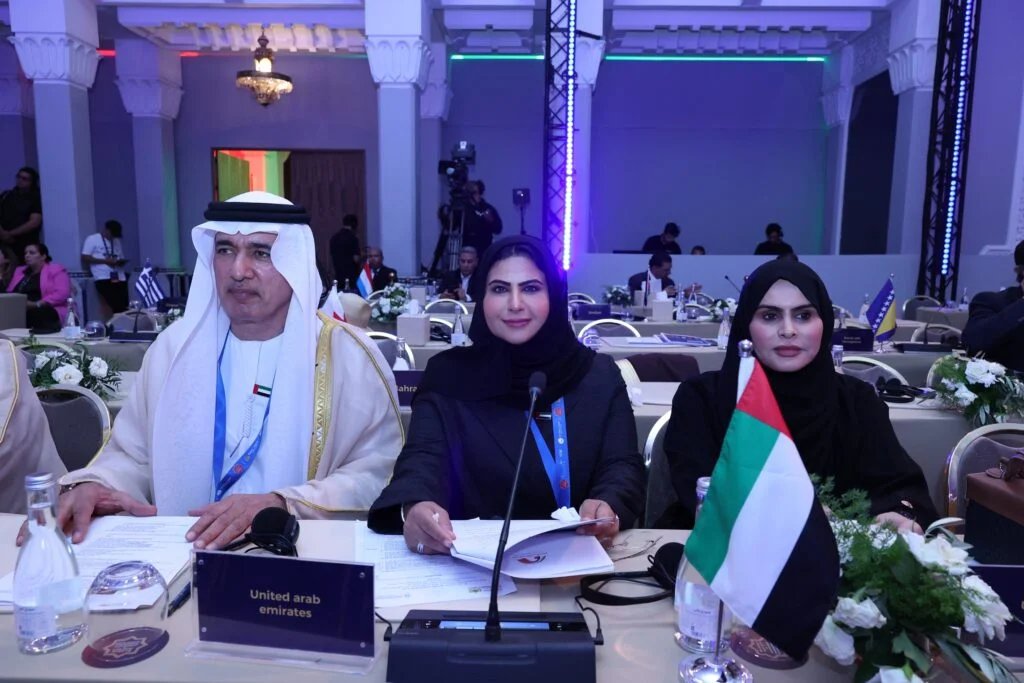
MARRAKECH, 20th June, 2026 (WAM) — Aisha Rashid Laytim, member of the Federal National Council (FNC), participated in the 4th edition of Marrakech Parliamentary Economic Forum for the Euro-Mediterranean and Gulf Region hosted by the House of Councillors of the Kingdom of Morocco in cooperation with the the Parliamentary Network of the World Bank and the International Monetary Fund (IMF).
During a session on promoting job creation through the blue economy, Laytim stressed that the blue economy has become one of the fastest-growing sectors worldwide, offering significant economic and investment opportunities linked to ports, maritime transport, sustainable tourism, renewable energy, marine industries and food security. She noted that it has become an integral component of global economic security and sustainable development.
She highlighted that small and start-up enterprises have proven to be the real drivers of innovation in modern economies, owing to their ability to adapt to technological transformations, respond to market needs and create employment opportunities, particularly for young people. She added that successful economies today are those with legislative and financial frameworks capable of supporting entrepreneurs and transforming ideas into productive ventures.
Laytim pointed out that the UAE has attached great importance to supporting the blue economy and strengthening its position as a global hub for ports, logistics services and maritime trade. She also noted the UAE’s efforts to develop policies that support entrepreneurship, the digital economy and innovation, while providing an attractive environment for start-ups through flexible legislation, business incubators, financing programmes and investments in technology and artificial intelligence.
She affirmed that the UAE believes empowering young people economically and providing opportunities for them is fundamental to stability, development and sustainability.
In a related session, Hashima Yasser Ali Saeed Al Afari, member of the Federal National Council (FNC), participated in a discussion on addressing the impact of climate change on food security.
Al Afari stated that the effects of climate change on food security have direct implications for the economic, social and humanitarian stability of countries. She noted that international reports indicate that more than 295 million people in 53 countries experienced acute food insecurity in 2024, driven by the continued impact of conflicts and climate change.
She added that nearly 80% of the world’s population most vulnerable to crop losses and hunger due to climate change live in Sub-Saharan Africa, South Asia and Southeast Asia, where poverty rates are high and farming households are disproportionately affected compared to other segments of society.
The sessions were attended by several FNC members.
Source: Emirates News Agency