

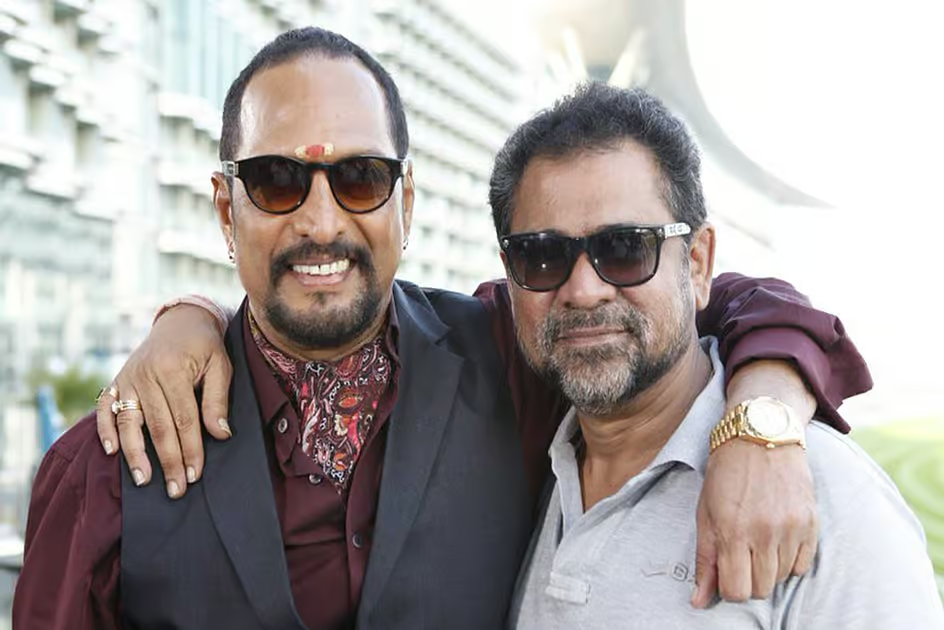
There are actors who become stars and then there are those who become an experience. Nana Patekar belonged to the latter category. His unmistakable voice, piercing gaze, raw intensity and extraordinary ability to command a scene made him one of Indian cinema’s most distinctive performers.
He could make audiences uncomfortable with a single stare, move them to tears with a moment of vulnerability and, as an entirely different generation would discover, leave them in splits with his impeccable comic timing.
On October 8, Patekar passed away at his residence in Goa following a reported cardiac arrest. He was 75.
His passing brings to an end a career spanning nearly five decades, one that defied the conventional rules of Bollywood stardom. At a time when Hindi cinema largely revolved around romantic heroes and larger-than-life personalities, Patekar carved a space for himself with characters who were often flawed and unpredictable.
And perhaps that was his greatest strength. He never needed to fit the mould of a conventional leading man to leave a lasting impression.
From theatre to the big screen
Born Vishwanath Patekar on January 1, 1951, in Maharashtra, the actor’s journey into cinema began with theatre, an influence that would remain evident throughout his career.
He made his film debut with Gaman in 1978, but it was his performances through the late 1980s and early 1990s that established him as a formidable acting talent.
His appearance in Mira Nair’s internationally acclaimed Salaam Bombay! (1988) brought him wider recognition. A year later came Vidhu Vinod Chopra’s Parinda, a film that would change the trajectory of his career.
Playing the ruthless gangster Anna, Patekar delivered a performance that was as unsettling as it was compelling. His character was volatile, menacing and capable of erupting into violence without warning. Yet beneath that terrifying exterior was a psychological complexity that made Anna far more than a conventional Bollywood villain.
The performance earned him his first National Film Award for Best Supporting Actor and cemented his reputation as one of the industry’s most powerful character actors.
The intensity that defined a generation
If Parinda introduced audiences to the full force of Patekar’s talent, Krantiveer (1994) transformed that intensity into something else entirely.
As Pratap Narayan Tilak, a man who confronts corruption and social injustice, Patekar delivered fiery monologues that became inseparable from the film’s identity.
His dialogue delivery, often imitated but rarely replicated, was central to his appeal. He had an unusual command over rhythm, moving from calm and quiet to an explosive outburst in a matter of seconds.
The performance earned him the National Film Award for Best Actor.
Other memorable roles followed, including Agni Sakshi (1996), which earned him another National Film Award for Best Supporting Actor, Khamoshi: The Musical (1996), Ab Tak Chhappan (2004) and Apaharan (2005).
In Khamoshi, he played a deaf father navigating a complicated relationship with his daughter, portrayed by Manisha Koirala. The role revealed a different dimension of his acting, one in which silence and emotional restraint carried as much heft as the spoken word.
With Ab Tak Chhappan, he returned to the world of crime, portraying encounter specialist Sadhu Agashe with a chilling matter-of-factness.
Across these films, there was little predictability in his choices, except perhaps the conviction with which he inhabited every character.
Then came Uday Shetty
For younger audiences, however, the name Nana Patekar may immediately bring to mind an entirely different character. Uday Shetty.
In Anees Bazmee’s Welcome (2007), Patekar played a gangster desperate to get his sister married into a respectable family. What followed was one of the most memorable comic performances of his career.
Alongside Anil Kapoor’s Majnu Bhai and Akshay Kumar’s Rajiv, Patekar demonstrated that the same intensity which made him a terrifying villain could also make him an exceptionally funny man.
His deadpan expressions and exasperated reactions became part of Bollywood’s comedy vocabulary.
It was a remarkable reinvention for an actor who had spent much of his career portraying deeply serious, often troubled men.
The film also introduced him to a generation that may never have watched Parinda or Krantiveer, but knew his comic expressions and dialogues by heart.
He returned to the role in Welcome Back (2015), further cementing Uday Shetty’s place in popular culture.
A return to his theatrical roots
Yet one of Patekar’s most emotionally resonant performances came much later, with the Marathi film Natsamrat (2016).
Adapted from V. V. Shirwadkar’s celebrated play, the film follows Ganpat Ramchandra Belwalkar, an ageing theatre actor struggling to find his place in a world that no longer seems to need him.
For Patekar, whose own artistic foundations lay in theatre, the role carried particular significance.
Here was an actor playing another actor, confronting ageing, loneliness, family relationships and the painful distance between the applause of the stage and the silence of ordinary life.
The performance became one of the defining achievements of his later career, reminding audiences that behind the commanding voice and larger-than-life screen persona was an actor capable of extraordinary tenderness.
Patekar’s contribution also extended beyond acting. He ventured into direction with Prahaar: The Final Attack (1991), a film exploring military discipline and the challenges faced by soldiers returning to civilian life.
In 2013, he was awarded the Padma Shri, one of India’s highest civilian honours, in recognition of his contribution to the arts.
Away from cinema, he was also known for his humanitarian work, particularly his efforts to support farmers and drought-affected communities in Maharashtra.
An actor who refused to be ordinary
Across nearly five decades, Nana Patekar played gangsters, soldiers, fathers, police officers, politicians and ageing artists. And he could be intimidating, vulnerable, eccentric and unexpectedly hilarious, sometimes within the same performance.
His career was never defined by the conventional leading-man glamour. Instead, it was built on a kind of raw authenticity that made even his most exaggerated characters feel strangely believable.
Three National Film Awards, a Padma Shri and countless memorable performances, however, tell just one part of his story. The other lives in the characters audiences continue to revisit, the dialogues they still quote fanatically, the comic scenes that remain just as funny years later and an on-screen persona that’s given generations of moviegoers memories that will last a lifetime.
Because whether it was the terrifying Anna of Parinda or the wonderfully exasperated Uday Shetty of Welcome, Nana Patekar had a rare ability to make a character impossible to forget.
Source: Khaleej Times