

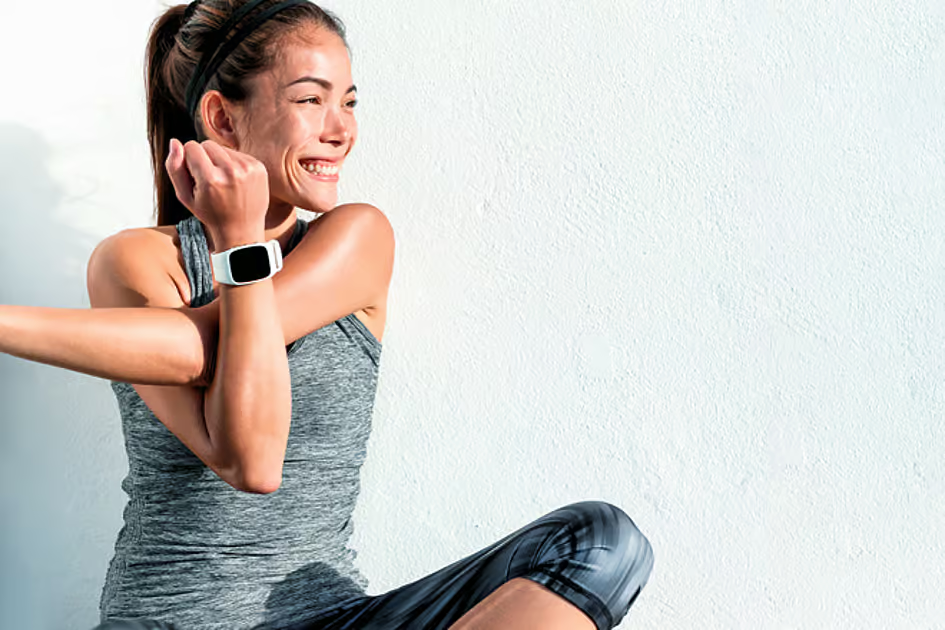
As investment into femtech surges, more women in the GCC region are using smart devices to track their menstrual cycles and fertility.
“Women are actively looking for tools that help them better understand their bodies and make informed decisions about their health,” said Dr. Ami Bhatt, Chief Medical Officer at wearable health tracker company Whoop. She said that according to the company’s data, menstruation is the second-most frequently logged behaviour among users in the GCC — one of the highest rates of menstrual logging globally.
The surge in demand coincides with a broader boom in femtech investment. The sector attracted an estimated $1.8 billion in venture funding in 2026, according to industry data. Now Whoop is deepening its focus on reproductive health through a new integration with Natural Cycles, a clinically validated fertility app. The partnership allows eligible members to combine continuous physiological data with personalised fertility insights, including temperature-based ovulation tracking.
Stay up to date with the latest news. Follow KT on WhatsApp Channels.
“We’re not just adapting male datasets to women,” Dr. Ami said. “We’re building products that reflect women’s unique physiology rather than treating it as an afterthought.”
A growing trend
This growing interest in using wearables for tracking fertility is being observed by doctors in the region as well. Dr Shiva Harikrishnan, Senior Consultant and Head of Obstetrics & Gynaecology at Medcare Royal Speciality Hospital, has observed it first-hand.
“Over the past few years, I have seen more women using wearable technology to better understand their menstrual cycles and fertility patterns,” she said. “These devices can be helpful because they track indicators such as skin temperature, heart rate, sleep quality and activity levels, which may provide insights into ovulation.”
However, she cautions that wearables are not foolproof. Illness, stress, disrupted sleep, travel and hormonal conditions can all affect accuracy. “I generally recommend them as a supportive tool rather than a replacement for medical advice or clinically validated fertility assessments,” she said.
For women trying to conceive, or those with irregular cycles or conditions such as polycystic ovary syndrome, Dr. Siva advised discussing their results with a healthcare professional.
She added that sometimes an overload of data could cause anxiety. “Small day-to-day changes are often completely normal, but some women may worry that every variation signals a problem,” she said. “I encourage patients to remember that our bodies are naturally dynamic, and no cycle is identical.”
Instead, she advised focusing on broader trends rather than individual readings.
Privacy and the digital divide
The rise of fertility tracking also raises questions about data privacy. Reproductive health data is among the most sensitive personal information a person can share.
Dr Ami emphasised that trust is central to the company’s approach. “At every step, members remain in control of their information, including what they choose to share,” she said. For the Natural Cycles integration, data is only shared when members connect their accounts and provide consent. They can disconnect at any time.
But another concern being raised is about the cost of these wearables. With many having subscription models and priced at hundreds of dirhams per year, a “digital divide” may emerge between those who can afford the technology and those who cannot.
“There is certainly the potential for a digital divide,” Dr Siva acknowledged. “It is important that advances in technology do not create the impression that good reproductive healthcare is only available to those who can afford the latest devices.”
She noted that many effective fertility awareness methods — tracking menstrual cycles, recognising physical signs of ovulation, and seeking guidance from a healthcare professional — remain accessible and evidence-based. “Every woman deserves access to accurate information, appropriate medical advice and quality care, regardless of whether she uses wearable technology,” she said.
Source: Khaleej Times