

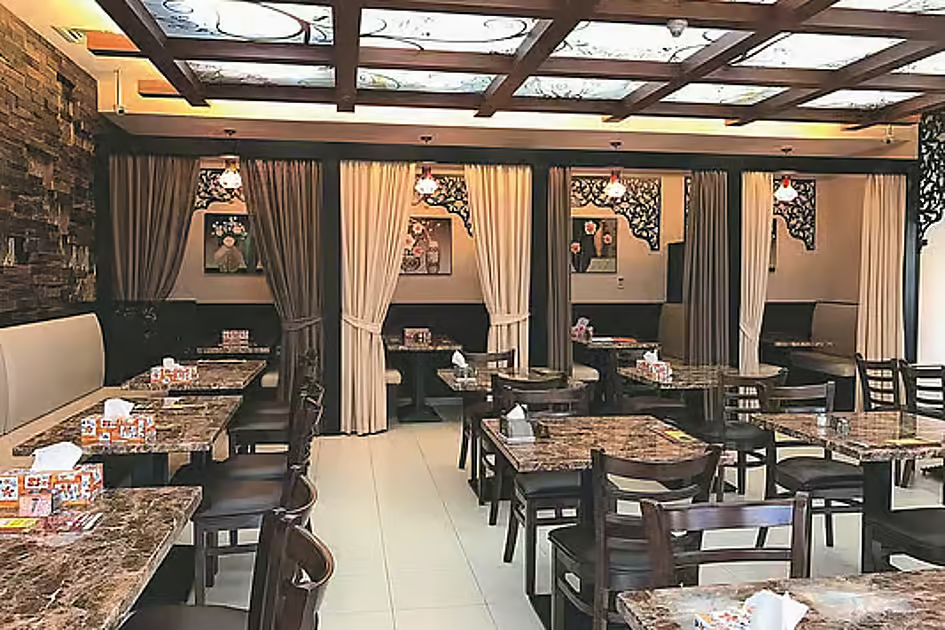
Annual fees for restaurants and cafes to play music will start at Dh1,500, while shops playing copyrighted music will pay fees starting at Dh1,700 across the UAE, effective December 1, 2026.
Restaurants and cafes with up to 50 seats will pay Dh1,500 annually, rising to Dh2,700 for 51 to 100 seats, and Dh4,800 for 101 to 200 seats. Establishments with more than 201 seats will pay an additional Dh20 per extra seat, though the total annual charge is capped at Dh6,000.
A steeper scale applies to restaurants and cafes with DJ and entertainment/night clubs. They will pay Dh2,500 for up to 50 seats, Dh3,500 for 51 to 100 seats, and Dh6,500 for 101 to 200 seats, with Dh20 charged per additional seat beyond 201. The ceiling for this category is set at Dh8,000 a year.
Stay up to date with the latest news. Follow KT on WhatsApp Channels.
This is under a new tariff schedule issued by the Ministry of Economy and Tourism as part of its “Collective Management in Music Guide” to regulate the local music market and raise awareness of the framework for protecting the rights of authors, creators and music production companies, composers and songwriters, singers and musicians, sound recording producers, and music publishers.
Shops, commercial complexes
Shops and commercial complexes that play background music will be charged according to floor area rather than seating.
Establishments up to 300 square metres will pay Dh1,700 annually, rising to Dh3,400 for premises between 301 and 700 square metres. For every additional 25 square metres beyond that, an extra Dh60 will apply, up to a maximum annual collection ceiling of Dh20,000.
Large shopping malls fall under a separate category, with fees applied to common areas rather than individual units. Malls will pay Dh625 for the first 100 square metres of shared space, plus Dh50 for every additional 25 square metres, capped at Dh50,000 annually.
Wider fee structure
The restaurant, cafe and retail tariffs form part of a wider pricing matrix covering fitness centres, hotels, radio and television broadcasters, and premium-class airlines.
Fitness centres will pay Dh1,700 for up to 300 square metres, plus Dh5 per additional square metre, capped at Dh6,000 a year.
Hotels and floating hotels are charged per room according to star rating, ranging from Dh50 per room for one- and two-star properties up to Dh150 per room for four- and five-star hotels, with a ceiling of Dh25,000 annually for the highest room-count band.
Radio stations will pay between 1 and 3 per cent of annual income depending on whether they carry general or predominantly musical content, while television channels pay 0.25 to 1 per cent, both subject to a Dh1,700 minimum. Premium airlines offering in-flight entertainment will pay on a sliding scale tied to passenger seat numbers, capped at Dh45,000 annually.
Regulatory framework
The tariff schedule sits within a broader governance structure introduced by the ministry to regulate licensed collective management organisations (CMOs) — the bodies to which composers, songwriters, performers, producers and publishers assign their rights for the collection and distribution of royalties.
Under the guide, based on Federal Decree-Law No. 38 of 2021 on Copyright and Related Rights and Cabinet Resolution No. 47 of 2022, licensed CMOs must obtain a one-year permit from the ministry, renewable annually, and are barred from altering the ministry’s approved pricing matrix without prior written approval.
Government entities, educational and academic institutions, national occasions, and non-commercial personal celebrations are exempt from the fees.
The framework also establishes a Cultural Fund, financed by a 10 per cent allocation carved out of the 25 per cent share collected before revenues are distributed to CMO members.
The fund, overseen by a joint committee representing the Ministry of Culture, the Ministry of Economy and Tourism and independent experts, will provide financial, technical and artistic support to musicians and back Emirati music’s international and regional presence.
The ministry retains full supervisory powers, including the right to conduct field inspections, review CMO financial records, receive complaints from rights holders and users, and impose administrative penalties or revoke permits for non-compliance.
Source: Khaleej Times